
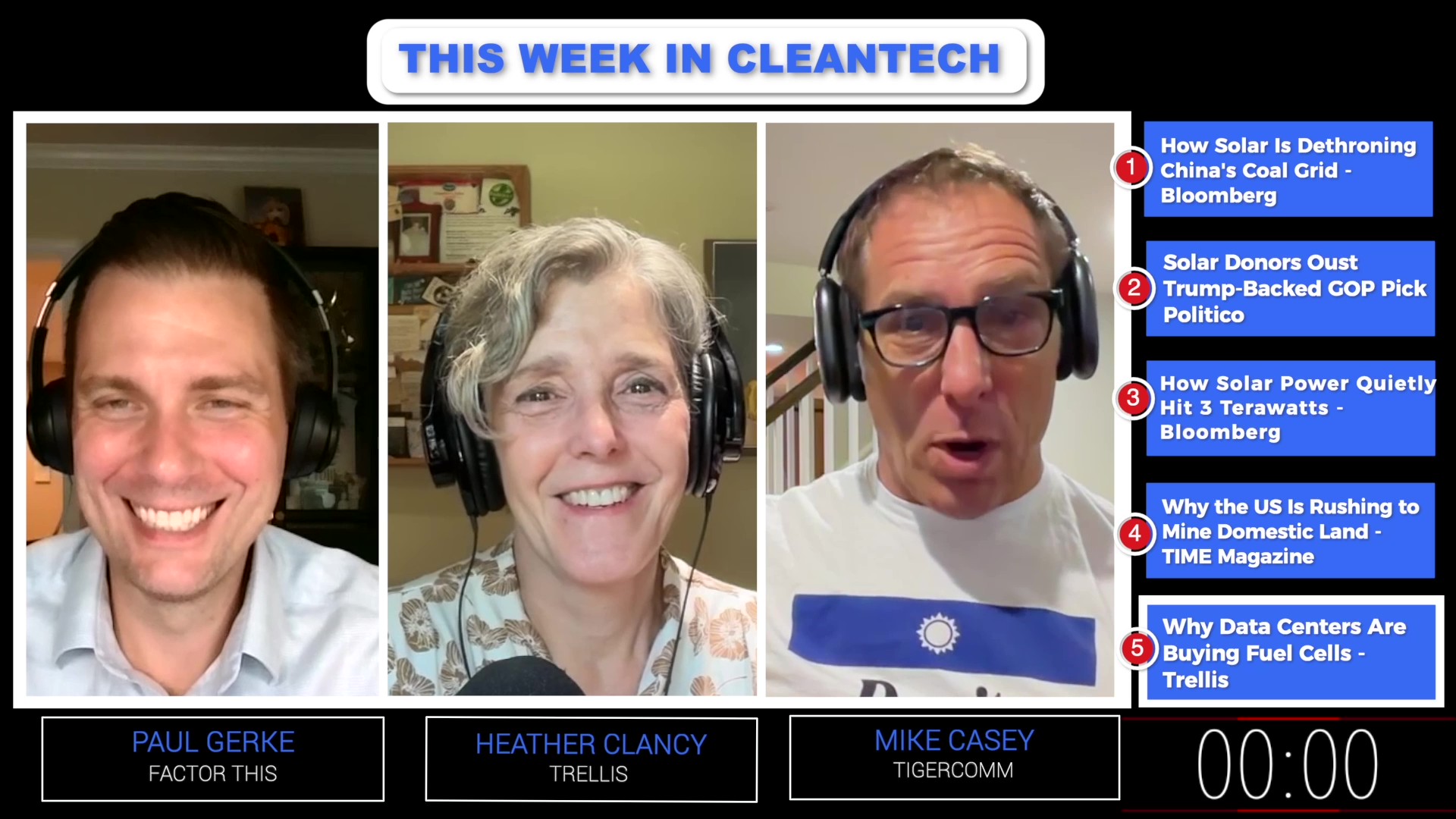
This Week in Cleantech is a weekly podcast covering the most impactful stories in clean energy and climate featuring Paul Gerke of Factor This and Tigercomm’s Mike Casey.
This week’s episode features special guest Heather Clancy from Trellis, who discusses why some data center companies see fuel cells as an attractive option for onsite power.
This week’s “Cleantecher of the Week” is is Aytaç Yilmaz, Co-founder & CEO of Ore Energy. The Amsterdam-based startup just closed a $43 million Series A for its iron-air batteries, which store renewable power for up to 100 hours by rusting and unrusting iron electrodes, no lithium or cobalt required. Ore’s also just signed the largest long-duration storage deal in continental Europe, a 1 gigawatt-hour agreement with Dutch utility Budget Thuis. Congratulations, Aytaç!
The China Electricity Council says solar will pass coal as China’s largest source of generation capacity this quarter. It might have already happened. At the end of June, solar sat at 1,274 gigawatts, just one gigawatt behind coal’s 1,275. By the year end, China expects total installed capacity of 4,300 gigawatts, with solar and wind making up about half and thermal power’s share falling to 31%.
The milestone comes as China’s renewable buildout has slowed, after a policy overhaul ended guaranteed revenue for wind and solar projects. The country added 72 gigawatts of solar in the first half of 2026, after adding 93 gigawatts in May 2025 alone. May was the last month before the new policy went into effect. China plans to add 240 gigawatts of new power capacity in the second half of the year, a 50% jump from the first half, and JPMorgan expects that same seasonal rebound. Solar utilization fell to 91.4% this year from 94.3% the year before, because the grid can’t absorb everything being generated.
Rep. Andy Ogles was on a path to a comfortable primary win but ultimately lost after a super PAC launched by solar executives, the Invest in Tomorrow Coalition, spent 2 million dollars against him. Trump had backed Ogles in a tele-rally a week before the vote.
Ogles is the third Republican to lose this year after being targeted by the group for pushing to phase out clean energy incentives in the One Big Beautiful Bill Act. Rather than focus on clean energy, the group pitched Ogle’s opponent’s right-wing credentials to conservative voters and hit Ogles for missing votes. The PAC ran a similar playbook against Chip Roy in his failed Texas attorney general bid and Ralph Norman in his run for South Carolina governor.
The world just hit 3 terawatts of installed solar capacity. It took 10 years to build the first terawatt, but the next two came in under five years. Bloomberg New Energy Finance expects deployment to top 9 terawatts by 2036. China drove most of that growth and is now outpacing its own grid, with curtailments rising because transmission and storage haven’t kept up.
The share of deployment going to developing countries has not seen the same growth in recent years, even as costs keep falling. BNEF thinks that’s about to change. Developing countries are starting from such a low base that they won’t hit the same grid constraints China’s facing now, and by 2036 they could account for more than a quarter of all solar installed worldwide. Pakistan, Nigeria, and the Philippines are already showing what that looks like, with rooftop solar booming and battery adoption following right behind it, even without much policy support.
Thacker Pass in northern Nevada is bigger than the island of Manhattan, and it’s the largest US lithium mine built in decades. The federal government has 40 mining projects on a fast-track list, moving through permitting faster than in previous years. The Fort McDermitt Paiute and Shoshone Tribe says Thacker Pass will destroy sites sacred to them. The Department of Energy still took a 5% equity stake in the project and the company building it.
The sped-up permitting was motivated less by clean energy than competition with China. Most of the critical mineral supply chain runs through Beijing, which responded to Trump’s tariffs by threatening to cut off US mineral supplies. South32’s Hermosa project in Arizona is the first mine expedited under the new process. Hell’s Kitchen out on California’s Salton Sea, once pitched as a lithium play for EVs, now leans AI data center demand. What a fast-tracked mine owes its neighbors is still unresolved.
Oracle has signed up for as much as 2.8 gigawatts of Bloom Energy fuel cells for its cloud and AI operations, with almost half of those projects underway and some running within 55 days of installation. Equinix has 73 megawatts of Bloom fuel cells online and another 35 megawatts contracted for 19 sites in six states. One of their Silicon Valley sites will run on fuel cells as primary power, with the grid as backup.
Goldman Sachs thinks fuel cells could cover up to 15% of new data center power demand, at least 8 gigawatts by 2030. They install in under a year, compared with years-long waits for gas turbines or new transmission. Equinix says the technology has already helped it avoid 285,000 metric tons of CO2 equivalent, as there’s no combustion and less water use than a traditional gas plant.