
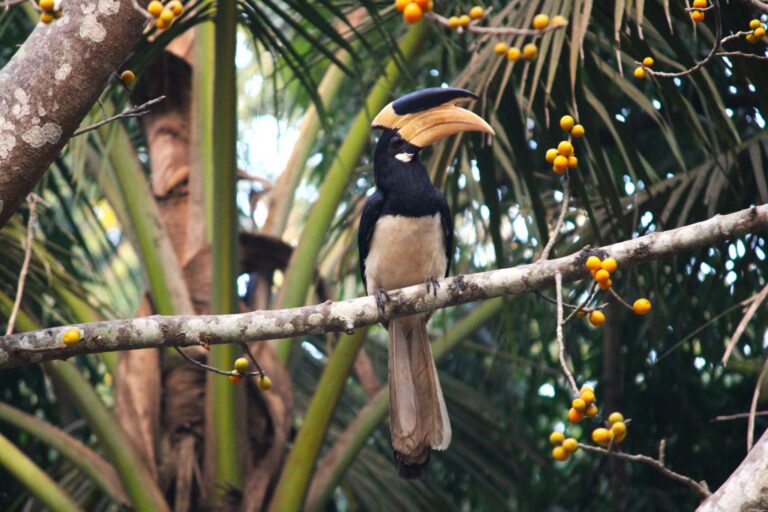
In India’s Western Ghats, sacred groves – small, community-protected forest patches dedicated to local deities – are far more effective at regenerating native tree species than surrounding village lands, according to a recent study, reports Mongabay’s Liz Kimbrough. For the study, a research team from the Applied Environmental Research Foundation (AERF) mapped and measured 82 giant, old-growth trees across 20 species in the village of Vanzole in the northern Western Ghats, the mountain chain that runs alongside India’s west coast. The researchers defined giant trees as those that measure more than 1 meter (3.3 feet). The researchers found that sacred groves held nearly twice the giant-tree species of nearby village areas, with 12 of the measured species growing exclusively within the groves. For example, while fruit trees including mango (Mangifera indica) and jackfruit (Artocarpus heterophyllus) were dominant in the villages, trees such as baheda (Terminalia bellirica), a medicinal plant, were common in the groves. “Settlements are curated orchards, while sacred groves are ecological time capsules,” study co-author Kevin Matteson, associate director of Project Dragonfly at Miami University, told Mongabay. Giant trees act as “ecological catcher’s mitts,” providing the massive branches and hollows needed by large, fruit-eating birds such as hornbills, Matteson said. As these birds feed, they disperse large seeds across the landscape. Seeds dropped in the less-disturbed ground of the sacred groves are more likely to grow into trees themselves compared to those dropped in village grounds, the study found. For instance, saplings of the strychnine tree (Strychnos nux-vomica), the…This article was originally published on Mongabay