
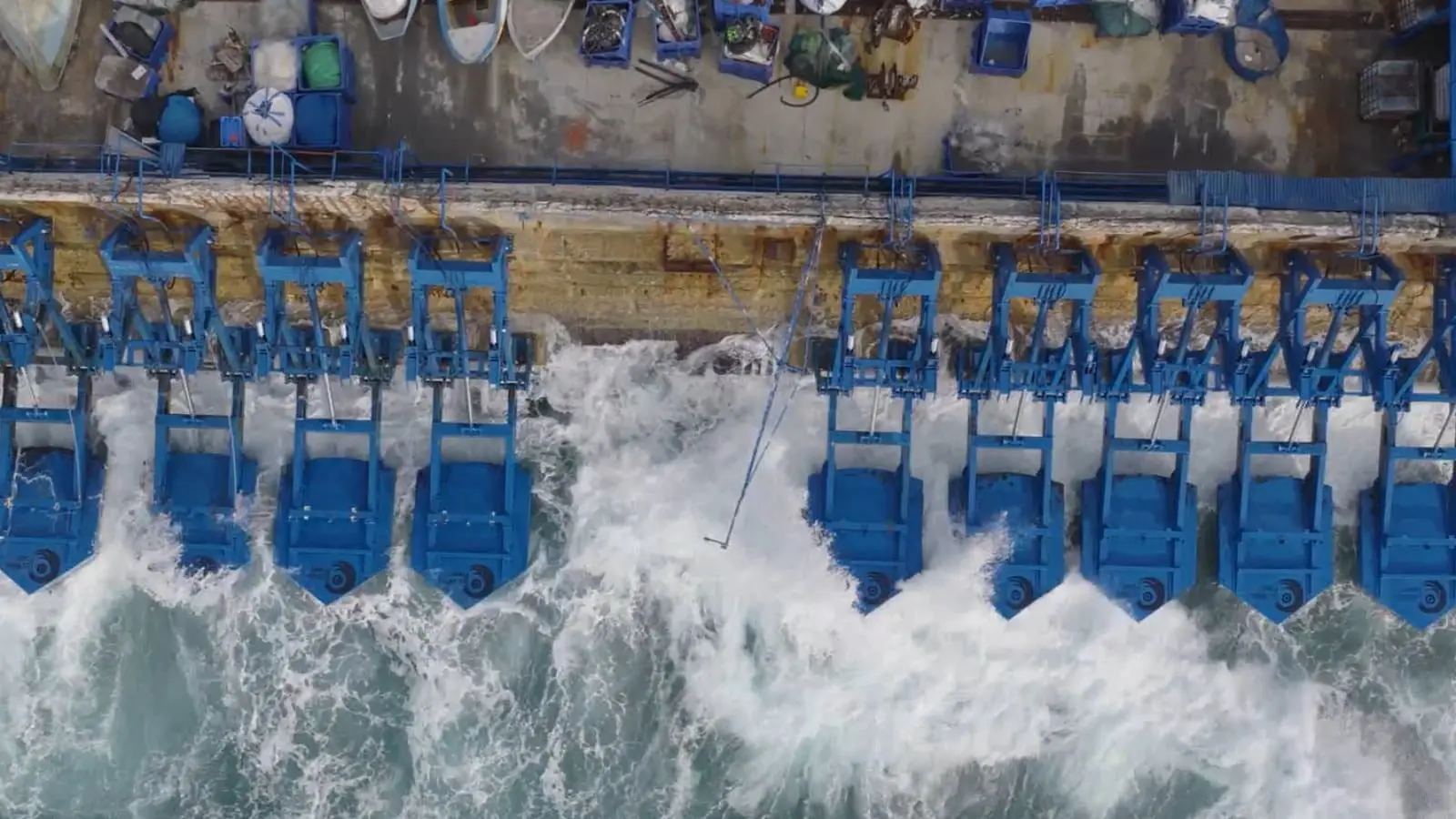

Onshore wave energy tech firm Eco Wave Power (EWP) has reported higher electricity generation from its grid-connected wave energy system at Jaffa Port in Israel as stronger sea conditions delivered increased power output during April and May.
EWP said the results from the EWP-EDF One pilot project are providing further real-world data on how its onshore wave energy technology responds to different wave conditions, while supporting development work aimed at larger commercial-scale installations.
The company focuses its monthly performance analysis on periods when wave heights exceed approximately 1m, which it considers particularly relevant to the operating conditions anticipated for its future commercial projects.
During April, Jaffa Port recorded three days with waves between approximately 1 and 1.5m. The system generated around 461kWh of electricity during those periods, with peak output reaching 26.2kW.
Performance increased in May as the site experienced four days with wave heights ranging from approximately 1 to 2m. The system produced around 1,004kWh of electricity – more than twice April’s output under the relevant conditions – while peak power reached 39.1 kW. Average output during the measured operating periods was around 10.45kW.
Of the electricity generated by the project, most is exported directly into Israel’s national electricity grid under a PPA with the Israel Electric Corporation (IEC), while a portion is used for on-site self-consumption.
The latest results add to a growing dataset from the Jaffa Port installation, giving EWP a clearer picture of the relationship between wave intensity and electricity generation.
The company recorded its strongest performance to date during February, when waves reached approximately 3m. Average output during the relevant period was around 20kW, with peak generation reaching approximately 54kW.
Taken together, the results show a clear increase in peak output as wave conditions become more energetic: 26.2kW during April’s 1-1.5m waves, 39.1kW during May’s 1-2m conditions and approximately 54kW when waves reached around 3m in February.
EWP says the operational data will help refine the technology and improve its understanding of how future systems could perform under different marine conditions.
Alongside its generation performance, the Jaffa Port project has continued to demonstrate operational reliability. EWP reports that the system has experienced no downtime attributable to its technology since the beginning of 2025.
The company’s approach differs from offshore wave energy systems because most of the energy conversion equipment is positioned on existing coastal infrastructure, while floating units interact directly with incoming waves. This configuration is intended to simplify access for maintenance and potentially improve the scalability of wave energy projects by reducing the amount of equipment that needs to be installed offshore.
EWP-EDF One is a pilot-scale installation featuring a relatively small number of floaters. Rather than being designed primarily for large-scale power generation, the project is intended to test the technology under real operating conditions and generate data on reliability, durability and energy production.
Future commercial projects are expected to use substantially larger floaters and greater numbers of units, allowing them to capture more wave energy and produce a larger and more consistent electricity output.
EWP is now using the data gathered at Jaffa Port to support that transition from pilot projects to commercial-scale deployments. The firm is also exploring how AI, predictive analytics and digital twin technology could be incorporated into its future wave energy systems.
The growing operational dataset from Jaffa Port could provide a foundation for developing models designed to optimize electricity generation, anticipate maintenance requirements and improve the management of larger installations. For wave energy, where output is closely linked to changing marine conditions, the ability to combine real-time data with predictive technologies could become increasingly important as projects scale up.
The company regards the combination of physical wave energy technology and digital optimization as a potential route towards improving the performance and reliability of future commercial installations.
Explaining the context of the Jaffa port work, Inna Braverman, founder and CEO of EWP, said: “We specifically analyze wave conditions above approximately 1m because these are particularly relevant to the commercial projects we are pursuing around the world. Every month of operation gives us additional real-world information that can be incorporated into our AI models, digital twins and predictive maintenance systems as we optimize the technology for larger commercial installations.”
Originally published in Factor This sister publication Enlit World.