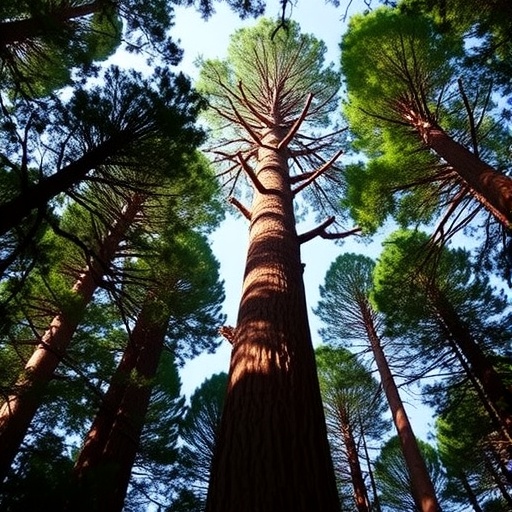
In the heart of East Asia, the island of Taiwan, historically revered as Formosa, reveals an extraordinary natural phenomenon hidden within its rugged and remote wilderness. Taiwan is home to some of the rarest and most monumental trees on the planet — towering giants that reach heights beyond 80 meters, defying typical forest expectations. Since 2014, a specialized multidisciplinary team known as the “Taiwan tree seekers” embarked on a rigorous scientific expedition to uncover, document, and analyze this monumental arboreal marvel. Composed of expert tree climbers, ecologists, geologists, and remote sensing analysts, this team’s concerted efforts culminated in the discovery of the tallest tree in East Asia, an 84.1-meter Taiwania fir aptly nicknamed “The Heaven Sword.”
Taiwan’s island geography plays a critical role in nurturing such extraordinary vegetation. Covering roughly 36,000 square kilometers — nearly equivalent to the size of Switzerland — Taiwan is dominated by steep, jagged mountain ranges with 258 peaks soaring above 3,000 meters, the tallest being Mt. Jade at 3,952 meters. The island’s flora is notably rich, boasting approximately 5,000 plant species that flourish across an impressive vertical gradient, spanning tropical rainforests at sea level to alpine tundra near the summit of its peaks. These diverse climatic zones and extensive forest coverage—covering around 60% of the land—provide the ideal environment for the growth of towering trees.
Despite a century of industrial logging, primarily between 1912 and 1991, Taiwan’s primary forests retained pockets of ancient growth. The island’s precipitous terrain served as a natural sanctuary, thwarting extensive deforestation by making access to many remote forest segments exceedingly difficult for loggers. As a result, large clumps of undisturbed old-growth trees have persisted, offering a living laboratory for ecological research and the study of these colossal arboreal specimens.
The quest to identify and catalog these giant trees officially commenced in August 2014 when researchers from the Taiwan Forestry Research Institute mounted an expedition to the Chilan conservation area. Their principal target was the legendary “Chilan Three Sisters,” a trio of enormous Taiwania firs widely recognized by local communities yet scientifically undocumented. Measuring each tree became a formidable task: the tallest measured a staggering 69.3 meters in height with a trunk diameter extending nearly three meters, indicating immense biomass and age. This discovery swiftly drew international attention when Australian climbers from ‘The Tree Projects’ ascended the Three Sisters in 2017, capturing breathtaking visuals and highlighting the majesty of Taiwan’s forests for the global community.
Emboldened by the success in Chilan, the team expanded their search to a remote sector near Mt. Benya, adjacent to the sacred Great Ghost Lake region, revered by indigenous communities. This area was rumored to house the largest concentrations of Taiwania firs, but obtaining precise measurements was daunting. The expedition demanded four days of grueling hiking through dense jungle and steep slopes. Ground surveys were plagued by optical illusions created by the multi-layered forest canopy, making it nearly impossible to gauge true tree heights from below. Although climbers managed to scale a towering 71.7-meter tree, it became clear that more sophisticated methods were essential to accurately map and measure these giants.
Enter LiDAR (Light Detection and Ranging), a cutting-edge remote sensing technology that revolutionized the search. LiDAR employs laser pulses emitted from airborne platforms to scan vast landscapes with incredible precision. By calculating the interval between pulse emission and return, researchers generated detailed 3D maps of the forest canopy, revealing tree heights and spatial distribution otherwise hidden from conventional methods. Collaborating with remote sensing experts from National Cheng Kung University, the Taiwan tree seekers harnessed LiDAR’s capabilities to transcend the limitations of ground surveys across treacherous terrain.
However, the rugged topography of Taiwan introduced complexities of its own. Automatic LiDAR processing algorithms occasionally overestimated tree heights when scanning areas adjacent to steep cliffs or uneven ground. Such geographic features interfered with data interpretation, leading to false positives and inflated height calculations. Recognizing the value of human intuition, the project evolved into a massive community science initiative in 2020, engaging hundreds of Taiwanese citizens to examine LiDAR-generated images carefully. This collective scrutiny dramatically refined the dataset, eliminating roughly 93% of misclassified readings and streamlining efforts to identify genuine giant tree candidates. Without this unprecedented citizen scientist involvement, the search would have been bogged down by endless treks to trees that turned out to be much shorter than initially indicated.
This fruitful collaboration culminated in the publication of the “Taiwan Giant Tree Map” by late 2022, a comprehensive catalog listing 941 individual trees exceeding 65 meters in height. This map established a foundational dataset for future ecological studies, forest conservation, and carbon sequestration assessments. With precise locations identified, climbing expeditions could be more strategically planned, optimizing time and effort.
On a landmark expedition during the Lunar New Year of 2023, researchers pursued the tallest tree pinpointed on the Giant Tree Map. The journey to reach this arboreal titan involved an arduous 20-kilometer river tracing followed by two days of steep, demanding uphill trekking. Upon reaching the crown, professional climbers released a measuring tape from the highest branch to the forest floor, officially recording the tree’s height at 84.1 meters. This “Heaven Sword of the Da’an River” not only set a new record for Taiwan but also claimed the title of the tallest known tree in all of East Asia, captivating both scientists and conservationists alike.
Continuing their rigorous documentation efforts, by early 2026 the Taiwan tree seekers have climbed ten different Taiwania fir specimens surpassing 70 meters, with two exceeding the 80-meter mark. Beyond mere measurements, the team’s investigations unveiled “temples of giants,” like an astonishing hectare-long stretch near Mt. Benya containing 11 trees each taller than 65 meters. Returning to Great Ghost Lake years later, they discovered a densely packed ancient forest enclave with roughly 30 massive Taiwania firs, emphasizing the region’s ecological and cultural significance.
These exceptional forests are more than natural wonders. Recent studies conducted by the team and citizen scientists in 2024 focused on the “Tao Tree” valley, home to Taiwan’s third-tallest tree, to quantify its carbon sequestration potential. The measurements revealed a staggering carbon density of 1,384.5 megagrams per hectare (Mg/ha), excluding root biomass, placing these Taiwanese giants among the most carbon-dense old-growth forests globally. Their immense biomass acts as vital carbon sinks, mitigating climate change by storing vast amounts of CO2 in living wood and soil.
In essence, Taiwan’s monumental Taiwania firs symbolize an intersection of natural grandeur, ancient cultural reverence, and cutting-edge scientific research. These “trees that hit the moon” are not only trophies of biodiversity but also pivotal players in global environmental health. The study and preservation of these towering verdant behemoths illuminate the importance of integrating traditional fieldwork, remote sensing innovation, and community participation to protect and understand the world’s last great forests.
Subject of Research: Not applicable
Article Title: The Journey of Finding the Tallest Tree in Formosa Taiwan
News Publication Date: 5-Jun-2026
Web References: http://dx.doi.org/10.3389/ffgc.2026.1746112
Image Credits: Steven Pearce
Keywords
Taiwania fir, Formosa forests, giant trees, LiDAR, remote sensing, Taiwan ecology, forest conservation, carbon sequestration, old-growth forests, East Asia tallest tree, citizen science, mountain ecosystems
Tags: conservation of ancient treesEast Asian monumental treesecological significance of tall treesmultidisciplinary scientific expeditionsrare tree species in Taiwanremote sensing in forestryTaiwan biodiversity hotspotsTaiwan mountain ecosystemsTaiwania fir discoverytallest tree in East Asiatropical to alpine vegetation gradientvertical forest biodiversity