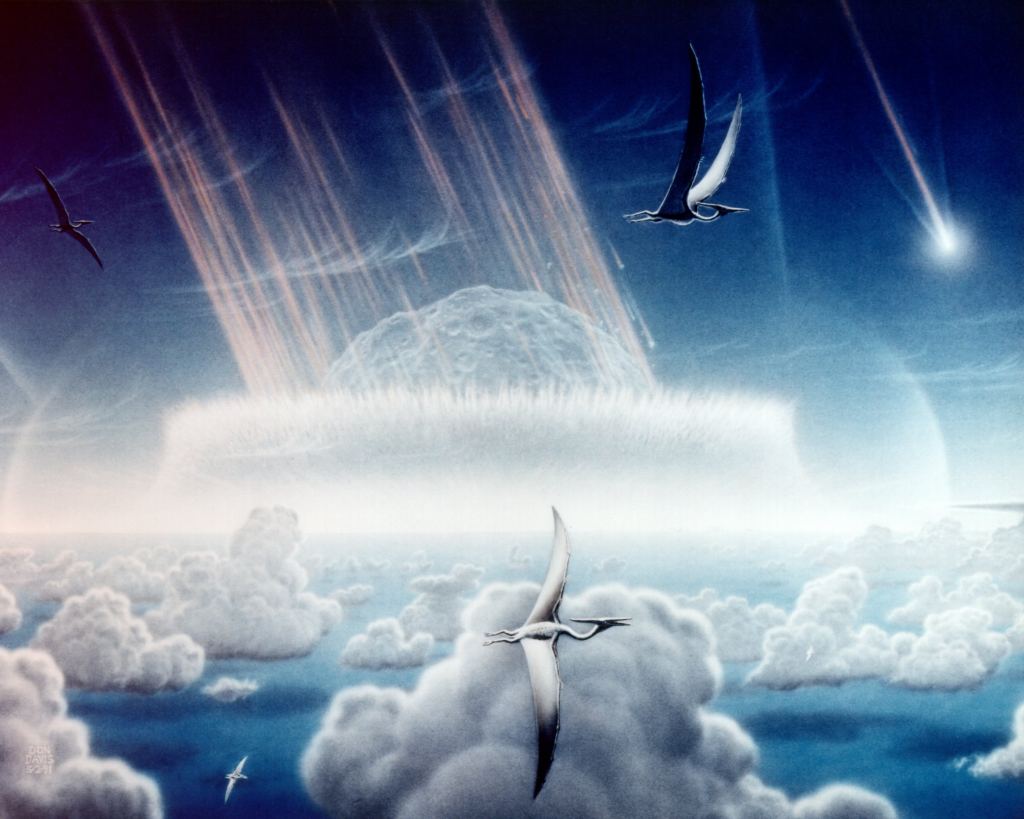
During the Cretaceous-Paleogene period (ca. 66 million years ago), a massive impact triggered an extinction-level event (ELE), wiping out about three-quarters of all plant and animal species on Earth, including the dinosaurs. Scientists have named the impactor that caused this devastation the Chicxulub meteor, after the nearby town of Chicxulub Pueblo in the Yucatan Peninsula in southern Mexico. The impact certainly left its mark, forming a 180-km-wide (112 mi) crater buried beneath the surface and creating thousands of limestone sinkholes filled with water (known as cenotes).
Today, Earth scientists are closing in on the type of impactor that caused the Cretaceous-Paleogene (K–Pg) extinction event. According to the latest findings from an international team of researchers, it may have been a rare type of space rock known as a carbonaceous (CO) chondrite. As they describe in a paper recently published in Science Advances, an advanced nickel isotope analysis of samples from around the world allowed them to narrow down the composition of the Cretaceous-Palaeogene meteorite.
Asteroids and other “space rocks” are essentially material left over from the formation of the Solar System, roughly 4.5 billion years ago. These objects regularly enter Earth’s atmosphere, with most burning up and others exploding in mid-air in what is known as an “airburst.” However, larger impactors like the Chicxulub meteor, estimated at 10 to 15 km (6 to 9 mi) in diameter, have occasionally reached the surface, causing massive explosions that eject enough material into the stratosphere to block out sunlight and trigger a “nuclear winter.”
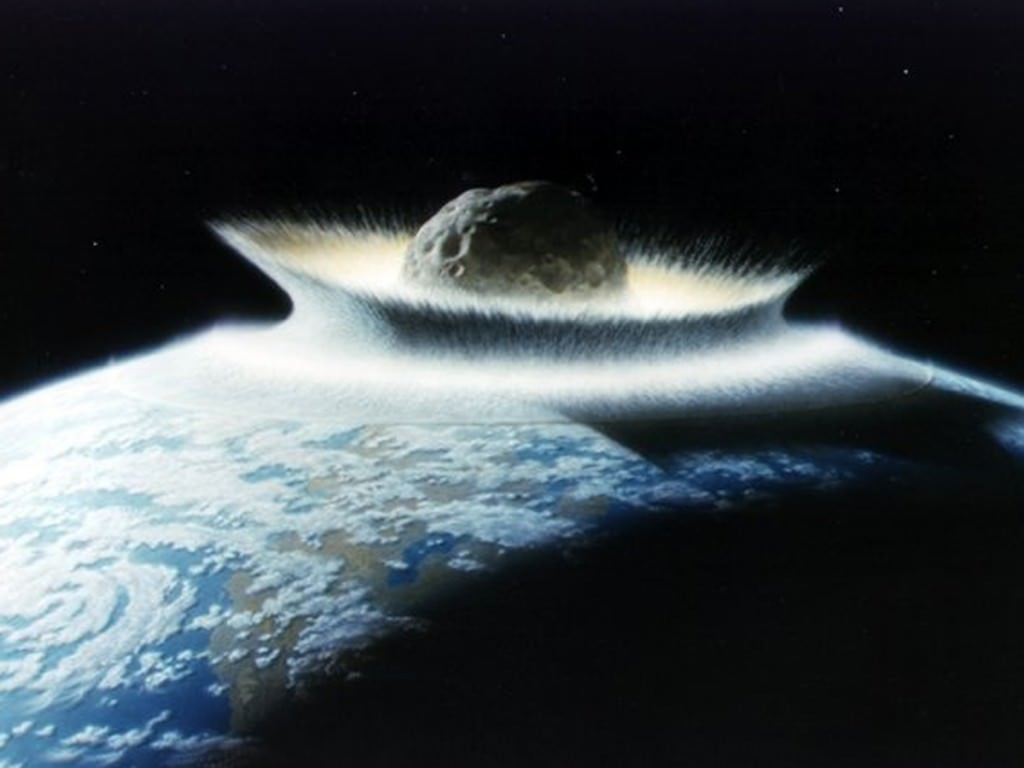 *When an asteroid struck the Yucatan region about 66 million years ago, it triggered the extinction of the dinosaurs. Credit: NASA/Don Davis*
By analyzing material left behind by the impact, and comparing it to other meteorites that have been recovered on Earth, scientists can determine where the impactor came from in the Solar System. This is precisely what postdoctoral researcher [Georgy V. Makhatadze] and his colleagues at the Institut de Physique du Globe attempted when conducting high-precision nickel-isotope measurements of clay samples that formed from the impact. These samples were gathered over several years from sites around the world.
They were joined by researchers from the Archaeology, Environmental Changes & Geo-Chemistry group at the Vrije Universiteit Brussel (VUB), the Pacific Center for Isotope and Geochemical Research (PCIGR) at the University of British Columbia (UBC), and the Department of Lithospheric Research at the University of Vienna. Together, they compared the nickel isotopes in the clay layer with those found in other meteorite samples recovered over many decades.
From this, they concluded that a CO chondrite caused the extinction-level event, likely originating from the outer region of the Main Asteroid Belt, the more distant Kuiper Belt, or other debris-rich regions of the outer Solar System. This would make the impactor a rare type of meteorite, as carbonaceous chondrites account for only 5% of the meteorite samples recovered on Earth. Those that fall into the Ornans class (CO chondrites) make up a tiny fraction of that group, as they are some of the most primitive and least-studied objects in the Solar System. Said Dr. Philippe Claeys, who worked on the study as a visiting professor at UBC:
Carbonaceous chondrites of the Ornans class are definitely not like the typical meteors you find in museum collections. A CO contains much less volatile elements—like carbon, zinc, water and particularly sulphur—than other classes of meteorites we’ve discovered so far on Earth. It doesn’t alter our theory of what caused the extinction event—but it makes it less likely that sulphur contained in the impactor was the smoking gun. The fine debris thrown into the atmosphere would have [been] the primary factor.”
While many questions remain about the origins of the world-shattering meteorite, this study has helped narrow it down considerably. The data obtained could be useful for predicting potential future impacts and developing strategies to defend Earth from these behemoths!
Further Reading: UBC