The chief aim of NASA’s Artemis Program is to create a “sustained program of lunar exploration and development.” Beyond returning astronauts to the Moon for the first time since the Apollo Era, NASA and other space agencies hope to build the infrastructure that will enable regular, long-duration missions to the lunar surface. In addition to targeting the South Pole-Aitken Basin, NASA is eyeing lunar caves as a potential site for habitats and other lunar facilities.
Meanwhile, space agencies need to send large amounts of cargo and robotic explorers to the surface. This includes the Geophysical Instruments for Marius Lunar pit Investigation (GIMLI), a Planetary Science Institute-led proposal that will investigate a “skylight,” a hole in an old lunar lava tube, to see if a large cave system extends beyond it. Such a location could provide a safe place for astronauts to operate on the surface in the future.
The mission team will be led by PSI Associate Director and Senior Scientist Than Putzig. The work will be carried out in partnership with the Norwegian Space Agency, while Honeybee Robotics will create much of the robot’s equipment and instrumentation. NASA will provide a lander and rover element through its Commercial Lunar Payload Services (CLPS), and funding will be provided through NASA’s Payloads and Research Investigations on the Surface of the Moon (PRISM) program.
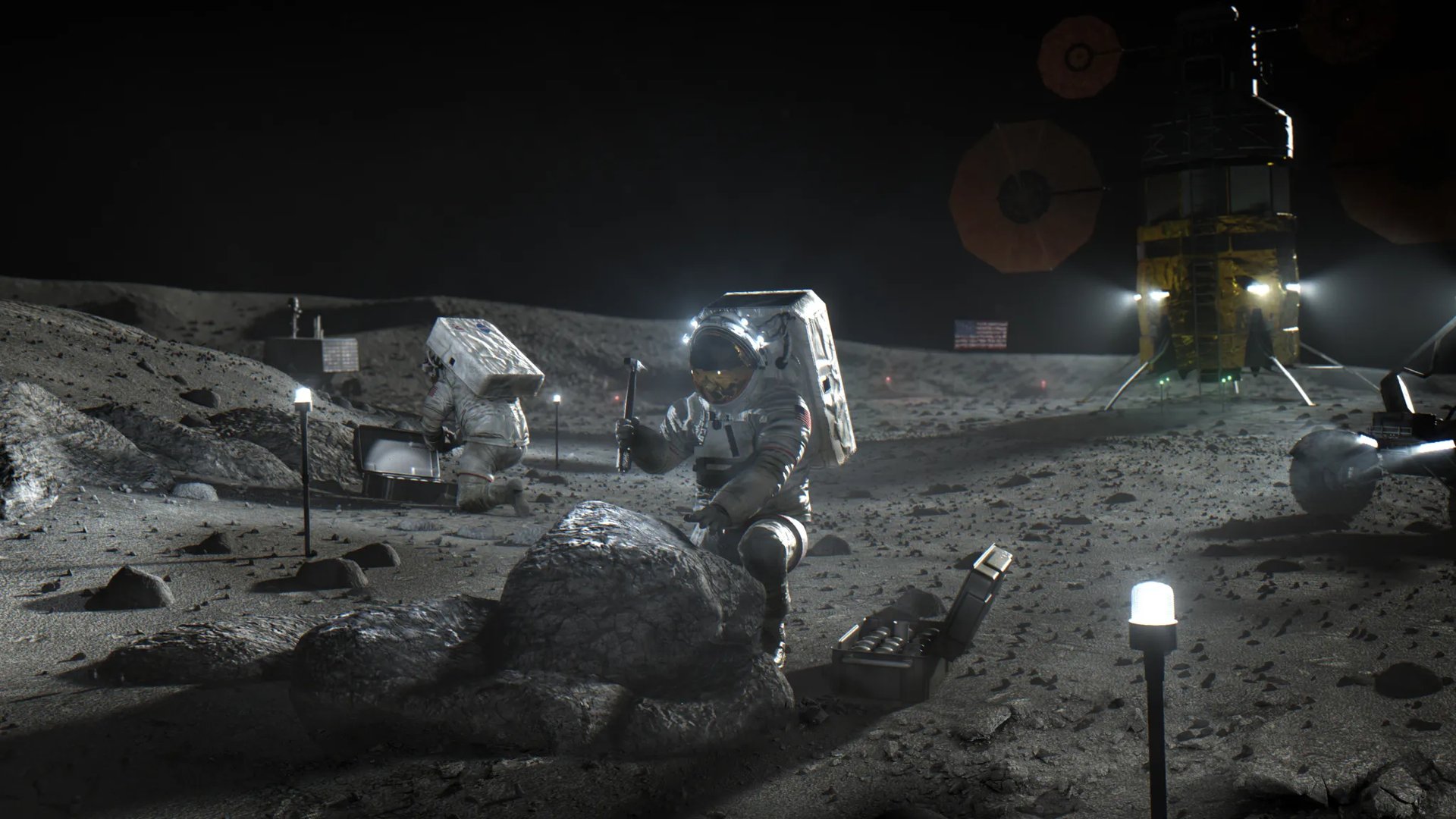 Artist’s impression of Artemis astronauts performing extra-vehicular activity (EVA) on the lunar surface. Credit: NASA
Said PSI Director and CEO Amanda Hendrix:
GIMLI represents the type of ambitious planetary science that PSI was built to pursue. Than and his team are taking a scientific question we’ve been studying from orbit and have developed a way to investigate it directly on the Moon. We’re excited to have PSI leading this effort and to be partnering with NASA and Honeybee Robotics to learn more about the Moon and its volcanic past.
Observations by lunar orbiters have provided compelling evidence of underground caves. This is evident from surface features like sinuous rilles (collapsed lava tubes) and the aforementioned skylights. Researchers theorize these latter features are openings leading to stable lava tubes left over from when the Moon was still geologically active (ca. 3.8 and 3 billion years ago).
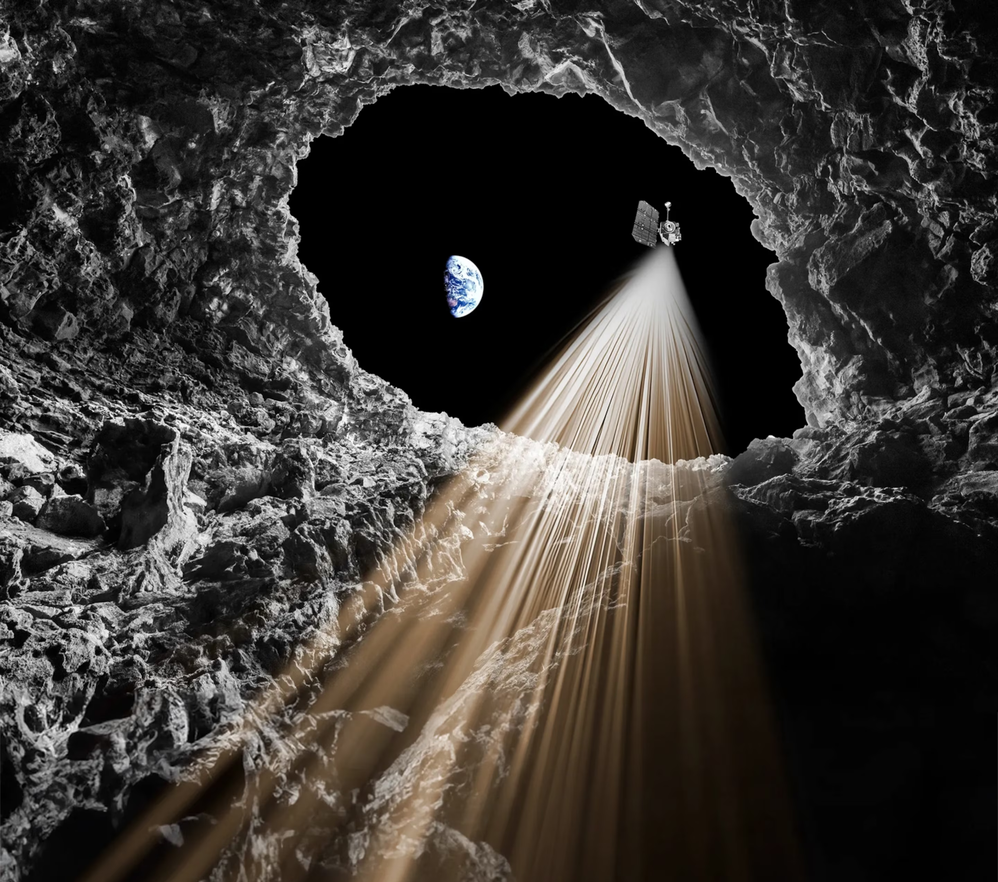
Observations from lunar orbit have provided compelling evidence that caves and lava tubes may exist under the Moon’s surface. GIMLI’s research will focus on the Marius Hill Pit (MHP), a large hole in one of the Moon’s most volcanically diverse regions. Like other lunar pits, MHP may serve as an opening to these underground spaces, which may have formed during ancient volcanic activity. One in particular is the Marius Hill Pit (MPH), a prominent skylight on the nearside’s Oceanus Procellarum.
GIMLI will allow scientists to investigate MHP directly from the lunar surface using an advanced suite of instruments. These include ground-penetrating radar, seismic sensors, a gravimeter to probe beneath the surface, and cameras that provide imagery of the surface and pit walls. These will allow the mission team not only to search for an underground recess, but also to determine its size (should one exist).
 Conceptual rendering of a lunar lava tube as it is developed as a human settlement. Credits: Port San Antonio/XArc
As Putzig explained, GIMLI will allow scientists to investigate MHP directly from the lunar surface, thus integrating itself nicely with NASA’s planned Artemis missions:
It’s long been a desire of mine to reintroduce intentional active-source seismic methods to planetary science, as it has essentially not been done since the Apollo astronauts conducted the first seismic surveys on the Moon. Combining that method with ground-penetrating radar and gravity measurements makes it all the more exciting, as these methods together will allow us to get a much better understanding of subsurface properties — including the anticipated detection of a lava tube extending away from the Marius Hills pit.
Even if GIMLI doesn’t find an extended cave system, the data could still help scientists address major questions about how MHP formed. The GIMLI team will also search beyond the pit to gather data on the region’s history of volcanic activity, while examining the walls will expose layers of regolith and lava flows not visible to orbiters or rovers. Finally, the interiors of any subsurface spaces on the Moon could preserve the history of the volcanic processes that shaped the Moon.
“Confirming a substantial lava tube would give us an insight into how volcanism operated on the Moon,” said Gareth Morgan, a PSI Senior Scientist and the Deputy Principal Investigator of the GIMLI program. “Lava tubes are a common feature of basaltic volcanism on Earth, so identifying them on the Moon means we could use knowledge of such terrestrial caves to better understand lunar history.”