
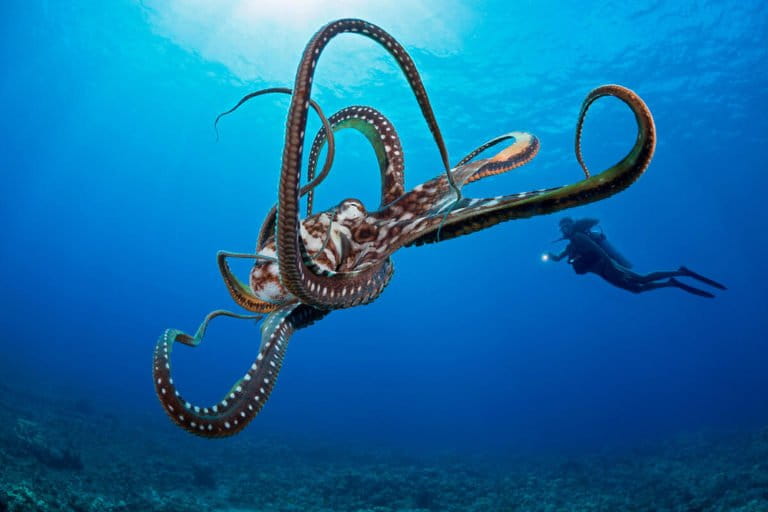
Happy World Octopus Day! Every Oct 8, the world celebrates one of the more unusual creatures of the sea. Octopuses are well-known for their eight legs and ability to squirt ink when frightened. They’ve also been known to use tools, a sign of intelligence, and can shape-shift to mimic the colors and texture of their surroundings, an effective way to disappear from both predators and prey. Mongabay has reported on several octopus discoveries this year, including: Ancient octopus were apex predators Modern colossal squid are believed to be the largest invertebrates in the sea, but Mongabay’s Shanna Hanbury recently reported on an even larger ancient octopus species whose fossils were described by Japanese researchers in April 2026. The Japanese team found a fossilized jawbone from the now-extinct Nanaimoteuthis haggarti. Based on its jaw size, researchers suggest the octopus may have reached 6.6 to 18.6 meters (22 to 61 feet) in length. On the higher end, that’s around two-thirds the size of an adult blue whale, the largest animal to ever exist. “It suggests that it may have been among the largest invertebrates ever known,” study co-author Yasuhiro Iba, a paleontologist at Hokkaido University in Japan, told Mongabay by email. They were likely gigantic predators that roamed the late Cretaceous seas between 100 million to 72 million years ago. A rare look at baby octopuses From long dead octopus to newly born, Hanbury also reported on baby Argentine octopuses and a rare photo of them. Patagonian octopus eggs in Puerto Lobos Protected…This article was originally published on Mongabay