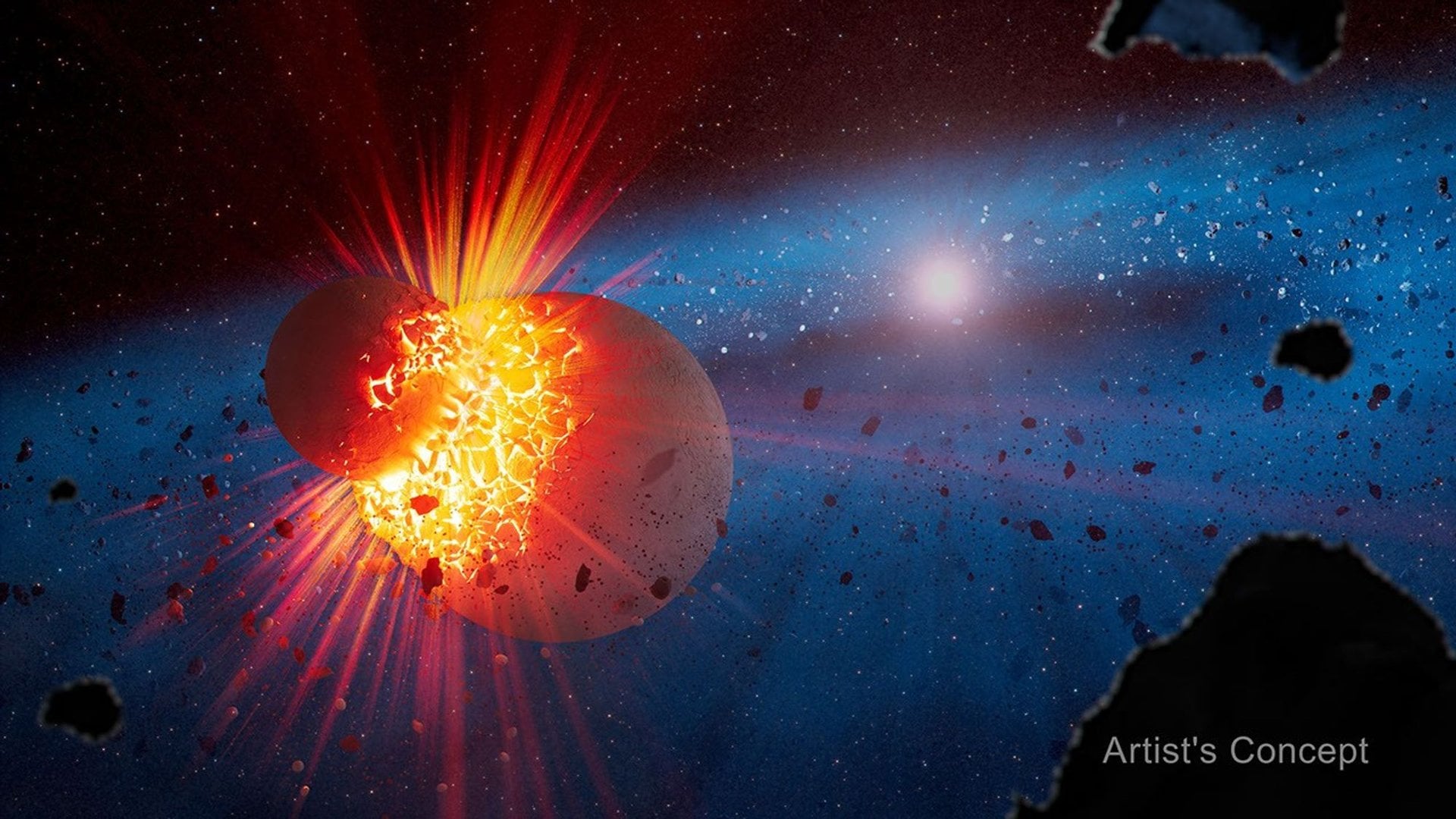
Scientists theorize that early in the Solar System’s history, collisions were relatively common as planets migrated and planetoids were hurled out of their orbits. According to the Giant Impact Hypothesis, a collision with a Mars-sized object (Theia) about 4.5 billion years ago led to the formation of the Earth-Moon system. Using the James Webb Space Telescope (JWST), astronomers have examined young star systems that appear to be experiencing similar cataclysmic events.
The team was made up of researchers from the Space Science Institute (SSI), the Konkoly Observatory, the MTA Centre of Excellence, the Steward Observatory, the Lunar and Planetary Laboratory (LPL), and multiple universities. The team’s findings were published Thursday in The Astrophysical Journal.
These observations provide insight into the composition and evolution of young systems, offering scientists a window into the early Solar System. “How rocky planets formed and giant planets evolved are part of the broader story of the solar system’s formation. It’s all one story,” said Kate Su, a researcher with the SSI and the lead author of the study. “Our work on extreme debris disks helps us bring together the big picture of what we currently understand.”
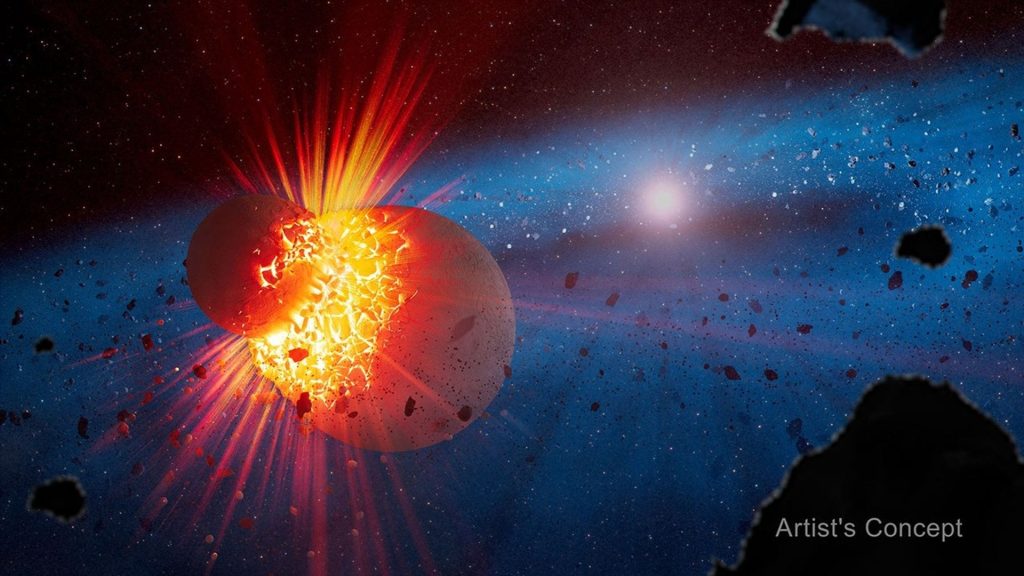
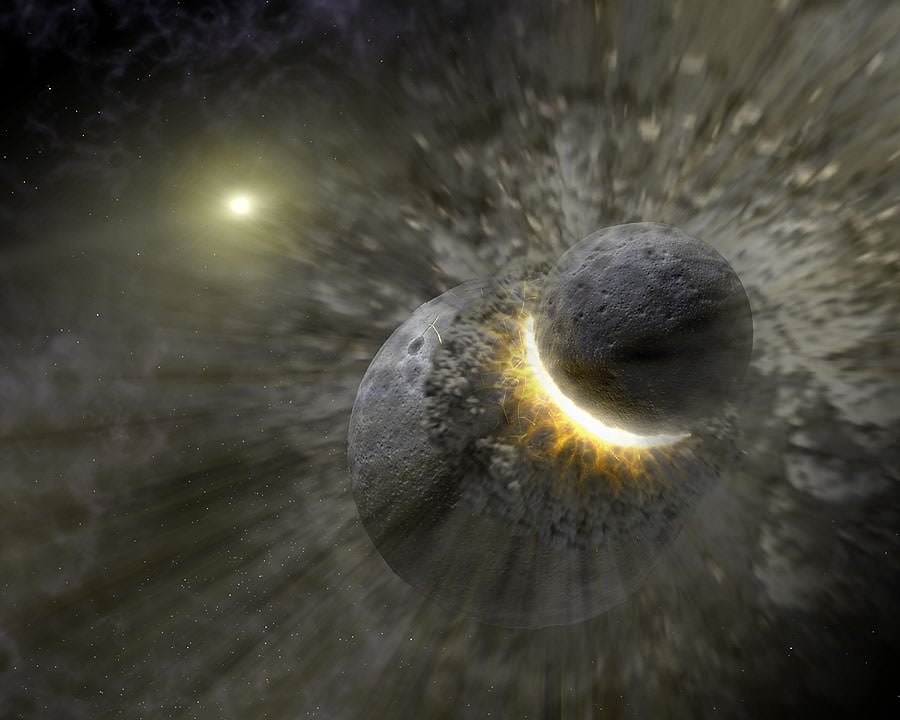 An artist’s concept of the collision between proto-Earth and Theia, which happened 4.5 billion years ago. The heat from the impact melted Earth’s crust, allowing bulk 3He to escape into space. Credit: NASA
As star systems age, the composition of their surrounding environment changes. They begin in the gas-rich protoplanetary disk phase where planets form, then evolve into the gas-poor debris disk phase. Before retiring in January 2020, NASA’s Spitzer Space Telescope discovered a stage within the latter known as the extreme debris disk phase. Systems in this phase contain large amounts of warm dust in a region comparable to where rocky planets orbit in the Solar System.
The team investigated star systems in this phase using Webb and, to their surprise, they found that these systems defied theoretical predictions about their commonality. Instead, they proved quite rare, with the current data suggesting that only about 1% of young stars show observable signatures. Nevertheless, the team compiled a sample of 21 extreme debris disks using Spitzer and Webb archival data (5 from Spitzer and 16 from Webb). They also identified 12 newly observed disks and performed follow-up observations on four of Spitzer’s.
Of their sample, eight disks are silica-rich (black dots in the table below), while 13 are silica-poor (purple). The former were likely produced by high-energy impacts between Mars-sized bodies, where much of the material is vaporized. The latter suggest that collisions within these disks are less energetic. The team also noted that silica-rich disks appear only around stars younger than 300 million years, while silica-poor disks appear around stars with a broad range of ages. As Sue said in a NASA press release:
This is the first time we have gathered enough systems to truly understand this subclass that we call extreme debris disks. Before Webb, we had limited information. We knew that they are weird and very different from the typical cold debris disks that we know, like Vega and Fomalhaut. Now that we have more data, we can pin down what these disks represent for planet formation and evolution.
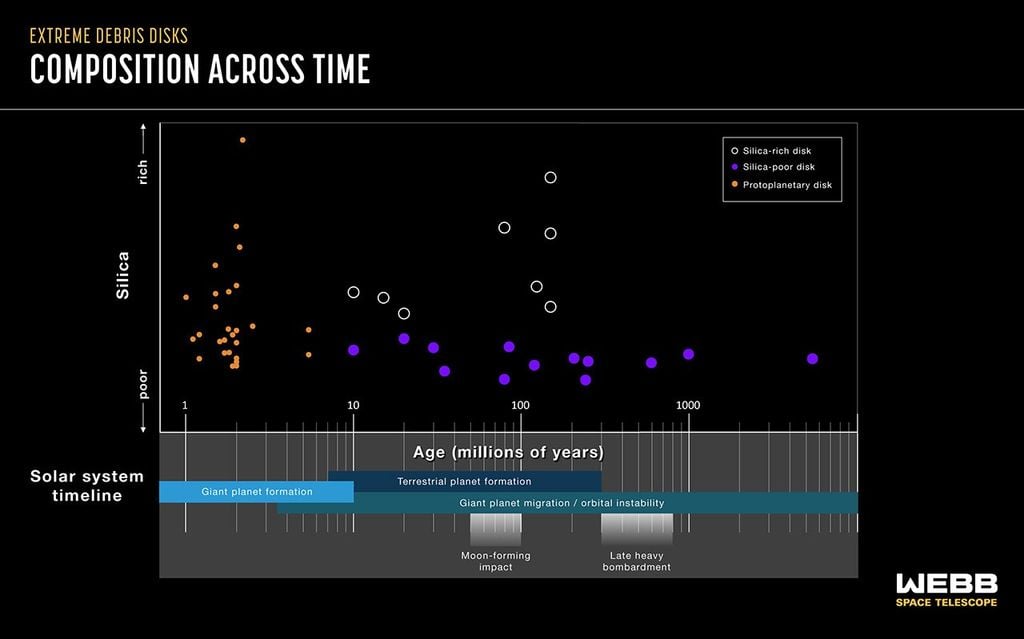 By investigating the compositions of extreme debris disks, scientists inferred that silica-rich disks are produced by high-energy impacts of Mars-sized objects, while silica-poor disks are created by less energetic events from Moon-sized bodies. Credit: NASA/ESA/CSA/Joseph Olmsted (STScI)
Simulations suggest that planets like Earth should form within the first few hundred million years of a solar system’s formation, which fits the ages of the silica-rich extreme debris disks in the sample. It also aligns with estimates that place the formation of the Earth-Moon system at about 100 million years after the Sun formed, and models suggesting it resulted from a collision between Earth and a Mars-sized object.
In addition, the results indicate that our Sun may have undergone a silica-poor extreme disk phase billions of years ago. This is consistent with the Late Heavy Bombardment theory, assuming that older silica-poor disks and their random infrared variability reflect orbital instability. In this scenario, the gas giants migrated over vast distances and disrupted the orbits of smaller bodies, triggering catastrophic collisions that generated dust-rich phases observed in extreme debris disks.
While many unanswered questions remain, researchers expect to address them as the sample size continues to grow. In addition to archival data, these studies will benefit from ongoing observations by Webb and next-generation telescopes like the Nancy Grace Roman Space Telescope and the recently-selected PRobe far-Infrared Mission for Astrophysics (PRIMA) mission.
“How rocky planets formed and giant planets evolved are part of the broader story of the solar system’s formation. It’s all one story,” said Su. “Our work on extreme debris disks helps us bring together the big picture of what we currently understand.”
Further Reading: NASA