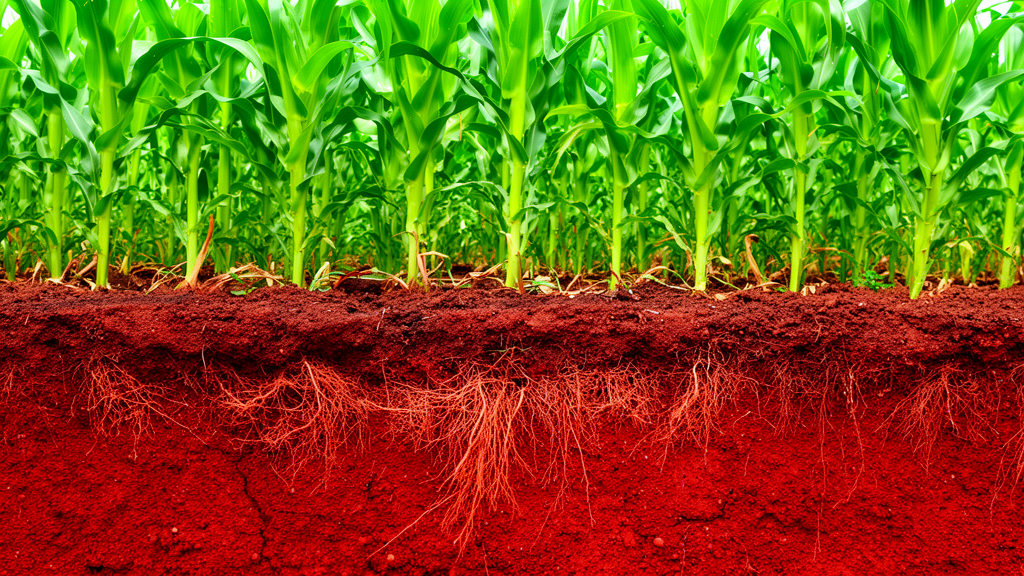
Inoculating maize crops with native arbuscular mycorrhizal fungi combined with reduced chemical fertilization significantly enhances crop growth, grain yield, and nutrient acquisition on nutrient-depleted ferruginous soils. In an agronomic field trial conducted in Ouoghi within the Savè municipality of central Benin, agricultural researchers evaluated seventeen distinct treatments to determine how indigenous fungal biostimulants interact with conventional mineral fertilizers. Across sub-Saharan Africa, expanding demographic pressures have intensified the reliance on intensive chemical inputs, which over time degrade soil structure, destroy natural ecological resources, and cause localized harvest shortfalls.
The experimental trial was established at an elevation of 105.1 meters, situated at longitude 8°00′ 149″ North and latitude 2° 25′ 646″ East in an area defined by a tropical climate with an annual average precipitation of 1,200 millimeters. Baseline laboratory analyses revealed that the experimental site possessed an impoverished tropical ferruginous soil profile characterized by moderate organic matter at 1.27 percent and a low total nitrogen concentration of 0.075 percent. Soil chemical testing determined a weakly acidic water pH of 6.2, an assimilable phosphorus concentration of 7.6 parts per million, and an exchangeable potassium concentration of 0.31 milliequivalents per 100 grams. Additionally, the soil exhibited exchangeable bases of 4.12 milliequivalents per 100 grams and a total cation exchange capacity of 7.5 milliequivalents per 100 grams. For the plant host, the researchers selected the improved maize variety designated 2000 SYN EE-W BENIN, an extra-early maturing cultivar that completes its growth cycle in 75 to 80 days and possesses a potential grain yield capacity of four tonnes per hectare.
Rather than relying on exotic microbial strains that often struggle to establish in foreign soil environments, the investigators utilized three native fungal species previously isolated and morphologically identified from the maize rhizosphere in central Benin. These indigenous symbionts belonged to the Glomeraceae family and comprised Glomus caledonius, Rhizophagus intraradices, and Funneliformis geosporum, which prior ecological surveys had shown to outperform other fungal families like Acaulosporaceae and Diversisporaceae in local agricultural soils. To mass-produce the biostimulant inoculum under controlled conditions, disinfected sorghum seeds of Sorghum bicolor were surface-sterilized in a 0.024 percent sodium hypochlorite solution, thoroughly rinsed five times with distilled water, and co-cultivated with native fungal spores in glasshouse pots containing a sterilized two-to-one mixture of clay and peat substrate. After six weeks of daily irrigation to stimulate robust fungal sporulation, the composite biostimulant was harvested by finely grinding the developed sorghum root biomass together with the growth substrate.
The field layout followed a completely randomized block design containing seventeen separate treatments replicated across three experimental blocks, with each individual plot covering an area of forty square meters. To prevent edge interference, data sampling was strictly confined to the two central rows of a 6.4-square-meter usable interior zone within each elementary plot. Maize seeds were coated prior to planting using a baseline ratio of one kilogram of biostimulant powder dissolved in 600 milliliters of sterile distilled water per ten kilograms of grain, designated as concentration one, while double and triple concentrations were also prepared. The experimental matrix tested unamended controls against single biostimulant doses, fractional mineral fertilizer regimes at one-quarter, one-half, and three-quarters of standard rates, and combined treatments. Conventional fertilization adhered to standard agricultural guidelines comprising 200 kilograms per hectare of NPK applied at sowing and 100 kilograms per hectare of urea applied as maintenance fertilizer forty days after sowing, alongside full-dose chemical controls.
Quantitative assessments conducted at sixty days after sowing revealed statistically significant vegetative growth differences among the seventeen experimental treatments, with plant height and collar diameter exhibiting pronounced responsiveness to combined inputs. Plants receiving combined fungal biostimulants and medium-to-high fertilizer doses attained the greatest heights, with treatments T14, T13, T11, T15, T12, T10, and T16 generating substantial increases between 30.56 percent and 33.12 percent relative to the absolute control. Specifically, collar diameter expanded prominently in treatments T14 through T12, achieving gains between 39.35 percent and 43.87 percent compared to untreated control plots. Leaf area measurements further confirmed this physiological stimulation, where treatments T12, T15, and T10 recorded expansive mean values of 472.67, 472.64, and 470.65 square centimeters, contrasting sharply with the 324.78 square centimeters recorded for the uninoculated control. Statistical modeling showed that fertilizer dosage served as a major determining factor, yet the biostimulant operated synergistically whenever mineral fertilizer reached at least fifty percent of recommended applications.
Multivariate hierarchical clustering classified the seventeen treatments into four distinct and statistically homogeneous performance tiers based on aggregate vegetative growth and harvest yield metrics. The first group contained solely the uninoculated control T0, which produced an average height of 140.66 centimeters, a collar diameter of 1.55 centimeters, and an average grain yield of only 1.65 tonnes per hectare. The second group grouped single fungal inoculations and lower mineral inputs, averaging 1.88 tonnes per hectare, while the third tier reached 2.19 tonnes per hectare. The fourth and highest-performing group encompassed treatments T10 through T16, which collectively achieved an average plant height of 185.81 centimeters, a collar diameter of 2.20 centimeters, a leaf area of 469.82 square centimeters, and a mean grain yield of 2.98 tonnes per hectare. Individually, treatment T11 produced the absolute peak yield of 3.08 tonnes per hectare, followed closely by T13 at 3.07 tonnes per hectare and T10 at 3.04 tonnes per hectare.
Microscopic root fragment staining and quantification at harvest demonstrated that mycorrhizal colonization frequency and infection intensity were heavily modulated by the accompanying mineral fertilizer rates. The highest mycorrhization frequency was recorded in plants receiving the single biostimulant concentration T1 at 51.67 percent, followed by T2 at 44.33 percent and the combined half-fertilizer treatment T10 at 40.00 percent. Similarly, absolute mycorrhization intensity peaked under T1 at 28.14 percent, T2 at 26.81 percent, and T10 at 26.59 percent, whereas treatment T15 with triple fungal dosage and high fertilizer recorded the lowest colonization at 27.67 percent frequency and 21.77 percent intensity. These physiological measurements confirmed that excessive chemical fertilizer inputs suppress the establishment of symbiotic mycorrhizal fungal networks in maize root tissues. When available soil nutrients, particularly soluble phosphorus, are supplied in substantial quantities, host plants reduce symbiotic dependence, whereas moderate fertilizer reductions encourage extensive fungal colonization of the root cortex.
Spectrophotometric and chemical quantification of whole-plant tissues revealed that inoculation with native mycorrhizal fungi significantly enhanced the absorption of essential macronutrients, including nitrogen, phosphorus, and potassium. Plant nitrogen concentration reached its highest level in treatment T10, which combined baseline fungal inoculation with half-dose NPK and urea, outperforming the full chemical fertilizer control T16. Phosphorus uptake was notably elevated in plants receiving fungal biostimulants at single and double concentrations, with treatment T1 achieving the highest values followed closely by T10 and T2. Potassium uptake similarly peaked under treatments T11, T15, and T10, demonstrating that fungal symbiosis facilitates the mobilization and active transport of mineral cations from impoverished soil reserves. Interestingly, statistical correlation analyses indicated that phosphorus and potassium uptake correlated positively with mycorrhization frequency and intensity, whereas nitrogen accumulation showed no significant correlation with root infection parameters, a phenomenon attributed to the severe baseline nitrogen deficiency of the soil.
Beyond field yield and vegetative biomass, the research team examined post-harvest grain characteristics critical to commercial storage, handling, and industrial milling technology. Laboratory measurements of thousand-grain weights showed that treatments T10 and T11 produced the heaviest kernels, reaching 315.2 grams and 315.0 grams respectively, compared to 241.2 grams in the absolute control plots. In cereal processing and flour milling industries, overly hard kernels resist mechanical crushing and diminish technological yields, whereas the friable kernel consistency induced by mycorrhizal inoculation optimizes flour-to-bran separation and processing efficiency.
Overall, the experimental findings establish that seed inoculation using native Glomeraceae biostimulants paired with half the standard mineral fertilizer dose offers a viable ecological pathway for sustainable cereal production on tropical ferruginous soils. Nonetheless, the authors emphasize that while these biological mechanisms demonstrate clear agronomic and technological efficacy, wider field adoption requires dedicated economic profitability assessments across broader geographic settings.
Subject of Research: Effects of native arbuscular mycorrhizal fungi and reduced mineral fertilizer on maize agronomic performance and nutrition in Benin
Article Title: Impact of Combinations of Native Arbuscular Mycorrhizal Fungi and Mineral Fertilizers on the Production and Nutrition of Maize Plants on Ferruginous Soil
Article References: Akpodé, C., Assogba, S. A., Hoteyi, S. M. I., Aguégué, M. R., Adoko, M. Y., Alao, L. T., Sina, H., Noumavo, P. A., Houssou, A. P., Adjanohoun, A., Babalola, O. O., & Baba-Moussa, L. (2025). Impact of Combinations of Native Arbuscular Mycorrhizal Fungi and Mineral Fertilizers on the Production and Nutrition of Maize Plants on Ferruginous Soil. Agricultural Research, 14(4), 782-793. https://doi.org/10.1007/s40003-024-00808-5
Image Credits: AI Generated
DOI: 10.1007/s40003-024-00808-5
Keywords: Arbuscular Mycorrhizal Fungi, Maize Production, Ferruginous Soil, Glomeraceae, Glomus caledonius, Rhizophagus intraradices, Funneliformis geosporum, Biofertilization, Mineral Fertilizer, NPK, Urea, Savè Benin, Grain Yield, Nutrient Uptake, 1000-Grain Weight, Grain Hardness, Mycorrhizal Colonization, Sustainable Agriculture
Tags: 1000-Grain WeightArbuscular mycorrhizal fungiBiofertilizationFerruginous SoilFunneliformis geosporumGlomeraceaeGlomus caledoniusgrain hardnessgrain yieldmaize productionmineral fertilizerMycorrhizal ColonizationNPKnutrient uptakeRhizophagus intraradicesSavè BeninSustainable Agricultureurea