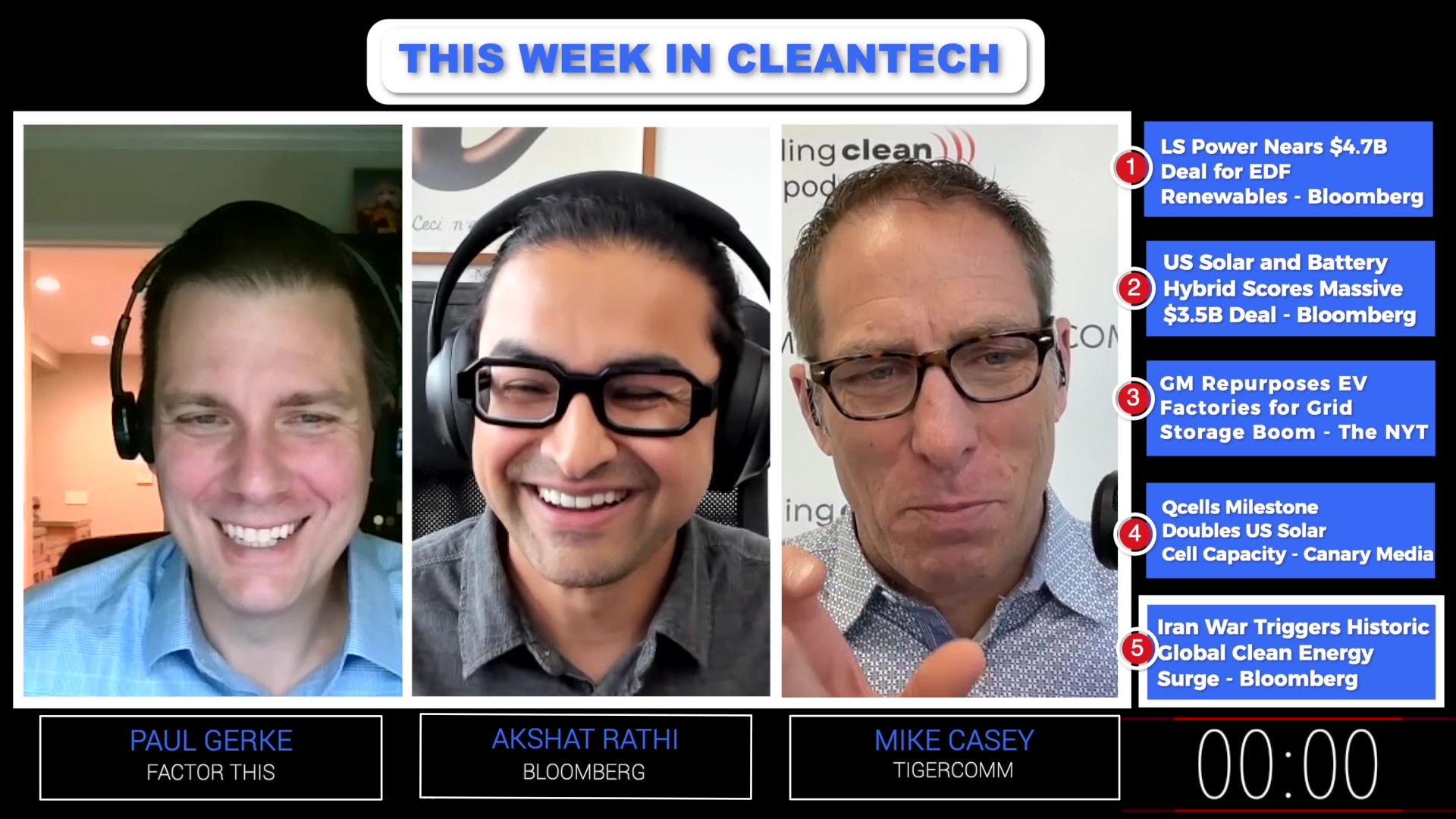
This Week in Cleantech is a weekly podcast covering the most impactful stories in clean energy and climate featuring Paul Gerke of Factor This and Tigercomm’s Mike Casey.
This week’s episode features special guest Akshat Rathi from Bloomberg, who discusses the energy crisis caused by the war in Iran, which is causing some governments to pursue structural shifts away from fossil fuels toward renewables.
This week’s “Cleantecher of the Week” is Varun Sivaram, Founder & CEO of Emerald AI. Emerald AI uses AI to let data centers flex power consumption on command without losing compute performance. Congratulations, Varun!
LS Power is in advanced talks to pay more than $4.7 billion for EDF’s North American renewable power business. The EDF unit for sale had 6.1 GW of solar and wind in operations in the US, Canada and Mexico at the end of last year, and an additional 19.2 GW under development.
Deal activity in the US power industry is accelerating as surging electricity demand from manufacturers, homes, and especially data centers drives up prices, with the biggest Silicon Valley companies forecasting over $700 billion in capital spending this year alone. The sale helps fund construction of new nuclear reactors in France and the UK, costing tens of billions of euros over two decades, amid pressure from falling French power prices.
Cypress Creek Energy secured $3.5 billion in financing for the first two phases of its Steel River project in Arkansas, 1.63 GW of solar and 1.9 GWh of storage. On completion of its third phase, the project will reach 2.45 GW and 2.9 GWh, making it one of the largest solar and storage projects in the country. Nearly all steel will come from within Arkansas, and the panels will be 100% US-made from First Solar. The deal was underwritten by Barclays, BNP Paribas, Santander, and Wells Fargo, and includes tax equity financing.
GM, in partnership with Peak Energy, plans to begin making components for large storage batteries, joining Tesla, Ford, and other carmakers pushing into a growing market to offset slower US EV sales after the $7,500 tax incentive was slashed by the Trump administration.
The batteries store excess electricity from solar, wind, and other sources, then provide backup power or help utilities, data centers, and other consumers manage swings in supply and demand. GM’s batteries will be sodium-based, meaning it is cheaper and easier to process than lithium. Sodium-ion batteries also don’t require elaborate cooling and heating systems to operate safely and efficiently. However, the GM VP said the tech needs to be refined and won’t be ready for mass production until 2028.
Qcells has officially begun commercial production of silicon solar cells at its factory in Cartersville, Georgia – the largest of its kind in the country.
For five years straight, the U.S. power sector has built more solar farms than any other kind of power plant. The US opened up enough factories in just a few years to assemble nearly 70 GW of finished solar panels, which is well beyond what the US installs in one year. But cell production has lagged far behind, with only three other US companies making solar cells until now. Within a few months, The Cartersville site will colocate four supply-chain steps – ingots, wafers, cells, and modules – in one L-shaped “four factories in one” facility. Full 3.3 GW production across all four is slated for Q3.
A war between the US and Iran has closed the Strait of Hormuz, spiking oil and LNG prices and triggering an energy crisis across Asia and Europe much like the one Russia’s 2022 invasion of Ukraine caused. Governments are deploying short-term fixes like fuel-tax cuts and subsidies, but, echoing the 1970s oil shocks, they’re also pursuing structural shifts away from fossil fuels toward renewables, EVs, heat pumps, and electrification for energy security reasons.
While some Asian nations have temporarily leaned on coal to replace gas, leaders across the region are framing renewables as a national security priority and accelerating deployment. China stands to benefit most, since its dominance of the solar, battery, and EV supply chains positions it to offer countries an affordable path out of hydrocarbon dependence.
Want to make a suggestion for This Week in Cleantech? Nominate the stories that caught your eye each week by emailing [email protected]