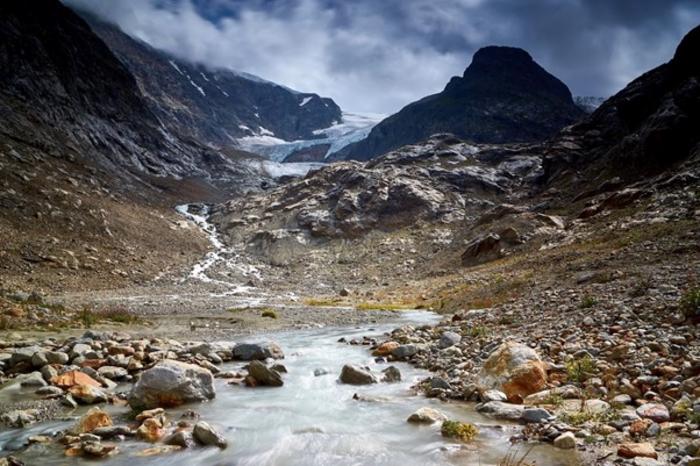
Rivers are known to naturally meander, change courses, braid and branch. But as rising temperatures melt glaciers and thaw frozen ground, the courses of Himalayan rivers are shifting and changing shape much more rapidly than before, according to a new study published in the journal Science. The rising instability of the rivers could pose a risk to water security and critical infrastructure, researchers say. The Himalayas, often referred to as the “Water Tower of Asia”, provide vital water resources for nearly 2 billion people downstream. But according to the study, in the upper high Himalayan region, where several important river basins originate, temperatures have risen nearly twice as fast as the global average in the past four decades. The researchers studied three upper high Himalayan river drainage basins: Yarlung Tsangpo, Indus and Ganges. The sources of these rivers occur at elevations of nearly 5,000 meters (16,404 feet), where there is extensive glacier, ice cover and permafrost. Meltwater from these glaciers and permafrost, which is sensitive to climate warming, forms the rivers’ primary water supply. To find out how climate change is shifting and reshaping these upper high Himalayan river basins, the researchers analyzed 40 years of satellite imagery. In particular, they measured 1,079 river bends, covering roughly 1,582 kilometers (983 miles), from 1980 to 2020. Since valleys can confine and influence river movements, the researchers chose unconfined bends or meanders that flowed freely through the landscape for their analysis. Their analysis found that the rivers’ courses were shifting sideways faster…This article was originally published on Mongabay