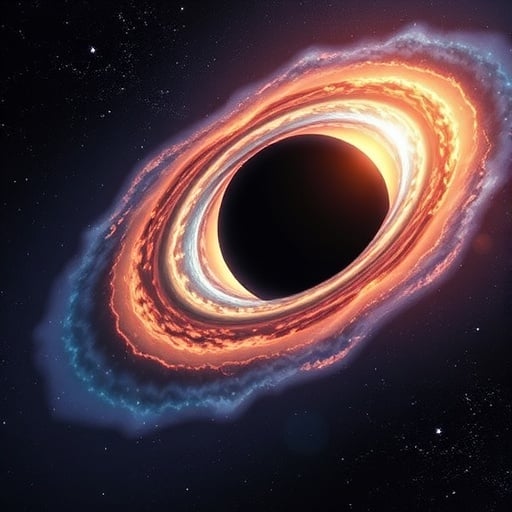
What happens when a black hole and a star meet in the middle of nowhere in a galaxy? It sounds like it could be a dramatic science fiction backdrop, with some hapless starship caught in the crunch. Actually, such encounters in real life are pretty rare. They happen maybe once every 100,000 years. But when they do occur, the immense gravity of the supermassive black hole tears the star apart. It’s an eerie-looking process. The star gets “spaghettified” — that is, pulled on one side by the black hole. That rips out a stream of gas from the star, which eventually loops around in a disk around the black hole as the star’s orbit spirals into the black hole.
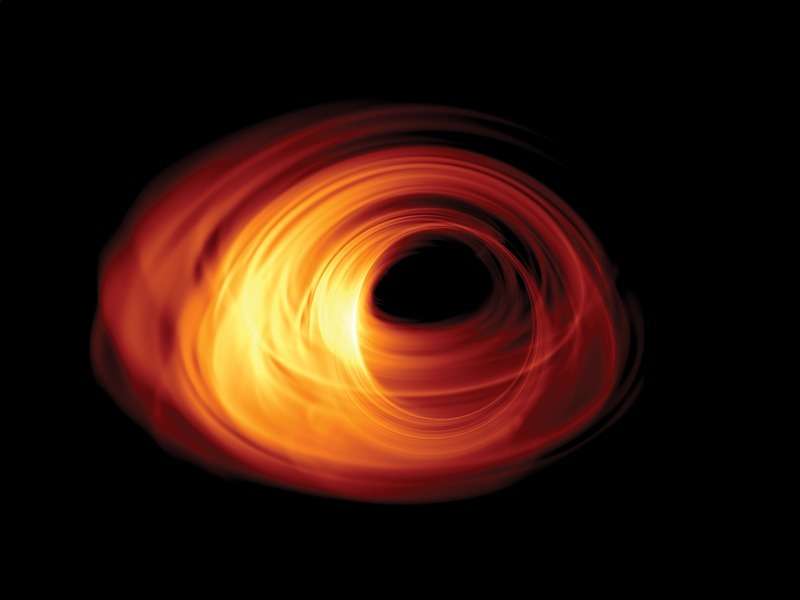
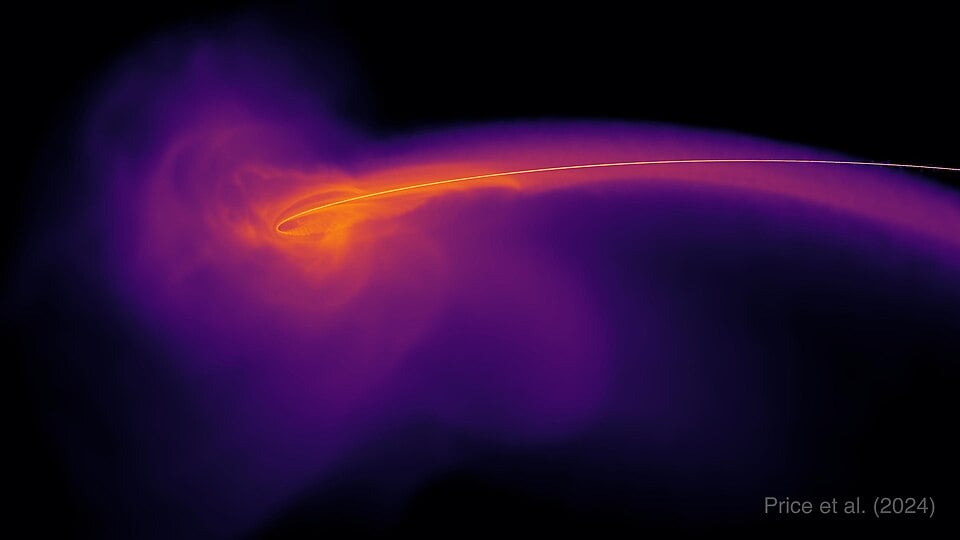 A computer graphics simulation of a star being disrupted by the gravitational pull of a nearby supermassive black hole. This part of a tidal disruption event emits radiation that can be detected and reveal the presence of the black hole. Courtesy Danielhamesprice CC BY-SA 4.0
As the material in the disk gets heated by friction in the magnetic field, it starts to glow in visible and other forms of light. Eventually, a jet forms, sending a stream of superheated material away from the site of the event. The glow is what allows astronomers to witness the action, called a “tidal disruption event” (TDE).
About a hundred or so TDEs have been observed optically (i.e., in visible light) since the late 20th century. They’ve also been detected with X-ray, infrared, and radio instruments, which gives astronomers an idea of how powerful the action is when they occur. Usually TDEs happen in the cores of galaxies, where the central supermassive black holes exist surrounded by orbiting stars and gas clouds. But there’s nothing that says they all occur there. Some happen well away from the core, or “off-nuclear” as the astronomers like to say.
Observing a Recent TDE
A team of researchers at the University of North Carolina-Chapel Hill recently used the Southern Astrophysical Research Telescope (SOAR) to watch a flaring event called TDE 2025abcr. They identified it as a possible TDE using an AI classification program adapted to search for TDEs away from galactic cores, according to team member Akash Anumarlapudi. “By removing the assumption that these events only happen in the galactic center, we were able to find a black hole that might have otherwise been missed,” explained Anumarlapudi. Once the AI identified a candidate, the team then turned to SOAR to do optical observations.
TDE 2025abcr was the first optical TDE discovered on the outskirts of a host galaxy. It’s not only nowhere near the core of its home galaxy, but the event occurred some 30,000 light-years away. For reference, our Sun lies some 26,000 light-years away from the core of the Milky Way, and we’re out in a spiral arm, not near the core. According to study leader Jonathan Carney, a PhD student in astrophysics at Chapel Hill, TDE 2025abcr turns out to be the most offset such event ever seen.
“Almost every tidal disruption event we’ve ever observed has occurred at the center of a galaxy, right where we expect the biggest black holes to be,” Carney said. “The tidal disruption event we discovered happened tens of thousands of light-years away from the center, revealing a massive black hole in a place we would not normally expect to find one. We know that wandering black holes exist in massive galaxies, but they are difficult to study because, with the exception of when they briefly disrupt a star, they produce no light.”
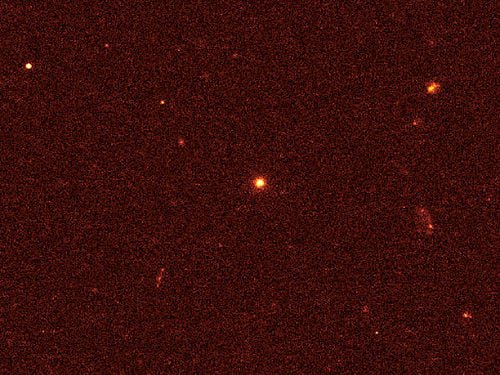 A Hubble Space Telescope optical image of the TDE Swift J1644+57. It sported a relativistic jet that flowed away from the TDE for about a year and a half. Courtesy NASA/ESA/STScI
Learning About the Black Hole
For a black hole to disrupt a star like this, it has to be quite massive. The team estimates this one is probably about a million times the mass of the Sun. It’s pretty rare to have such a monster just wandering around in space like this one does. So, that raises questions about how it got to where it was when it encountered the hapless star. It’s possible that the black hole was part of a galaxy collision in the distant past. During that event, it could have been kicked out from the center of one of the participating galaxies. Or, it could have been one of several black holes at the core of a galaxy and gotten nudged out of place through interactions with one or more of the others.
Observations of this event show that astronomers have a way to spot wandering black holes away from the cores of their galaxies. Normally, black holes don’t give off much, if any, radiation or other clues to pinpoint their locations. But if one tangles with a star that gets too close, the resulting electromagnetic radiation from the collision gives away the black hole’s location. TDE 2025abcr’s discovery is a template for how astronomers can do visible-light observations of other such black hole entanglements from Earth. That means they’ll be able to discover and study hundreds of thousands of TDEs per year ranging out to great distances from the Milky Way. The Vera C. Rubin Observatory, for example, could be a major contender in the hunt for black holes that tangle with nearby stars.
Ongoing TDE studies with Rubin and other observatories can also reveal more information about the life cycles of the stars that get swept up into a TDE event. TDEs also release enormous amounts of energy, and that can help astronomers study gravitational forces and matter that occur under conditions that cannot be studied in the lab.
For More Information
UNC-Chapel Hill Astronomers Detect One of the Universe’s Rarest Black Hole Events
TDE 2025abcr: A Tidal Disruption Event in the Outskirts of a Massive Galaxy