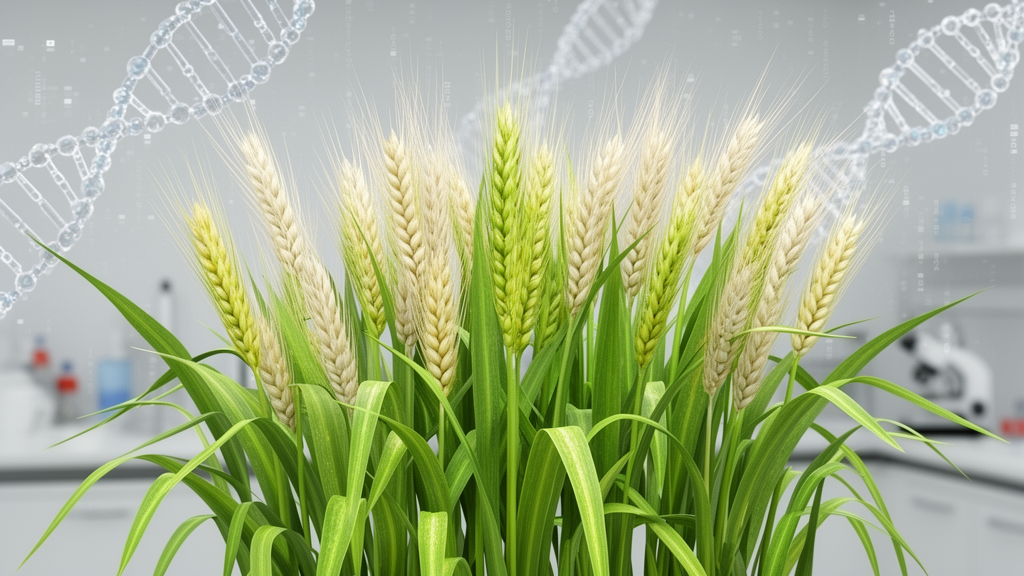
Agricultural geneticists investigating cereal resilience have mapped the genomic regions controlling dynamic tiller orientation and temperature-sensitive chlorophyll loss in barley using whole-genome resequencing paired with bulked segregant analysis. By measuring allele frequency divergences between contrasting phenotypic bulks, the team mapped significant candidate genomic regions and prioritized candidate genes associated with both traits. Tiller angle directly shapes canopy architecture, light capture, weed competition, and planting density, while leaf colour reflects photosynthetic capacity and chloroplast stability under heat. The investigation pinpointed candidate genomic intervals on chromosomes 4H, 3H, and 7H for tiller angle, alongside a primary candidate region on chromosome 4H and a secondary locus on chromosome 5H for thermo-inducible leaf colour, providing molecular markers and candidate variants for barley breeding.
Barley (Hordeum vulgare L.) is among the most widely cultivated cereal crops worldwide, occupying roughly 44.05 million hectares and yielding approximately 142.00 million tonnes annually according to FAOSTAT data. Australia is the second largest global producer after Russia, contributing 13.27 million tonnes annually, or about 9.4 percent of global production. In Australian farming systems, particularly across Western Australia, barley represents a crucial component due to broad adaptability and commercial importance for malting, food, and animal feed. However, increasing climatic variability and seasonal yield instability make improving architecture and stress resilience a central breeding priority. Dynamic tiller growth, where plants show early prostrate vegetative tillers before transitioning to erect architecture at booting, enhances ground cover and weed suppression while maintaining light interception during grain filling. In parallel, leaf colour phenotypes linked to chloroplast development are highly sensitive to thermal conditions, which influence photosynthetic complex assembly and cellular survival under stress.
To dissect the genetic architecture governing these traits, the investigators examined two doubled haploid populations developed from mutagenized Vlamingh crossed with Buloke. The first population, consisting of 208 doubled haploid lines from the mutant V-V-HD crossed with Buloke, was evaluated for tiller angle. While Buloke exhibits consistently erect growth, V-V-HD displays prostrate vegetative tillers followed by erect tillering after booting. Segregation across 208 lines revealed 77 prostrate, 112 erect, and 19 ambiguous lines, supporting a major controlling locus identified in earlier linkage studies. The second population, comprising 203 doubled haploid lines from mutant V-V-Y crossed with Buloke, was evaluated for thermo-inducible leaf colour. Under high temperatures during grain filling, V-V-Y develops chlorophyll-deficient yellow foliage, whereas Buloke and Vlamingh remain green. In this population, 100 lines exhibited yellow leaves while 103 remained green under heat treatment, fitting a 1:1 segregation ratio confirming single-gene nuclear inheritance at the vvy locus.
For QTL-seq analysis, the team selected 15 doubled haploid lines from each extreme phenotypic class, generating four contrasting DNA pools: prostrate and erect tiller bulks, and chlorophyll-deficient and normal green leaf bulks. Genomic DNA was extracted from 15-day-old seedling leaves and pooled equally alongside parental DNA from Buloke, V-V-HD, and V-V-Y. Paired-end sequencing on the DNBseq-T7 platform generated 150-base-pair reads across all seven samples, producing 5.49 billion raw reads. Read counts per sample ranged from 684.7 million in the prostrate bulk to 833.4 million in the erect bulk, achieving sequencing depths between 24.3-fold and 29.6-fold. After trimming adapters and low-quality bases with Trimmomatic, 99 percent of reads were retained, yielding 5.43 billion high-quality reads. Alignment to the Morex v3 reference genome using BWA-MEM2 achieved a 98.6 percent overall mapping rate, with alignment rates spanning 96.3 percent in parents to 99.9 percent in phenotypic bulks, providing comprehensive coverage for allelic frequency estimation.
Multi-sample variant calling using BCFtools identified 22,740,801 high-confidence biallelic single nucleotide polymorphisms across the seven chromosomes, averaging 3.25 million variants per chromosome, ranging from 1.98 million on chromosome 1H to 4.58 million on chromosome 2H. Functional annotation revealed that 97.1 percent of variants were intergenic, while 2.9 percent (661,902 variants) affected gene models, including 161,913 missense and 4,772 stop-gained changes. The variant pool was filtered to parent-informative sites showing contrasting alleles with at least 90 percent parental depth support. The SNP index for each bulk was calculated as the proportion of reads carrying reference parent alleles, and ΔSNP index values were generated from bulk differences. Values were smoothed using a 1-megabase sliding window with a 50-kilobase step size. To eliminate parental reference bias, analyses were run reciprocally using Buloke and mutant parents, prioritizing candidate genomic intervals where smoothed absolute ΔSNP index values concordantly exceeded simulation-based 95 percent and 99 percent confidence thresholds.
In the V-V-HD tiller angle population, QTL-seq identified a major concordant genomic signal on chromosome 4H between 64.80 and 69.30 megabases. This 4.5-megabase interval contained 2,966 cross-validated polymorphic variants, including 36 gene-associated variants across 17 annotated genes. Prioritized candidates included two transcriptional corepressors belonging to the SEUSS family, HORVU.MOREX.r3.4HG0346170 and HORVU.MOREX.r3.4HG0346190, carrying intronic variants with absolute ΔSNP index values of 0.59 and 0.53, respectively. Additional candidates included HORVU.MOREX.r3.4HG0346690, encoding a lysine-specific demethylase 3A-B containing an intronic variant and a missense change (Val28Ile), and HORVU.MOREX.r3.4HG0346390, encoding an F-box family protein carrying a Thr318Ala missense substitution. The region also contained an intronic variant in peroxisome biogenesis protein 22 (HORVU.MOREX.r3.4HG0346360), a 3-prime UTR variant in a mitochondrial transcription termination factor (HORVU.MOREX.r3.4HG0346280), and a synonymous variant in a kinase gene.
The detection of the chromosome 3H tiller angle locus between 586.20 and 586.95 megabases is notable when compared with previous mapping studies. Earlier linkage and fine-mapping of the V-V-HD mutant by Zhou and colleagues mapped prostrate growth to a 3.53-megabase interval on chromosome 3HL (631.84 to 635.37 megabases on Morex v1), implicating a zinc-finger transcription factor homologous to rice PROG1. The distal chromosome 3H locus identified by QTL-seq in this study does not overlap that previously fine-mapped region, representing an independent phenotype-associated region. Candidates within this interval include an F-box protein (HORVU.MOREX.r3.3HG0314970) with missense mutations (Arg340Pro and Ala217Pro), transmembrane protein 45B (HORVU.MOREX.r3.3HG0314880), a kinase, and a SAGA-associated transcriptional regulator. While this interval lies within meta-QTL MQTL3H-11 reported by Du and coworkers, it contains no overlapping genome-wide association markers. Consequently, the newly identified signals on chromosomes 4H, 3H, and 7H represent provisional associations requiring further experimental validation before being deployed in marker-assisted breeding programs.
For thermo-inducible leaf colour in the V-V-Y population, QTL-seq delimited a major concordant region on chromosome 4H between 604.10 and 609.30 megabases, alongside a secondary locus on chromosome 5H between 440.25 and 441.40 megabases. The 5.2-megabase chromosome 4H interval encompasses the remapped vvy locus and partially overlaps meta-QTL MQTL4H-13. Within this region, 3,705 cross-validated polymorphic variants were identified, including 771 gene-associated variants across 131 genes, with multiple loci reaching absolute ΔSNP index values of 1.00. Several prioritized candidates carried high-impact variants, including stop-gained mutations in zinc finger MYM-type protein 5 (HORVU.MOREX.r3.4HG0416980; Ser124Stop), an F-box ubiquitination effector (HORVU.MOREX.r3.4HG0416990; Trp62Stop), and a receptor-like kinase (HORVU.MOREX.r3.4HG0416530; Gln181Stop). In addition, a splice donor variant was identified in polyubiquitin (HORVU.MOREX.r3.4HG0417530), a stop-lost mutation in tyrosine decarboxylase (HORVU.MOREX.r3.4HG0418140), and a 5-prime UTR premature start codon gain in an arginine-serine-rich splicing factor (HORVU.MOREX.r3.4HG0416540), highlighting disruption across protein quality control and post-transcriptional regulation pathways.
Expression analysis across two independent barley RNA-seq datasets evaluating seedling leaves, shoots, and roots under heat stress (35.5 and 38 degrees Celsius) clarified candidate gene responses within the chromosome 4H interval. The molecular chaperone DnaK/Hsp70 (HORVU.MOREX.r3.4HG0416940) and BAG family chaperone regulator 6 (HORVU.MOREX.r3.4HG0418350) displayed strong transcriptional induction under elevated temperatures, whereas DnaJ (HORVU.MOREX.r3.4HG0416610) exhibited stable basal expression with modest 1.7-fold induction, supporting their combined role in protein refolding under heat. Cold regulated protein 27 (HORVU.MOREX.r3.4HG0417410) and a WD repeat-containing protein (HORVU.MOREX.r3.4HG0417170) were induced at 24 and 48 hours of heat stress, while the arginine-serine-rich splicing factor showed delayed 3.6-fold induction at 48 hours. Conversely, THO complex subunit 1 (HORVU.MOREX.r3.4HG0417620), involved in nuclear mRNA export, showed transient downregulation before recovering. Together with candidates such as chlororespiratory reduction 31 (HORVU.MOREX.r3.4HG0418020) and a heat shock transcription factor (HORVU.MOREX.r3.4HG0418180), these findings suggest thermo-inducible leaf yellowing stems from impaired chloroplast proteostasis and altered temperature-responsive RNA handling.
To facilitate breeding applications, the research team developed eight Kompetitive Allele-Specific PCR (KASP) markers targeting single nucleotide polymorphisms across the 604.10 to 609.30 megabase chromosome 4H candidate interval. Specific homozygous alleles at each functional marker segregated consistently between green and yellow lines, validating the 4H association. However, because mapping populations were created by crossing gamma-ray mutants with Buloke, the identified intervals contain both induced mutations and background natural polymorphisms, meaning these loci represent phenotype-associated regions rather than confirmed causal lesions. Furthermore, previous studies reported a yield QTL co-localizing with the vvy locus, indicating that evaluating near-isogenic lines and larger germplasm panels will be necessary to separate yield effects from leaf colour before applying these markers in marker-assisted selection.
Subject of Research: Genomic mapping of tiller angle plasticity and thermo-inducible leaf colour in barley
Article Title: QTL-seq identifies genomic regions and candidate genes for tiller angle and thermo-inducible leaf colour in barley mutant-derived doubled haploid populations
Article References: Garg, V., Barmukh, R., Bohra, A., Chitikineni, A., Mir, R. R., Zhang, X., Bhatnagar-Mathur, P., Li, C., & Varshney, R. K. (2026). QTL-seq identifies genomic regions and candidate genes for tiller angle and thermo-inducible leaf colour in barley mutant-derived doubled haploid populations. Plant Stress, 24, Article 101568. https://doi.org/10.1016/j.stress.2026.101568
Image Credits: AI Generated
DOI: 10.1016/j.stress.2026.101568
Keywords: Barley, Hordeum vulgare, QTL-seq, Tiller angle, Thermo-inducible leaf colour, Doubled haploid populations, Bulked segregant analysis, Whole-genome resequencing, Chromosome 4H, Chromosome 3H, Candidate genes, vvy locus, KASP markers, Chloroplast function, Plant architecture, Heat stress response, Molecular breeding
Tags: barleybulked segregant analysiscandidate geneschloroplast functionChromosome 3HChromosome 4HDoubled haploid populationsheat stress responseHordeum vulgareKASP markersmolecular breedingplant architectureQTL-seqThermo-inducible leaf colourTiller anglevvy locusWhole-genome resequencing