
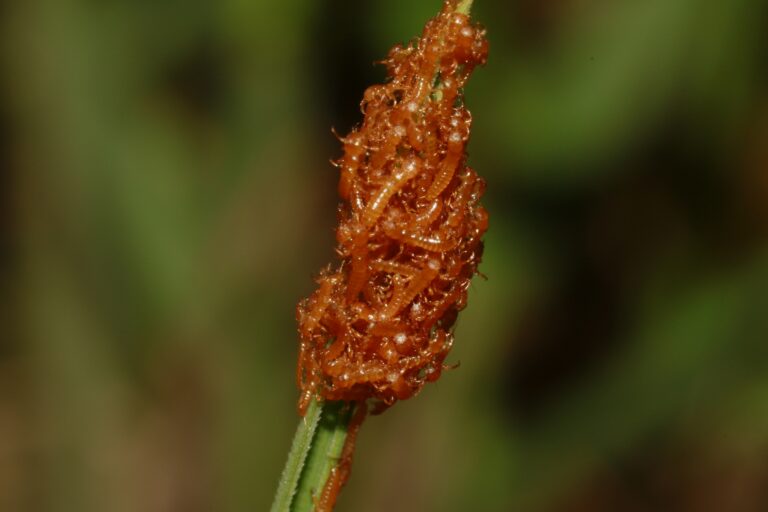
European Black oil beetle larva lures unsuspecting bees by manufacturing smells that mimic floral scents, new research suggests. The larva then hitches a ride on the bee to its burrow, where it eats the bee’s eggs and pollen, and develops into an adult beetle. This is the first known instance of an animal hijacking the smell of a flower to lure another animal to parasitize it, the study’s authors say. Larvae of the European black oil beetle (Meloe proscarabaeus) are orange and gather on the tips of plants to attract bee hosts, which they then parasitize. The research team hypothesized that the larvae emit some kind of chemical to attract the bees. Using chemical analysis, the researchers found that the beetles emit compounds called floral monoterpenoids, the same chemicals that produce the scent of flowers in many plant species. The researchers prepared a synthetic mix of the compounds in the lab and found that bee species in the wild were attracted to them, supporting the hypothesis that the beetle’s larvae imitate flowers to lure bee hosts. Ryan Alam, the study’s lead author from the Max Planck Institute for Chemical Ecology in Germany, told Mongabay by email that the team hasn’t identified a specific flower with a scent that matches the floral chemical profile the larvae emit. However, he added that the compounds are known components of the scent of willow flowers, which makes the plants an intriguing candidate. “Determining the precise floral source (if any!), and understanding how closely the…This article was originally published on Mongabay