
The California Air Resources Board on Friday approved major changes to the state’s cap-and-invest program, including a controversial plan to allow polluting industries to earn free emissions allowances if they invest in decarbonizing their facilities — a move critics say could undermine California’s decarbonization goals.
Friday’s vote capped months of fighting between environmental groups and polluting industries over the future of the state’s two-decade-old carbon-trading regime, which lawmakers reauthorized last year. Companies covered by the program must either reduce their carbon emissions below a certain state-mandated limit or buy allowances from the market to offset emissions in excess of that limit.
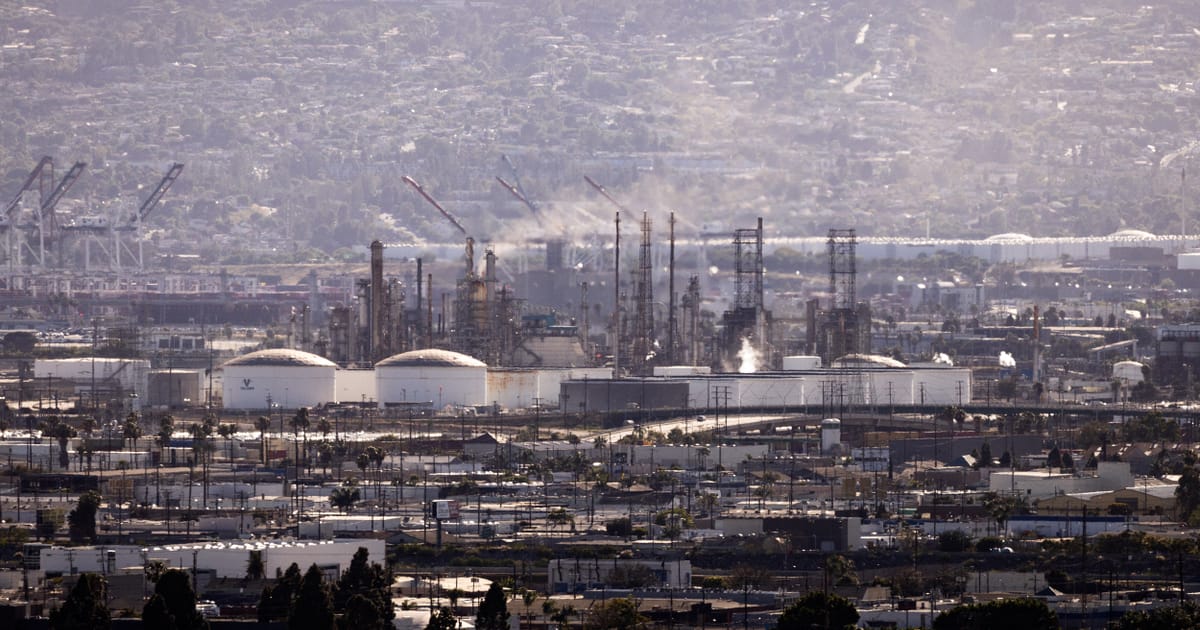
CARB’s initial proposal in January came under fire from several polluting industries, which warned they would have to raise prices or shutter operations given the cost of meeting its increasingly stringent emissions limits. Oil companies such as Marathon Petroleum and Chevron threatened to close some of the state’s last remaining oil refineries.
The January proposal also included cuts to programs funded by cap-and-invest meant to offset rising electricity costs via utility customer credits. California utilities and lawmakers protested changes to that program, which was part of a sprawling energy affordability package passed last year.
CARB issued a revised plan in April that both increased funding for utility bill credits and set aside about $800 million in additional compliance support to polluting industries. The April plan put forward CARB’s manufacturing decarbonization incentive (MDI) program, which will make free allowances available to companies that invest in cutting carbon emissions.
Environmental groups and state lawmakers opposed the MDI proposal, which they fear will threaten the cap-and-invest program’s ability to help California meet its near-term target of reducing carbon emissions by 40% from 1990 levels by 2030.
In response, CARB added last-minute amendments to tie allowances to proven carbon-cutting projects. It also stipulated that the plan will be rolled out in stages so that staff and board members can ensure it’s working as intended before the new rules take effect statewide.
Still, these guardrails were not enough to quell concerns from critics.
“These changes to Cap-and-Invest allow more pollution and undermine the program’s ability to support investments that cut emissions and costs for families,” Katelyn Roedner Sutter, California senior director for the Environmental Defense Fund, which opposes CARB’s plan, said in a Friday statement.
CARB Chair Lauren Sanchez said Friday that the updates represented a “challenging balancing act” between meeting climate targets, improving energy affordability, and supporting industries important to the state’s economy. Offering hard-to-decarbonize industrial facilities a way to reduce the cost of complying with the state’s increasingly stringent emissions caps could help dissuade them from leaving the state, she said.
The MDI, which could provide up to $4 billion in value for companies tapping into it, could also help make up for the billions of dollars of federal industrial decarbonization funds stripped by the Trump administration, Sanchez said. “The federal attacks on that funding are unprecedented, and we are fighting many of them in court, but this part of the proposal can help to backfill some of that investment,” she said.
Gov. Gavin Newsom has also framed California’s cap-and-invest program as a pushback against the Trump administration’s attacks on the state’s clean vehicle regulations and other climate efforts.
“While Trump sows ongoing chaos and uncertainty, California is staying focused by protecting our economy, safeguarding public health, and doubling down on the clean energy future,” Newsom said in a Friday statement praising CARB’s vote.
Fears of missing carbon targets and losing climate funding
Critics of the new plan worry that MDI will undermine climate goals for a simple reason: It could let major polluters emit more greenhouse gases than they ought to.
In January, CARB determined that the cap-and-invest program had to remove allowances equivalent to 188 million metric tons of emissions from circulation in order to meet its 2030 decarbonization targets. But the MDI program would keep those allowances in circulation — and give them away for free to companies that invest in carbon-cutting projects, even though those might not deliver emissions reductions until later.
The MDI could also sap funding for some of the climate and energy programs cap-and-invest helps pay for.
Lawmakers, academic experts, and community advocates warned that the MDI could depress prices in California’s carbon market, thereby reducing the revenue cap-and-invest raises for the state’s Greenhouse Gas Reduction Fund. GGRF has become a catchall source of alternative funding for programs facing cuts in the state budget over the past several years.
In particular, the programs CARB has designated as “Tier 3” could lose their funding if carbon market revenues fall. That amounts to hundreds of millions of dollars for affordable housing, low-carbon transit, and clean air and drinking water for low-income communities.
At Friday’s meeting, board members grilled CARB staff for hours over this risk. Rajinder Sahota, CARB’s deputy executive officer for climate change and research, asserted that analyses from environmental advocates and the state’s Legislative Analyst’s Office, which predict the MDI program could lead to billions of dollars of lost carbon-market revenue, have overestimated the likely financial impacts.
But Kyle Meng, a professor at the University of California at Santa Barbara who co-authored an analysis that found the MDI could lead to $2.3 billion less for the GGRF and $1.7 billion less for the California Climate Credit from 2027 to 2030, pushed back against those assertions in a social media post after Friday’s vote.
“Seeing such voodoo economics coming from the agency tasked with governing the world’s second most valuable carbon market was disappointing, to say the least,” Meng wrote.
Sanchez agreed at Friday’s hearing to insert several last-minute amendments, which were proposed by other board members to forestall the risk of MDI undermining state carbon-reduction targets or throttling carbon market revenues.
For one, CARB can claw back allowances if companies don’t follow through on the decarbonization investments they’ve promised, Sanchez said.
Another provision will require CARB’s executive officer to report to the board before any allowances are awarded, to give board members an opportunity to amend the MDI program’s workings to avoid deep hits to carbon market revenues or the integrity of the cap. Sanchez described the changes as “pushing pause on the MDI” pending “analysis that is then reported back to us as a board and any changes and amendments that are needed.”
It’s unclear how these changes might affect the debate over funding for GGRF-reliant programs that’s currently raging in the state capitol.
State Sen. Henry Stern, an ex officio CARB member, brought up this issue at Friday’s hearing, noting that recent proposals from the state Senate Budget Committee are ready to “reject the current expenditure plan” absent more guarantees that the MDI would not undermine program funding.
Even so, Stern, who was among more than two dozen other lawmakers who signed a letter protesting CARB’s April plan, expressed support at Friday’s hearing for an MDI program that could backfill lost federal funding for the toughest-to-decarbonize part of the state’s economy.
“This has serious potential to be a core accountability tool for our justice communities, looking for not just GGRF to take care of their problems but for the polluting entities themselves to pay for them,” he said. “And I, frankly, don’t think we’re going to be able to hit both our targets in this sort of broader transitions that we want to see unless we bring serious private capital to the table.”
A majority of board members voted down a proposal to delay adoption of the new rules after CARB staff warned that revising the plan to exclude the MDI could force the agency into a monthslong process that could prevent it from reauthorizing the program by a September deadline, which would in turn trigger an even longer administrative review. Such delays could do more harm than good to confidence in the carbon market and further depress revenues, Sahota said.
Ultimately, the board voted 10 to 3 to adopt the plan. The MDI program will open to applications from companies in mid-2027.
The guardrails didn’t satisfy Lynda Hopkins, who joined board members Diane Takvorian and Gladys Limón in voting against the updates.
“My concern is that this proposal comes at the expense of zero-emission transit, affordable housing, clean air, clean water, increased gas, greenhouse gas emissions, and potentially community emission-reduction plans,” Hopkins said.
But CARB board member Cliff Rechtschaffen said he supported the program with the changes inserted on Friday, including several he proposed to tie allowances to specific facilities that prove they’ve invested in effective decarbonization projects.
“I don’t support a delay, because of the risks and uncertainties my colleagues have outlined,” Rechtschaffen said. “I think the risks on the market are real. We live in a very volatile world, and a regulation in the hand is worth maybe one and a half or two in the bush.”
{
if ($event.target.classList.contains(‘hs-richtext’)) {
if ($event.target.textContent === ‘+ more options’) {
$event.target.remove();
open = true;
}
}
}”
>
Jeff St. John
is chief reporter and policy specialist at Canary Media. He covers innovative grid technologies, rooftop solar and batteries, clean hydrogen, EV charging, and more.
read next