Dreams of finding a sort of Earth 2.0 motivates a lot of the thinking around the search for exoplanets. But there’s more to exoplanet science than searching for potentially habitable worlds. Scientists need a deeper understanding of the exoplanet population overall in order to understand the cosmos.
When the ESA launches PLATO (PLAnetary Transits and Oscillations of stars) in 2017 its job will be to find rocky exoplanets around Sun-like yellow dwarfs, sub-giants, and red dwarfs. Finding Earth-like planets that may host liquid surface water is an important part of PLATO’s mission, but it has a wider scope. It will also help us understand runaway greenhouse planets like Venus.
In anticipation of PLATO’s scheduled launch in March of 2017, researchers have forecast how many Venus Zone (VZ) terrestrial planets PLATO should detect. Their work is titled “The Expected Yield of Venus Zone Terrestrial Planets from PLATO,” and the lead author is Stephen Kane. Kane is a professor of planetary astrophysics in the Departments of Earth and Planetary Sciences and Physics and Astronomy at the University of California. The paper will be published in Publications of the Astronomical Society of the Pacific and is currently available at arxiv.org.
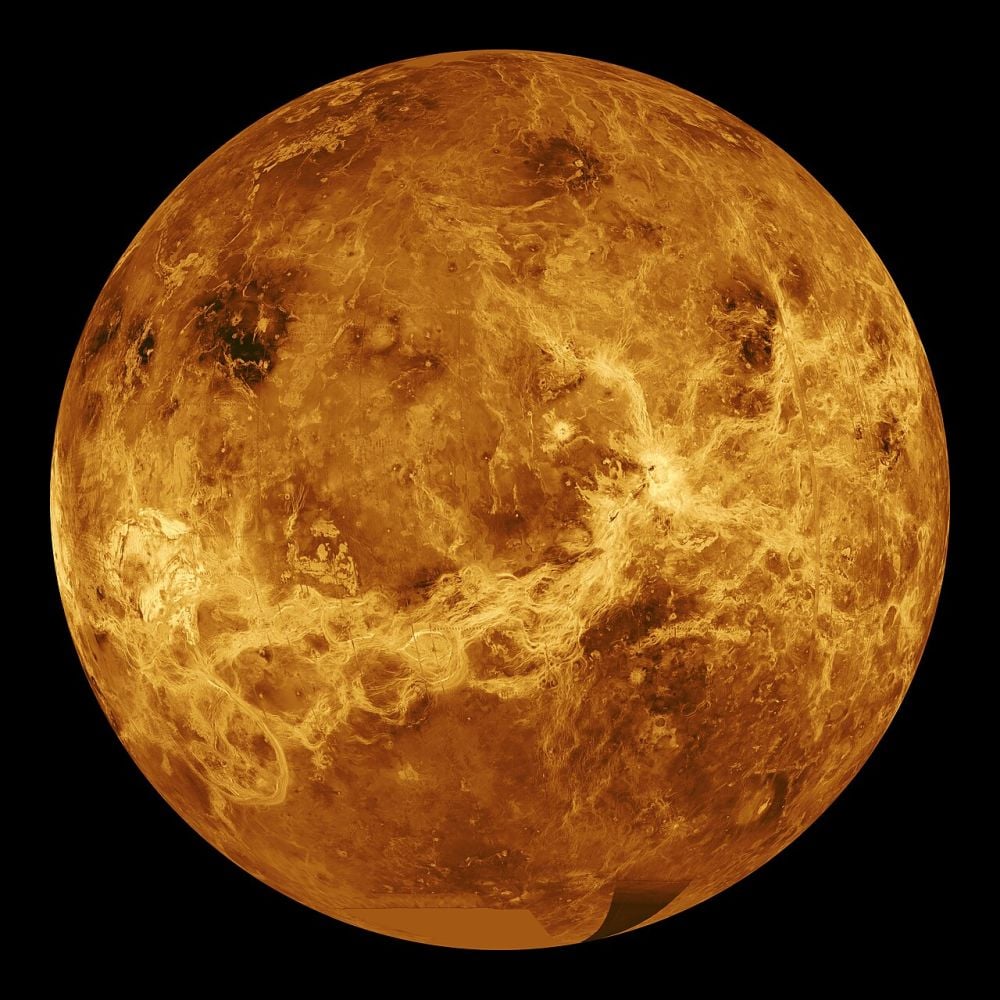
Scientists want to know more than just how many of which types of exoplanets there are. They want to understand the evolutionary pathways planets follow. Earth has a long history and started out as a much different world than it is today. Some exoplanets may start out similar to Earth, yet end up as something entirely different, like Venus. Venus’ runaway greenhouse climate drastically differentiates it from Earth, and researchers want to know why that happened, and how often two planets that start out similarly can become so different from one another over time.
“The characterization of terrestrial exoplanets and the conditions that lead to divergent climate outcomes is a primary goal of exoplanetary science,” the authors write. “The Venus Zone (VZ) provides a framework for identifying planets that may have experienced runaway greenhouse processes similar to Venus, and the statistical properties of such planets bear directly on models of planetary habitability.”
In many ways, Venus is a twin of Earth. The planets are about the same size, have similar masses, and similar densities. They’re similarly differentiated, and have very similar bulk compositions, having formed in the same region of the solar nebula. Both worlds have volcanism, and both have young surfaces. Both planets also have thick atmospheres, though Venus’ is substantially thicker.
“A central question in planetary science is whether Earth’s clement climate is a common outcome of terrestrial planet evolution or an exceptional one,” the authors write.
To answer this question, PLATO will search for more worlds in the Venus Zone (VZ). The Venus Zone is on the inside of the Habitable Zone, where planets receive enough stellar irradiation to generate a runaway greenhouse climate. The outer edge of the VZ is the runaway greenhouse climate limit, and the inside edge is where exoplanets recieve enough stellar flux to completely strip away their atmospheres.
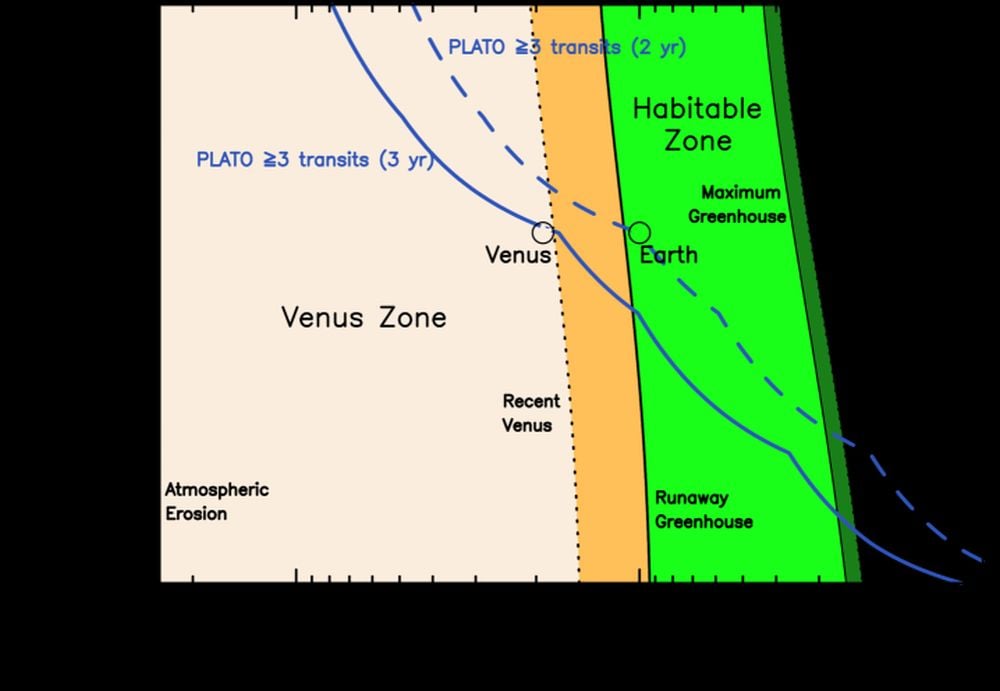 *This figure shows the Venus Zone (VZ) and Habitable Zone (HZ) shown in incident stellar flux versus stellar effective temperature space. The light orange region indicates the definite VZ and the darker orange region shows the optimistic VZ extension between the Recent Venus and runaway greenhouse limits. The bright and dark green regions show the conservative and optimistic HZ, respectively. The locations of Venus and Earth in the solar system are marked. For K dwarfs (lower portion of the plot), the entire VZ lies to the left of the PLATO 2-year detection horizon, while for G and F dwarfs the outer VZ near the runaway greenhouse boundary requires a 3-year baseline for detection. Image Credit: Kane et al. 2026. PASP*
Of the more than 6,000 confirmed exoplanets, 384 are in the Venus Zone. That number is dominated by super-Earths with radii greater than 1.25 Earth radii, while Earth-size planets are rare. Earth-size planets are particularly rare close to the outer VZ boundary at the runaway greenhouse limit. This is where PLATO will make most of its new detections.
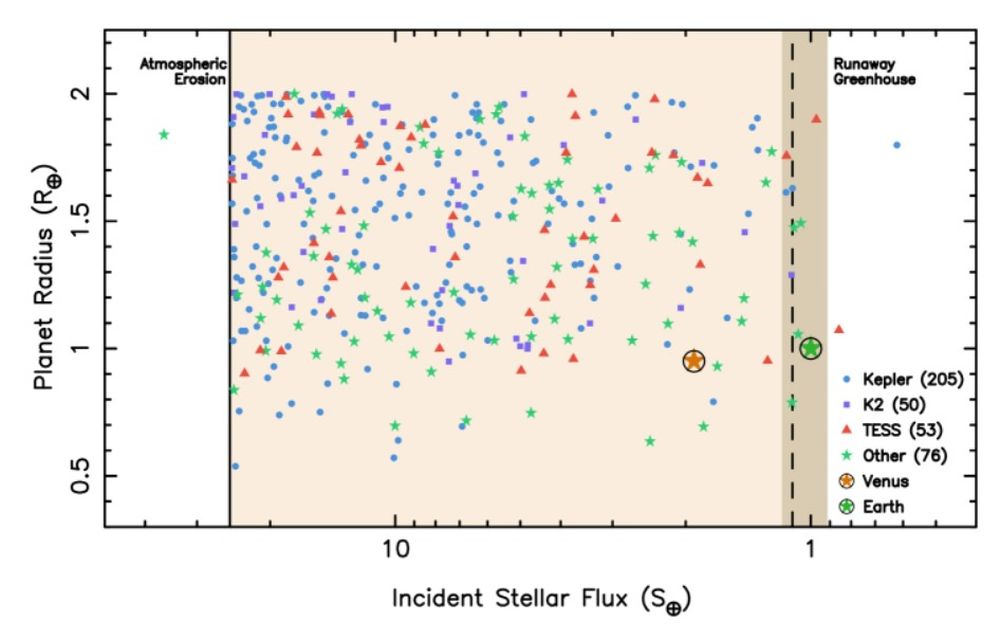 *This figure shows the 384 known VZ terrestrial exoplanets, color-coded by the mission that found them. Light orange shading shows the VZ. The darker band at the right edge of the VZ shows the range of the outer VZ boundary. The outer VZ near the runaway greenhouse boundary is sparsely populated at Earth-size radii, highlighting the region where PLATO will contribute the most new detections. Image Credit: Kane et al. 2026. PASP*
The authors are using the VZ to build a sample for comparing planets. They’ll use PLATO’s detections along with data from Venus-specific mission like DAVINCI and VERITAS to try to understand where the runaway greenhouse transition boundary is in terms of stellar insolation. The more VZ exoplanets PLATO can find, the better researchers can constrain this boundary.
The researchers estimate that PLATO willl find between about 170 to 280 VZ terrestrial planets with radii between 0.8 and 2.0 Earth radii. They say that under conservative assumptions, about 40 to 80 will be Earth-size. Another subset, the bright P1 sample, they estimate PLATO will detect ∼50–85 terrestrial and ∼13–22 Earth-size VZ detections. These detections are especially valuable because the brightness of the star will allow radial velocity mass determination, and asteroseismic age dating for F and G dwarfs. This subset will also allow atmospheric characterization by future telescopes.
This overall effort to find Venus-like planets is important because researchers can compare the findings to Venus itself.
“Although there is likely a continuum of planetary environments that exist within the exoplanet population, those cases that may be ground-truthed through a direct comparison to Solar System bodies are especially useful,” the authors write. “Venus is particularly valuable in this regard given its dramatic past divergence with Earth, the study of which will be greatly informed through an expansion of the exoVenus population around bright stars.”
While the focus in on exoplanets in the VZ, the real goal is understanding planetary habitability from a different perspective. Instead of searching for more Earth analogs in the habitable zone, scientists can tap into the much larger population of Venus analogs in the inner parts of exoplanetary systems.
“Understanding the prevalence and diversity of Venus-like worlds is essential for placing Earth’s climate evolution in a broader context and for assessing whether our planet’s habitability is the rule or the exception,” the authors conclude.