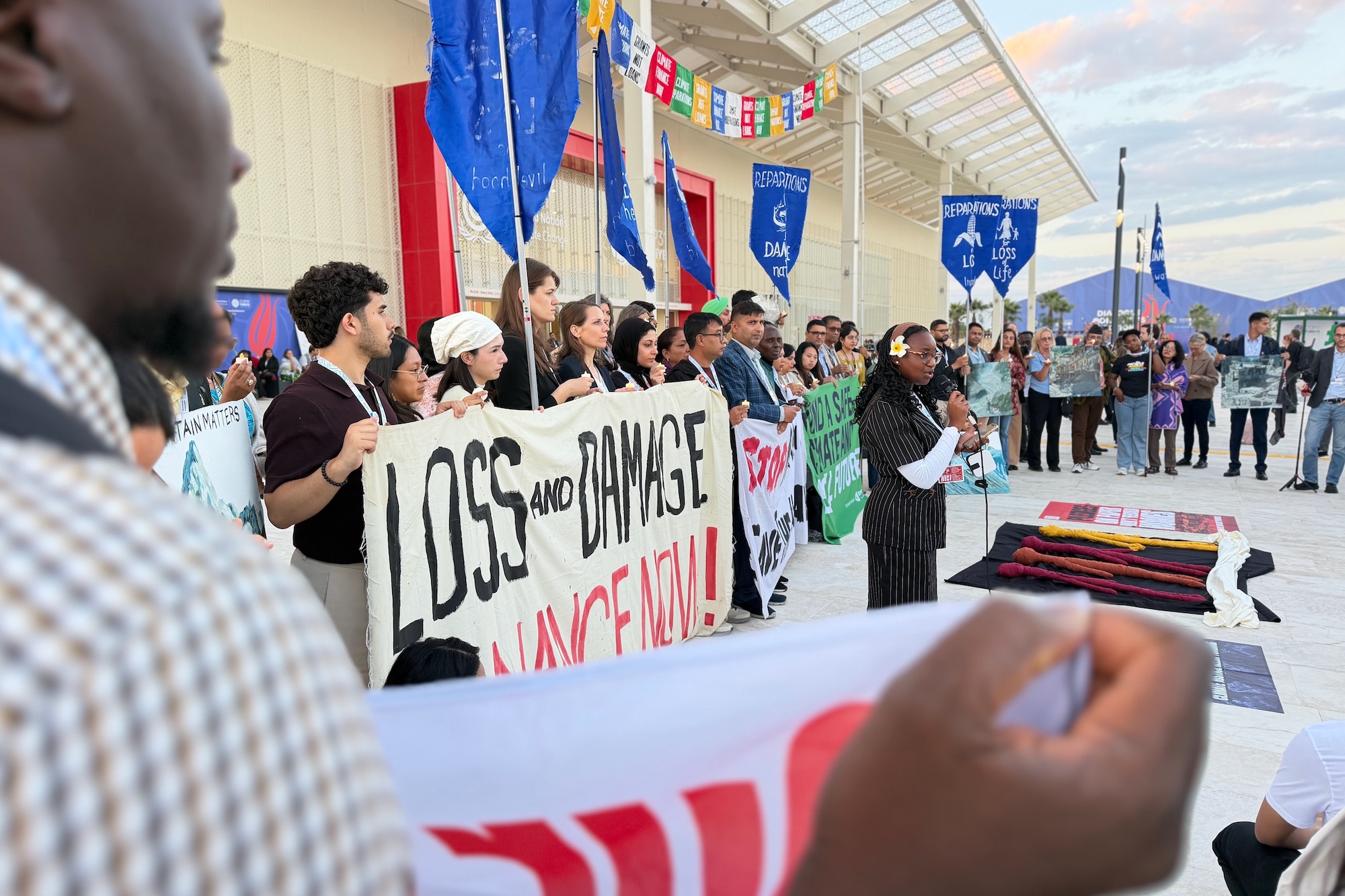
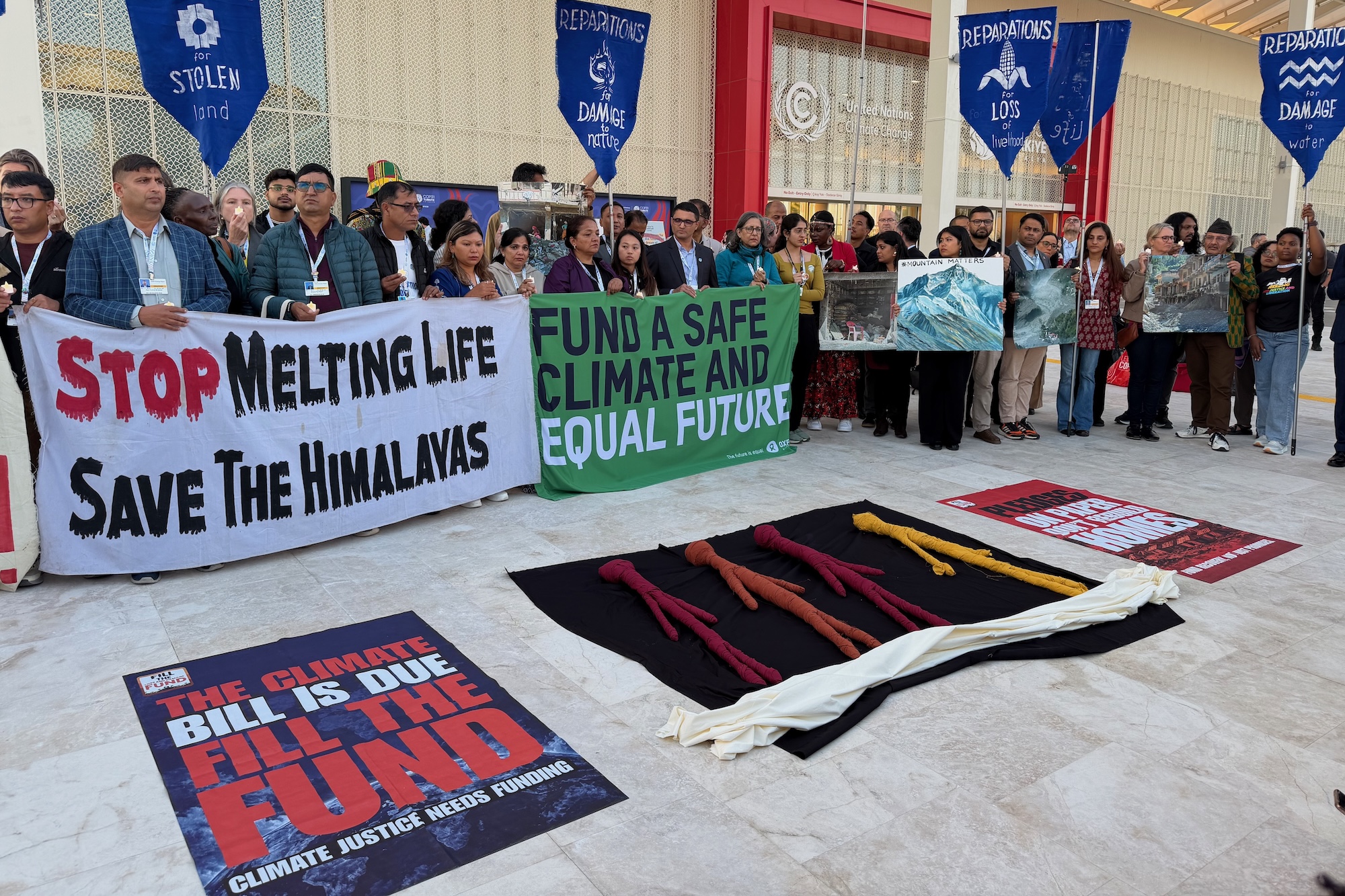
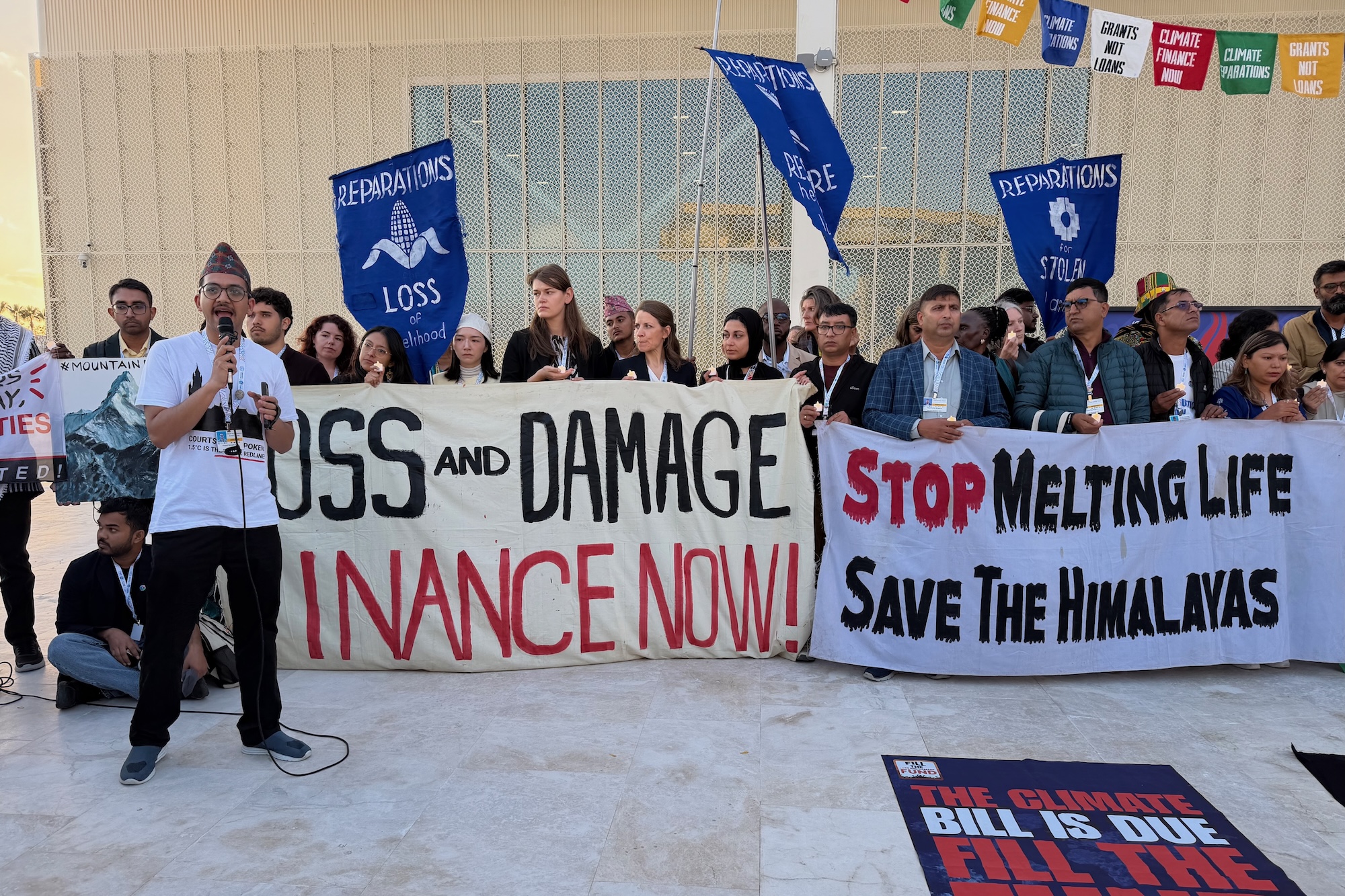
Climate activists protest outside of the COP31 climate talks in Antalya, Turkey, calling on nations to fill the Fund for Responding to Loss and Damage. (Image: Farai Shawn Matiashe)
Nepal requested $21 million from the Fund for Responding to Loss and Damage to help communities recover from the deadly August flash floods. The South Asian country — and every other nation that’s submitted a request — is still waiting.
Climate activists protest outside of the COP31 climate talks in Antalya, Turkey, calling on nations to fill the Fund for Responding to Loss and Damage. (Image: Farai Shawn Matiashe)
Nima Yangji Tamang is living in a temporary disaster shelter outside of Nepal’s capital city, Kathmandu, after flash floods swept away her house in August.
Before she was displaced, the 34-year-old lived on her ancestral lands in the small mountain village Syabrubesi about 120 kilometers (75 miles) from the capital near Lāṅṭāṇ National Park, where the glacier collapse that set off the floods occurred.
“I was working in the field when we heard faint screams,” the mother of two told TriplePundit in the local language, Tamang, through a translator. “Then, my friend got a phone call from his son that a flood was coming … We were not sure how big, but our place has a history of flooding, so I immediately alerted my husband. We had to run.”
The floods did not give Tamang’s family time to grab valuables like their savings or family photographs.
They lost everything.
When the glacier collapsed into a river high in the Himalayas, it caused flash floods and mudslides that rushed down the mountains all the way to the Gyirong Port crossing on the China-Nepal border. The disaster washed away the communities in its path. At least 1,455 people died, and 5,285 people are missing across Nepal’s Rasuwa, Nuwakot, Dhading and Chitwan districts, according to the National Disaster Risk Reduction and Management Authority. Another 13,795 people were rescued.
The loss and damage from the floods — including the destruction of people’s homes, infrastructure damage, and disruptions to livelihoods and essential services — adds up to US$2.7 billion, according to Nepal’s National Disaster Management Authority.
Global loss and damage fund promises hope
At this year’s United Nations climate summit (COP31) in Antalya, Turkey, the Nepal government confirmed that the Fund for responding to Loss and Damage (FRLD) board set aside a provisional US$21 million toward addressing the losses from the August floods. Nepal requested the funds immediately after the climate disaster, but it’s in the midst of a lengthy process that must be completed before it can access the money.
The loss and damage fund was created at the 2022 climate talks (COP27) in Egypt and put into practice at COP28 in the United Arab Emirates the following year. It aims to help vulnerable communities in developing countries recover from climate-induced catastrophes like extreme weather and rising sea levels. A 26-member board, which includes representatives from both developing and developed nations, heads the fund, and the World Bank serves as the interim trustee.
A group of countries that are contributing the most to global climate change pledged to give a combined US$700 million to the fund in 2023, but just a fraction of the promised funding was ever transferred. One of the world’s biggest contributors to greenhouse gas emissions, the United States, pulled out of the agreement in 2025. Around $342 million is currently available, and countries must limit their requests to $21 million per project.
To date, the fund has paid out nothing, despite at least 119 countries submitting requests. Funding those projects alone will require $2.8 billion.
Eligible developing countries submit their proposals to the United Nations Secretariat, which reviews and screens them. The fund’s board must then review the recommended proposals and vote to approve the funding before the World Bank can disburse any money. The process is slow. Nepal has waited over three months in the aftermath of the floods, and the money has yet to be released.
While the government goes through the bureaucratic process, the situation at home is dire, said Prajwol Bickram Rana, a membership engagement coordinator at the global movement World’s Youth for Climate Justice.
“The elderly have no shelter after their homes [were] swept away,” Rana told 3p at COP31. “People are staying in holding centers where they are overcrowded. Ten people are sharing a single room.”
Most families from the affected areas are struggling to feed themselves after the floods destroyed their farmlands, added Rana, who is also a lawyer and climate advocate. “It is difficult for them,” he said.
Hari Rimal lost his farmland in Devighat, a settlement in the Nuwakot District about 75 kilometers (47 miles) from the capital city. The floods also destroyed his business and home, where he had lived for over four decades.
“This was my livelihood,” the father of three told 3p in his local language, Nepali, through a translator. The family is now renting a room in Kathmandu and surviving on food donations.
Shanti BK, another resident of the small mountain village Syabrubesi, is relying on food donations from a disaster shelter after her family of five lost everything. “I am devastated,” the 27-year-old told 3p in the local language, Tamang, through a translator.
Her family survived the floods, but they lost their house and means of livelihood. They are now staying with a relative in a single room in Kathmandu.
“I feel like my identity has been swept away along with everything,” BK said. “My sister, nieces, and I do not feel safe in this city. Where we lived was small, but we were a community unlike here. Everything here is overwhelming.”
Where is the funding?
The loss and damage fund aims to help people affected by climate disasters like Tamang, Rrmal, and BK rebuild their lives. And if the Nepal government receives the $21 million it requested, it will be used to do so, said Prakash Kumar Dahal, a governance and inclusion advisor at the Forum for Protection of Public Interest, a nonprofit advocating for climate justice in Nepal.
In a letter addressed to the loss and damage fund’s board in August, the government of Nepal said it would use the money to help protect affected populations, restore essential services and prevent further suffering. But locals say the funds are not coming quickly enough.
“We need immediate relief,” Dahal told 3p at COP31. “If they provide relief, people might have better hygiene facilities, better sanitation and infrastructure. That is so vital for communities.”
The delay in funding is making the situation worse, Dahal added. “It might take up to one or two years. You never know,” he said. “Yet people are suffering. They have lost everything.”
The amount that can be requested from the fund at once also needs to better match the scale and magnitude of the climate disasters brought by global warming, Dahal argued. If and when the money does come, the provisional $21 million covers just 0.7 percent of the $2.7 billion in damages caused by the August floods. The Nepal government will need to find the rest of the money elsewhere, or submit another request.
Part of the reason Nepal is relying on the loss and damage fund is because it primarily provides grants rather than loans. Loans, which may be offered by international financial institutions, often leave developing countries facing an unsustainable mountain of debt after a disaster. Climate activists in Nepal insist that the government should emphasize grants, not loans, said Rana of World’s Youth for Climate Justice.
Nepal established its own relief fund, where it accepts contributions from nations and organizations, and continues to wait for the loss and damage fund to kick in. Millions of dollars in financial aid and emergency relief has arrived from countries across the globe, including India, the United States, Australia and the United Kingdom. But it still doesn’t cover the cost of the damages.

Calls for urgency
The Fund for responding to Loss and Damage board must learn from its slow response to the floods in Nepal, said Teresa Anderson, the global lead on climate justice at ActionAid International.
“They have realized that they need to respond quickly, as they said [when the fund was established]. They did not know how to do so when they set up the funds,” she said. “Now, they are learning, and we hope that they continue to learn those lessons and institutionalize things, to move faster.”
To move quickly, the board must allow government ministries to directly access the funds, remove administrative hurdles, simplify eligibility checks, and introduce a rapid disbursement window with dedicated funds to deliver some support immediately after disasters, Dahal said.
Still, the ultimate responsibility lies with the wealthy countries, which have not given enough money to the fund, ActionAid International’s Anderson said.
“Rich countries are not prioritizing the collective survival of people on planet Earth,” she added. “We know that there are elites and mega-corporations who are earning billions every day, and policymakers and politicians are unwilling to tap into the money that is accumulating in elite bank accounts.”
The board is still finalizing the distribution process, leaving Nepalis in wait for the funds to rebuild the livelihoods of flood survivors and reconstruct homes, bridges, roads, power plants, health facilities and schools.
“I still have hope,” Tamang said. “I want to go back and rebuild our family home.”

Farai Shawn Matiashe
Farai Shawn Matiashe is a journalist based in Mutare, Zimbabwe, who writes for The Guardian, CNN International, The Economist, The Africa Report, African Business and the Thomson Reuters Foundation. Farai, who has reported across Africa, Asia, Europe and the Americas, is passionate about reporting from rural areas.