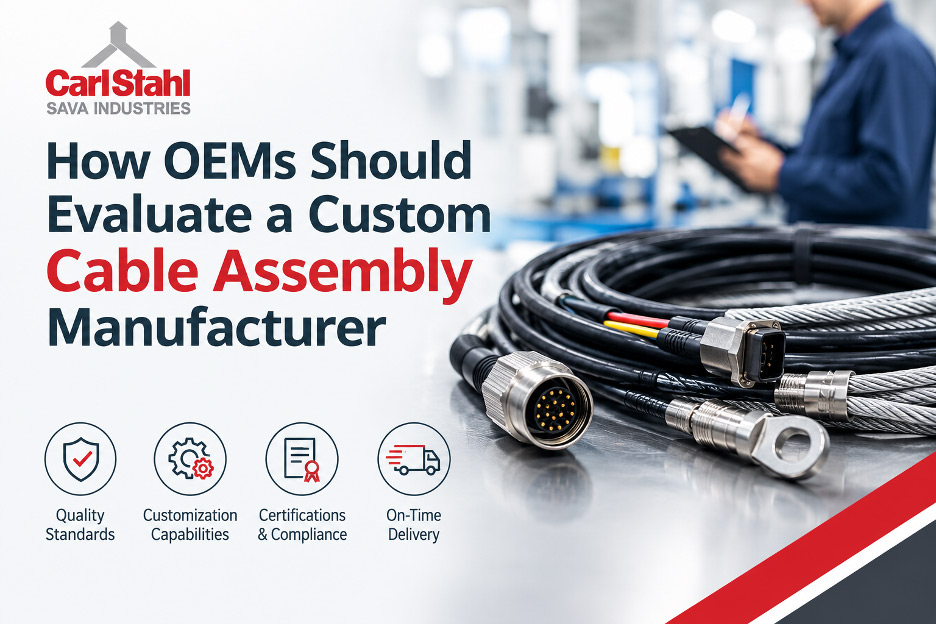
For OEMs, a cable assembly is often a small but important part of a much larger mechanical system.
The assembly may control movement, transfer force, connect mechanical components, or operate within a tightly constrained installation space. Because of this, choosing a custom cable assembly manufacturer involves more than comparing prices and standard product specifications.
Custom assemblies are developed around the requirements of a specific application. Cable construction, material, finished length, termination style, fittings, routing, flexibility, and operating conditions can all influence the final configuration.
A capable manufacturer should therefore be able to work with OEM engineering teams from the initial concept through prototyping and repeat production. Evaluating that capability carefully can help OEMs avoid design problems, improve assembly consistency, and establish a more reliable supply relationship.
The best custom cable assemblies begin with a clear understanding of the application.
Instead of selecting a cable first and trying to adapt it to the equipment, OEM engineers should identify how the completed assembly will function. Important considerations can include operating load, movement, travel distance, installation space, bend radius, cycle frequency, attachment points, and environmental exposure.
For example, a cable assembly installed inside compact equipment may require a small and flexible construction. An assembly used in industrial machinery may require greater strength or resistance to repeated movement.
These differences can significantly influence the final design.
For applications that require a configuration developed around specific mechanical requirements, custom cable assembly solutions can provide greater flexibility than standard cable products.
A custom cable assembly is not defined only by its length.
Depending on the application, customization may involve the cable construction, diameter, material, termination, end fitting, coating, dimensional tolerance, or combination of components.
An OEM may require:
- A specific cable diameter or construction
- Stainless steel or galvanized cable
- Coated or protected cable
- Precise finished assembly length
- Specific end fittings
- Custom termination configurations
- Defined dimensional tolerances
- Flexible routing through restricted spaces
- Assemblies designed for repeated movement
- Prototype quantities before production
Each of these requirements can affect the performance and manufacturability of the finished assembly.
A manufacturer should therefore evaluate the complete requirement rather than treating the cable as an isolated component.
Engineering support is one of the most important factors when selecting among custom cable assembly manufacturers.
OEM development teams do not always begin with a complete cable specification. They may provide a mechanical drawing, installation dimensions, required travel, operating load, or functional description and expect the manufacturer to help develop the appropriate assembly.
The manufacturer may need to recommend:
- Cable construction
- Cable material
- Finished length
- Termination method
- End fittings
- Component dimensions
- Assembly tolerances
- Routing considerations
Early engineering input can identify potential problems before production begins.
For example, a proposed cable may provide adequate strength but lack the flexibility required for repeated movement. A fitting may appear compatible with the equipment but may not provide the desired retention. A termination may also require a different configuration to meet the application’s mechanical requirements.
A manufacturer capable of identifying these issues early can help reduce redesigns and production delays.
The cable itself is an important part of the custom assembly design.
Different cable constructions provide different combinations of strength, flexibility, fatigue resistance, and handling characteristics. The appropriate construction depends on how the completed assembly will operate.
An assembly that must move repeatedly may require different characteristics from one used primarily for positioning or load transmission.
OEM engineers should therefore discuss the intended operating conditions with the manufacturer rather than selecting a cable solely based on diameter or breaking strength.
The manufacturer should be able to explain how construction choices affect the finished assembly and recommend an option appropriate for the application.
Material selection can also influence the performance and service life of a custom cable assembly.
Stainless steel, galvanized steel, coated cable, and other materials may offer different combinations of corrosion resistance, strength, flexibility, and environmental durability.
The operating environment should guide the selection.
For example, an assembly exposed to moisture or corrosive conditions may require a different material strategy from one operating inside controlled equipment. Applications involving frequent movement may also require careful consideration of cable construction and fatigue performance.
An experienced manufacturer should be able to discuss these tradeoffs with the OEM engineering team and explain why a particular material is appropriate.
The ends of a custom cable assembly are just as important as the cable itself.
Terminations determine how the assembly connects to the surrounding equipment and how mechanical forces are transferred. The fitting must also be compatible with the installation method and available space.
OEMs should define termination requirements early in the design process.
Depending on the application, the assembly may use different end configurations or specialized components. The manufacturer should be able to evaluate whether the selected termination is compatible with the cable construction and intended operating conditions.
Related components such as cable fittings can also play an important role in creating an assembly that integrates correctly with the OEM’s equipment.
Treating the fitting as an afterthought can create avoidable installation or performance problems.
Many custom mechanical cable applications use wire rope assemblies where flexible force transmission, positioning, or controlled movement is required.
The wire rope construction and termination must work together as one assembly. Strength, flexibility, routing, bend radius, and repeated cycling can all affect the final configuration.
For OEMs, this means that selecting the correct wire rope alone is not necessarily enough.
The manufacturer should understand how the wire rope will interact with fittings, pulleys, attachment points, and other components within the equipment.
This system-level approach can be particularly valuable when the assembly operates in a compact or mechanically demanding environment.
A custom cable assembly that looks correct on a drawing may behave differently once installed in the actual equipment.
Prototyping provides an opportunity to test the physical assembly before committing to larger production quantities.
OEM teams can evaluate:
- Assembly dimensions
- Cable routing
- Installation clearance
- Termination fit
- Flexibility
- Operating travel
- Component interference
- Connection points
- Overall mechanical performance
Prototype testing can reveal issues that may not be obvious during the initial design stage.
A manufacturer that can support prototype quantities can also help OEMs move more efficiently from concept to validation and eventually into production.
Once the design has been finalized, manufacturing consistency becomes critical.
An OEM may require hundreds, thousands, or more assemblies over the life of a product. Small variations in cable length, termination position, component alignment, or assembly dimensions can affect installation and performance.
OEMs should therefore ask potential suppliers about their manufacturing controls.
Important questions include:
- How are incoming materials inspected?
- How are cable lengths verified?
- How are termination dimensions controlled?
- How are fittings installed and inspected?
- What testing is performed?
- How are production tolerances established?
- How are engineering changes documented?
- How is repeatability maintained between production runs?
The answers can help OEM teams determine whether a supplier is prepared to support long-term production.
A successful prototype does not automatically guarantee successful production.
OEMs should determine whether the manufacturer has processes capable of reproducing the approved assembly consistently.
This includes controlling materials, dimensions, termination positions, component specifications, and other characteristics established during development.
A strong manufacturing process should make it possible to produce subsequent batches according to the same approved requirements.
This is especially important when the cable assembly becomes part of a larger product that is manufactured repeatedly.
OEM production requirements can change significantly over time.
A project may begin with a small number of prototypes, progress to a pilot build, and eventually require much larger quantities.
The cable assembly manufacturer should be able to support this transition.
During supplier evaluation, OEMs should ask how the manufacturer manages the move from prototype to production and whether engineering support remains available after the initial development stage.
A scalable manufacturing relationship can reduce the need to qualify a new supplier as production volumes increase.
A manufacturer’s experience with similar applications can also be valuable.
Different equipment types can create different cable assembly requirements. Compact mechanisms may require specialized routing and small assemblies. Industrial machinery may require durable components and repeated-cycle performance. Automated equipment may require consistent movement and precise dimensions.
Relevant application experience can help a manufacturer understand common challenges and identify practical solutions.
However, industry experience should complement, not replace application-specific engineering. Every custom assembly should still be evaluated according to the actual requirements of the OEM’s equipment.
OEMs should also consider whether the supplier can support related requirements as the product evolves.
A project may begin with one custom cable assembly but later require additional cable configurations, different terminations, related fittings, pulleys, or other mechanical components.
Working with a manufacturer that has broader cable and mechanical component capabilities can simplify communication and sourcing.
It can also create a longer-term engineering relationship rather than limiting the supplier relationship to a single assembly.
Clear communication is essential when developing a custom assembly.
The manufacturer should be able to work from drawings, specifications, dimensional requirements, and other technical information supplied by the OEM.
As the project progresses, changes should also be communicated clearly between engineering and manufacturing teams.
Documentation can help ensure that the approved assembly is reproduced accurately during future production runs.
OEMs should therefore evaluate not only the manufacturer’s physical production capabilities but also its ability to communicate technical requirements consistently.
Before approving a custom cable assembly manufacturer, OEM procurement and engineering teams should evaluate several areas.
A practical checklist should include:
- Custom assembly experience
- Engineering and design support
- Cable construction options
- Material selection
- Termination capabilities
- Fitting options
- Prototype support
- Manufacturing controls
- Quality inspection
- Testing capabilities
- Production scalability
- Documentation and communication
- Ability to support future design changes
The goal should not simply be to select the supplier offering the lowest initial price.
A poorly matched assembly can result in installation problems, redesigns, inconsistent production, equipment downtime, or increased manufacturing costs.
The right supplier should provide value throughout the complete product lifecycle.
The strongest OEM relationships often begin before the final assembly specification has been completed.
When the engineering team and manufacturer communicate early, potential issues can be identified while design changes are still relatively easy to make.
This can lead to better material selection, more practical terminations, improved manufacturability, and a smoother transition into production.
For OEMs, the ideal custom cable assembly manufacturer is therefore more than a component supplier. It should be capable of understanding the application, contributing engineering knowledge, producing prototypes, controlling production quality, and supporting changing requirements over time.
Selecting a manufacturer based on these capabilities can give OEM teams a stronger foundation for developing reliable mechanical systems.
For companies looking for a supplier with experience in custom cable and mechanical assembly solutions, Sava Cable provides custom assembly capabilities along with cable, wire rope, fittings, and related components for OEM applications.