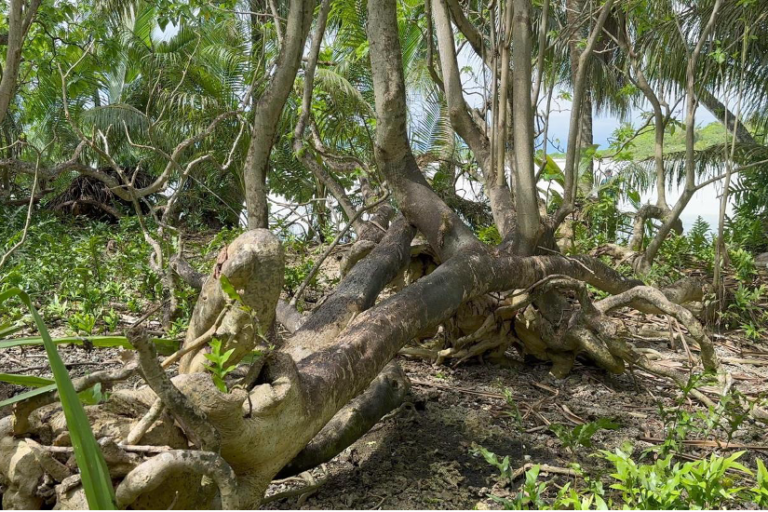
Palmyra Atoll in the North Pacific is one of the most remote island systems on Earth. A native rainforest tree on the island performs a critical ecological service by providing nesting sites for thousands of seabirds, whose guano fuels the surrounding coral reefs. But a new study revealed that this entire cycle depends on an invisible partner: Symbiotic mycorrhizal fungi. Researchers mapped the fungal diversity across the atoll and discovered the native pisonia (Pisonia grandis) trees have a 100% with a specific genus of fungi called Tomentella — meaning the trees depend on the fungi to survive. These fungi capture intense pulses of nitrogen and phosphorus from bird guano that would otherwise wash into the ocean. This relationship was present in every tree the team sampled. “Most ectomycorrhizal fungi struggle in extremely nutrient-rich soils, but the Tomentella fungi associated with Pisonia appear to be adapted to the high phosphorus levels created by seabird guano,” study co-author Alex Wegmann told Mongabay over email. “This suggests a long evolutionary partnership between the fungi, the trees, and the massive seabird colonies that shape these atoll ecosystems.” The discovery has major implications for the ongoing effort to restore Palmyra’s native forests by removing 1.5 million invasive coconut palms. The study found that Tomentella abundance drops off sharply when there are more than 250 meters (820 feet) away from a pisonia tree. Therefore, natural regeneration might fail in large areas cleared of coconut palms, because the necessary fungi aren’t present in the soil, the study…This article was originally published on Mongabay