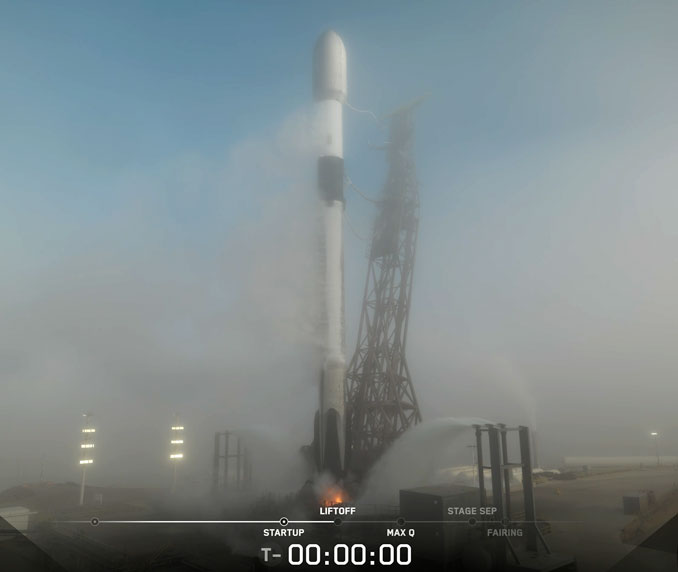
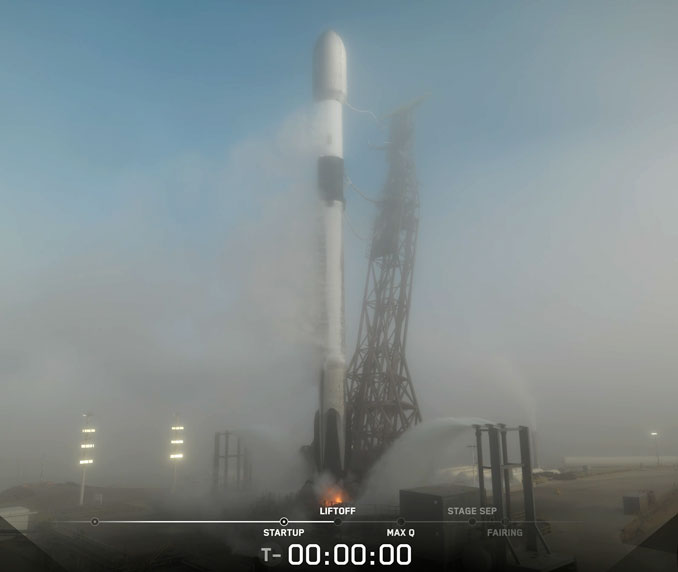
Update July 20, 11:18 a.m. EDT (1518 UTC): SpaceX aborts the mission after ignition.
SpaceX suffered its second launch scrub in less than a week after its Falcon 9 rocket failed to launch from Vandenberg Space Force Base on Monday.
On-screen telemetry graphics showed all nine Merlin engines briefly ignited before quickly shutting down. SpaceX ended its broadcast prior to offering an explanation and didn’t immediately share further details on social media.
“Standing down from today’s Starlink launch; vehicle and payload remain safe,” SpaceX wrote in a brief post on X.
The Starlink 17-39 mission was set to add another two dozen of SpaceX’s Starlink V2 Mini broadband internet satellites to its massive low Earth orbit constellation. Liftoff from Space Launch Complex 4 East was timed for 7:49 a.m. PDT (10:49 a.m. EDT / 1449 UTC). The company’s website now lists the next launch opportunity as being Tuesday during a window that opens at 7 a.m. PDT (10 a.m. EDT / 1400 UTC)
The Starlink 17-39 mission was using the Falcon 9 first stage booster B1082. This was going to be its 23rd flight after launching the NROL-145, USSF-62, and OneWeb Launch 20 missions, plus 19 Starlink deliveries.
Rare setbacks
The Monday morning mission was scheduled to be the 85th Falcon 9 rocket launch of the year and the 667th to date.
The last time a Falcon 9 launch encountered an abort after engine ignition was June 14, 2024 during the Starlink 10-2 mission launch attempt. That mission ultimately launched on June 23, but using a different first stage booster.
This launch abort came just days after a similar post-ignition abort of SpaceX’s Starship-Super Heavy rocket from down at its Starbase facilities in southern Texas. The company had to scrub the Flight 13 launch attempt and founder Elon Musk announced that at least two Raptor engines would need to be “removed and replaced.”
SpaceX is currently targeting Thursday, July 23, for its next attempt to launch the Starship Flight 13 mission, but a tropical disturbance in the Gulf of Mexico might be another obstacle for the test flight.
Starship and the Super Heavy booster both use Raptor engines, fueled by liquid methane, while the Falcon 9 rocket is powered by kerosene-fueled Merlin engines.