NASA and China’s national space agency plan to send crewed missions to Mars in the coming decades. Per NASA’s Moon to Mars mission architecture, this will involve using infrastructure established through the Artemis Program to send crews to the Red Planet sometime in the 2030s or 2040s. Similar to Artemis, these missions will culminate in the creation of habitats that will facilitate long-duration exploration and research. Naturally, this presents many challenges, including lengthy deep-space transits and the hazards of extended periods in microgravity.
However, crewed missions will also face significant challenges upon arrival, such as the dangers of working in Mars’ thin, unbreathable atmosphere, extreme temperature variations, and elevated radiation levels. Fortunately, these challenges are inspiring innovative concepts from space agencies, their affiliated research institutes, and commercial partners. In a recent report, the Bioastronautics and Life Support Systems (BLiSS) team at the University of Michigan proposed an active, pressurized tunnel system to connect habitats on the Martian surface.
Their concept is described in the paper “LATCH: Lightweight Actuated Tunnels for Crewed Habitation,” which was submitted to the annual Moon to Mars eXploration Systems and Habitation (M2M X-Hab 2026) Academic Innovation Challenge. The report is one of several projects NASA selected under the X-Hab program, an incentive challenge administered by the National Space Grant Foundation (NSGF) that invites university students nationwide to provide concepts prototypes, and lessons learned that will help shape future space missions.
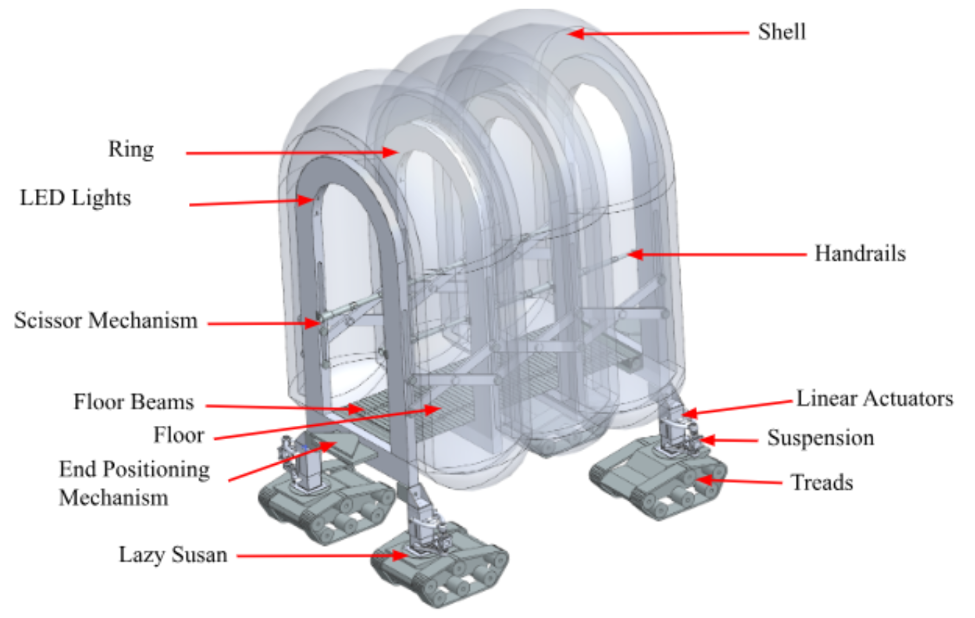 *Full Tunnel Extended with Components Labeled. Credit: BLiSS team/NTRS*
Dr. Nilton Renn, the John R. Barker Collegiate Professor in Planetary Sciences and Space Engineering at the University of Michigan, is the BLiSS team’s Principal Investigator. Dr. Tracie Prater, an esteemed aerospace and mechanical engineer at NASA’s Marshall Space Flight Center and a materials and processes engineer at United Launch Alliance, served as the Project Sponsor.
Challenges
Regardless of the location – the Moon or Mars – maintaining a continuous human presence requires a lot of movement. This means the movement of crews and cargo from the surface to orbit, and between surface assets – i.e., habitats, vehicles, landing pads, etc. Given the nature of the lunar and Martian environments, this will require crews to don spacesuits and conduct Extravehicular Activities (EVAs) every time. This is a time-consuming process that requires hours of preparation (pre-breathing oxygen), suiting up, airlock depressurization, and post-EVA cleanup.
This process takes a full day to complete, and also places crewmembers at risk of decompression and exposure to elevated radiation. Similarly, crews must remain in their spacesuits when entering or leaving the Mars Ascent Vehicle (MAV), which is cumbersome given the size of the suits themselves. The need for pressure suits during ascent and descent also adds mass to the vehicle’s overall load, increasing costs and the propellant required. As the team describes in their report:
In fact, preliminary analysis of the Mars Ascent Vehicle (MAV) used by crew to get to and from the Martian surface shows that each EVA suit requires 560 kilograms more propellant than an Intra-Vehicular Activity (IVA) suit would require. Additionally, EVA suits take up volume in the launch vehicle, roughly the size of a person. This would require a larger cabin size, which in turn would require more propellant mass.
To eliminate this burden, the HATCH team proposed a “lightweight pressurized tunnel system [which can] provide active positioning and berthing between crewed surface assets on Mars.” This concept would consist of tunnels that could be deployed as needed for transits, then retracted when not in use. Such tunnels would reduce transit times to and from habitats and landing pads from a full day to just a few minutes.
“The project calls for the development of concepts for a ‘lightweight pressurized tunnel system’ which can ‘provide active positioning and berthing between crewed surface assets on Mars,'” the team writes.
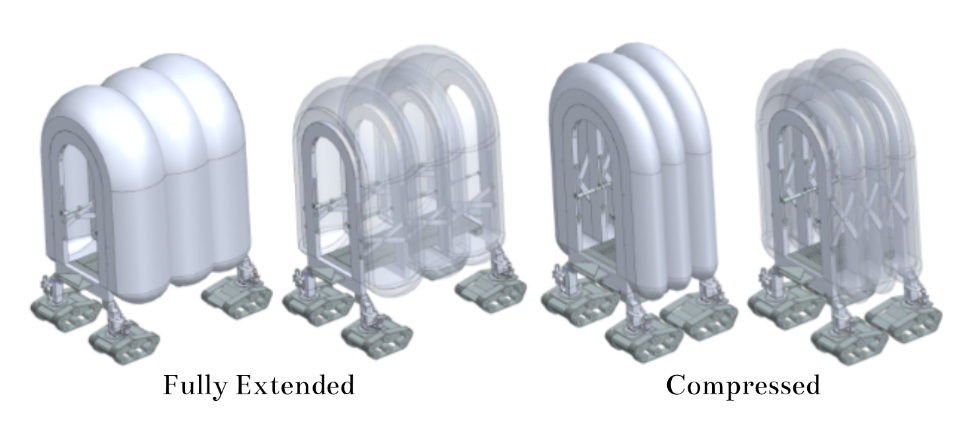 *Full Tunnel Model with Different Views. Credit: BLiSS team/NTRS*
Design
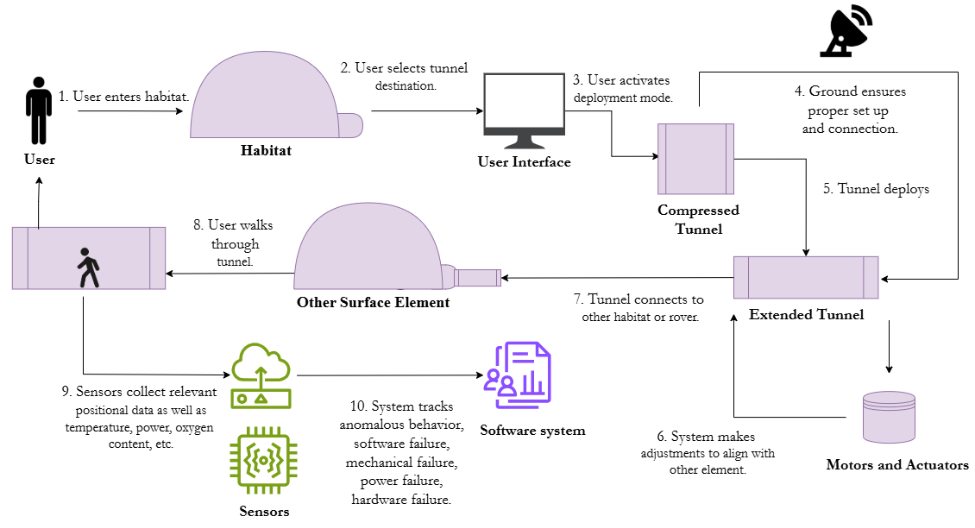
Each tunnel consists of an inflatable shell, structural rings, a passive extension mechanism (driven by motors and actuators), extendable handrails and tracks, and tread units mounted to each section. These tunnels are then integrated with each airlock on the habitat, which the crew can extend using the User Interface (UI). The UI will also allow crew members and ground controllers to view the tunnel’s status, which will be routinely monitored by sensors for leakage, contamination, or system faults.
The process begins with the crew member selecting a destination (the MAV or another surface element), then instructing the UI to extend the tunnel towards its hatch. The passive extension mechanism also allows crew members to make fine adjustments to its path, while sensor data and ground-controller monitoring provide feedback for alignment and trajectory correction. Once the tunnel is fully extended and both ends are secured, the tunnel will slowly pressurize with oxygen and nitrogen gas.
Once pressurized and the environment is confirmed safe by the sensors and ground control, the tunnel is used to allow up to two crew members to walk through it carrying cargo. During their transit, crew members not using the tunnel will be informed by the UI of any sudden safety issues. In the event of an emergency, alert systems will be activated automatically (lights, handrails, and other needed support systems) to help ensure the crew members safely reach the other side of the tunnel.
When not in use, the tunnels will be depressurized and retracted. This will prevent the tunnels from accumulating radiation inside and Martian dust on the outside. Maintaining them in the retracted position between usage also ensures that they are less vulnerable to debris damage.
Testing and Risk Assessment
As part of their proposal, the BLiSS team provided full Computer-Assisted Design (CAD) models and a prototype demonstrator of the tunnel and actuation system (along with the control software) for testing. In addition, a comprehensive risk matrix was developed to identify and assess potential hazards that could impact the success of future missions. This allowed the BLiSS team to identify various technical, schedule, cost, and safety-related risks that could compromise the functionality and safety of their system.
One notable risk involved the possibility of the structure yielding while astronauts are inside, leading to potential injury or death. To mitigate this, they proposed adding additional floor beams and/or a roll-out floor to support increased loads or accidents (e.g., cargo being dropped). The team also took measures to mitigate the risk of inaccurate berthing that could render the system unusable, including a multi-sensor fusion approach using LiDAR and computer vision. This would allow for cross-validation between sensors, enabling course correction and fine-motion detection.
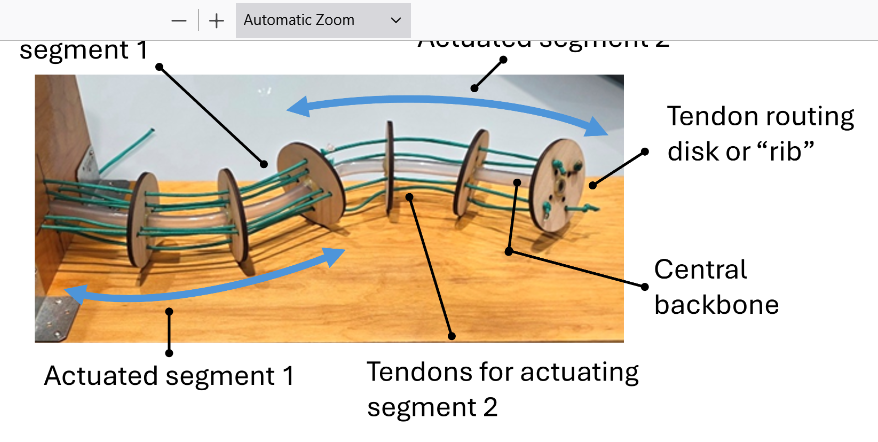 *Prototype of a two-tendon actuator showing the system components and independent articulation of each segment. Credit: Baldwin Wallace University team/NTRS*
“By implementing robust mitigation measures and continuously monitoring and reassessing risks throughout the project life cycle, we aim to minimize disruptions and maximize the effectiveness of our tunnel system in supporting crew transportation between surface assets during space missions,” they state.
A similar concept submitted by the Baldwin Wallace University Engineering Department was the Tunnel Ready Elements for Active Deployment (T.R.E.A.D). Their concept is also in keeping with the goals of the 2026 M2M X-Hab Challenge: to create a system of extending tunnels that will connect surface elements on Mars, emphasizing reusability and preventing the accumulation of buildings and tunnels on the surface that no longer serve mission objectives.
For their proposal, the Baldwin Wallace team conceived a double-tendon-based actuation system with pressurized bladders. Each set of tendons consists of four individual cables controlled via a winch system, with the first set controlling the initial half of the tunnel’s curvature and the second controlling the final stretch. The tendon system also serves as a primary means of retraction and provides the necessary flexibility to bend and adjust to uneven terrain.
These and other concepts are merely some of the latest proposals for how astronauts will live and work in the extraterrestrial environment of Mars. As the 2030s approach, NASA and other space agencies will continue to ramp up their preparations for sending crewed missions to the Red Planet. The methods used and the lessons learned from these missions will likely inform the blueprint for off-world living should humanity embark on a path that leads us to become “interplanetary” someday.
Further Reading: NASA Technical Reports Server (NTRS)