(This is Part 2 of a series on what would happen if the Sun stopped. Read Part 1 first.)
When you crank up your stove to heat a pan to cook your eggs, you have to wait a while. It takes time for the heat to work its way into the metal. Once the pan is hot enough you cook your eggs, and when you’re done you can sit and eat them while the pan slowly cools back down on its own.
The Sun is slightly larger than a stovetop pan, but the same basic physics applies. Once upon a time the Sun, or rather the cold cloud of gas and dust that would become the Sun, was cold. Now it is hot. It took time to become hot. And the surface of the Sun is exposed to the frigid vacuum of space, constantly radiating its warmth away into the dark, constantly cooling off.
All of which means fusion isn’t the hot pan itself. Fusion is the flame underneath it. Fusion keeps the Sun warm. Take the flame away, and the Sun stays warm anyway, at least for a while, because like every hot thing it takes time to cool down.
In fact, the rate of fusion is tuned with remarkable precision to keep the Sun just barely warm enough to avoid catastrophe, through a not-so-magical process called hydrostatic equilibrium.
Here’s how it works. The Sun is a giant ball of gas, so giant that its own gravity is forever trying to pull it tighter. And when a giant ball of gas gets squeezed into a smaller volume, it heats up. Back in the 19th century, astronomers were genuinely stumped about how the Sun had managed to stay warm for so long. So in 1854 a German aristocrat named Hermann von Helmholtz suggested that maybe it kept warm simply by slowly shrinking. Start with a big ball of gas, let it compress, watch it heat up, let that heat escape as lovely sunshine, let it compress a little more, and keep the whole cycle running.
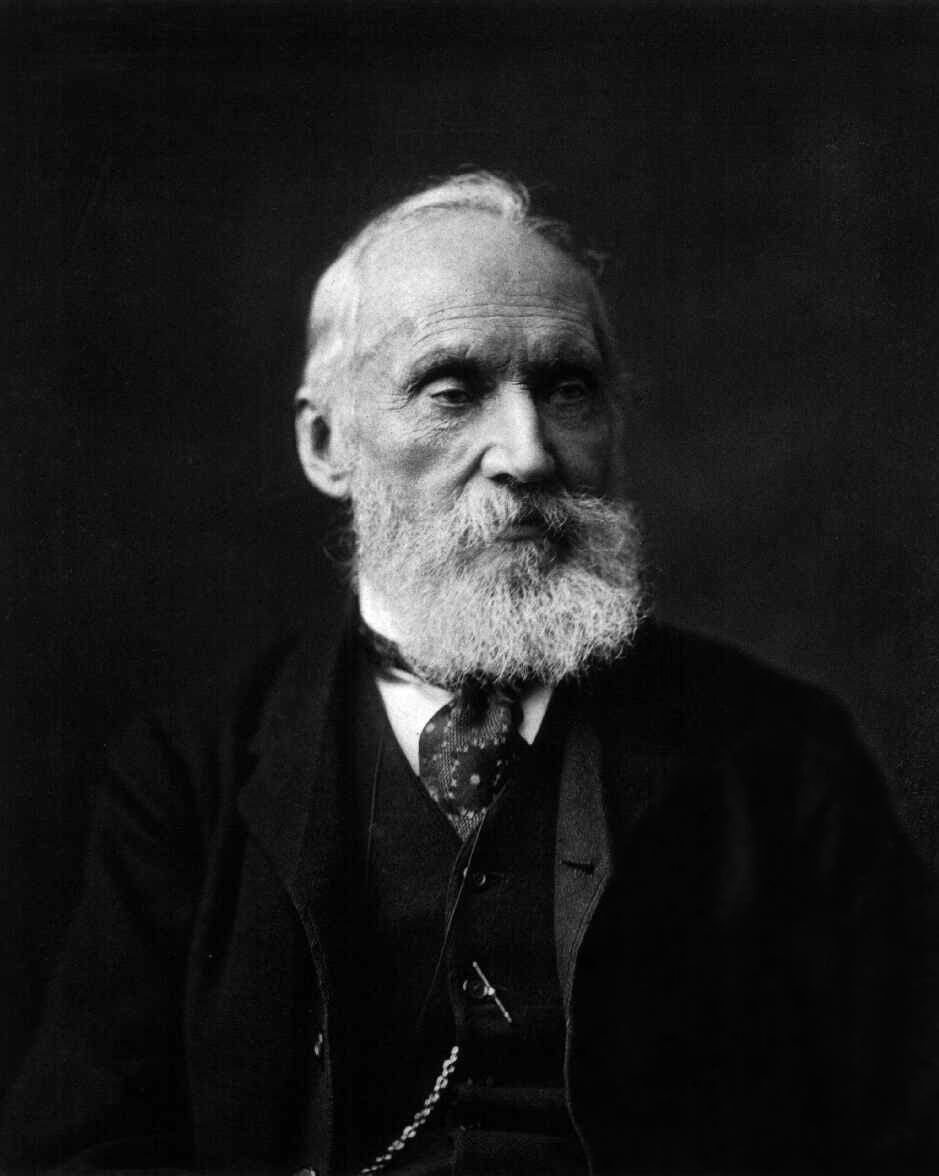
A decade later another aristocrat, because this was very much the age of “if you want to be a scientist it helps enormously to be independently wealthy,” took up the problem. William Thomson, the first Baron Kelvin, Lord Kelvin to us plebes, ran more careful calculations to pin down the lifetime of the Sun. And he got the wrong answer.
He flirted with a few possibilities but generally landed somewhere around a few tens of millions of years. A long time, certainly. But badly out of step with what the geologists, and later the biologists, were finding. They were arriving at ages for the Earth in the hundreds of millions, even billions, of years. For decades afterward astronomers were the butt of jokes in scientific circles (I have no interest in discussing any present-day parallels), in part because Lord Kelvin had been so loudly, publicly confident about his numbers, which were, as noted, very wrong. It took until the 1920s and the birth of nuclear physics before anyone could propose a power source that would let the Sun burn for billions of years.
But even though Lord Kelvin was wrong, he was wrong in a deeply useful way. Because he knew nothing of fusion, it is precisely his calculations that we will use to work out what happens if fusion shuts off. So, thanks, I suppose.
And here is the genuinely beautiful part: nuclear fusion regulates itself. If the Sun contracts a little, the core compresses, more protons get the chance to speed-date one another, and the fusion rate climbs, which heats the core and pushes it back outward, cooling things off. And if the Sun puffs up a little, the fusion reactions slow, the pressure drops, and the Sun settles back down. A thermostat with no moving parts.
In other words, and the thermodynamics nerds among you will get a real kick out of this, the Sun actually heats up as it loses energy. That sounds completely backward, but nature is under no obligation to be intuitive, especially where self-gravitating systems are concerned.
The fusion is dialed in just right to keep the Sun from either exploding in a blaze of glory or collapsing into a black hole. And it turns out that “just right” is not very much fusion at all. Fusion is a trickle topping off a vast reservoir of stored heat, just barely enough to keep the lights on, no more and no less. Which means that if fusion shuts off, we still have all that heat banked inside the body of the Sun, and we still have the Kelvin-Helmholtz mechanism (yes, Helmholtz proposed it first, but Kelvin-Helmholtz simply rolls off the tongue more easily, sorry Hermann) standing ready to keep the Sun powered even longer, just by letting it shrink.
In other words, the Sun is hot because it’s hot. Fusion only keeps the lights on. And because the Sun is gigantic and crowded and complicated and messy, changes inside it take a very, very long time to make themselves felt.
Case in point: the photons.
In Part 3, we follow a single photon on its absurd hundred-thousand-year journey out of the Sun, and discover that the sunlight on your face is older than human civilization.