
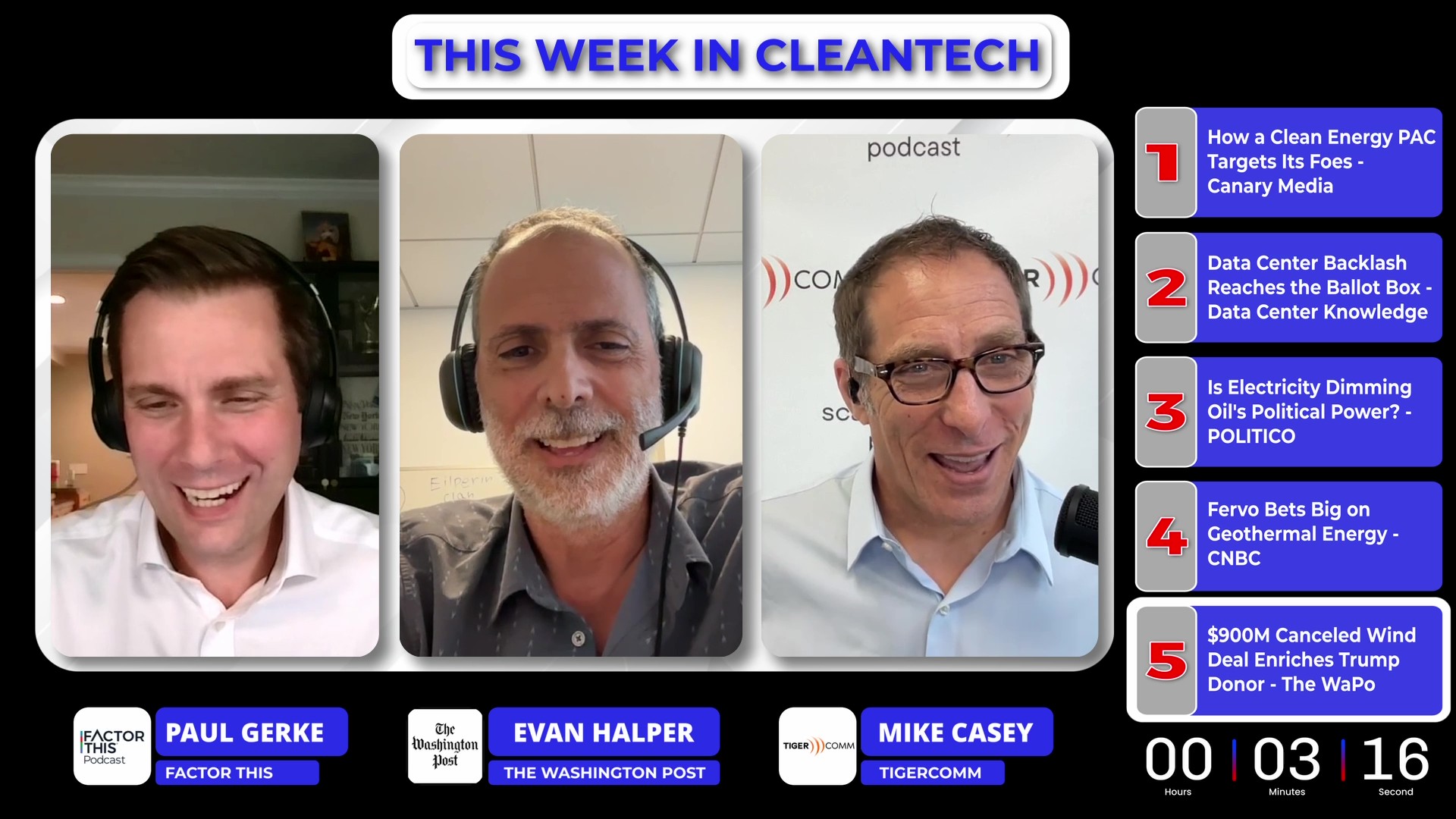
This Week in Cleantech is a weekly podcast covering the most impactful stories in clean energy and climate featuring Paul Gerke of Factor This and Tigercomm’s Mike Casey.
This week’s episode features special guest Evan Halper from The Washington Post, who breaks down new drama surrounding the Trump administration’s settlement requiring RWE to abandon offshore wind leases in exchange for $1.2 billion.
This week’s “Cleantecher of the Week” is Emily McAteer, co-founder and CEO of Odyssey Energy Solutions, which just closed $74 million to scale a platform that connects more than 6,000 solar installers and EPCs across 50-plus countries in Africa, Asia, and Latin America with financing and bulk equipment procurement. The company’s already facilitated $3.6 billion in capital and unlocked 1.5 gigawatts of distributed solar projects, with activity in India up 205% over the past year.
The Invest in Tomorrow Coalition (ITC) has raised commitments for $20 million this cycle and gone five for five in the Republican primaries it’s touched, with Ogles, along with Chip Roy, and Ralph Norman losing after ITC money came in against them. Against Roy and Norman, the message hammered them for not being Trump-enough, after ITC tested which lines actually moved conservative voters. Tom Matzzie said the industry needed to prove it’s not an industry people can hurt without consequences.
At least 18 incumbent officeholders have lost elections over the past year after taking action on a data center project or getting tied up in a fight over one. In Utah, State Senate President Stu Adams lost his primary after getting linked to the Stratos data center project. In Utah’s Box Elder County, commissioner Lee Perry said the data center vote is what cost him the race. Then there’s Missouri, which got hit even harder. Four Festus city council members lost their seats over a $6 billion data center project, three who voted yes and one who voted no.
Political fortunes used to rise and fall with the price of gas. Reporter Ben Storrow makes the case that electricity is starting to take over that role, and it’s happening on both sides of the Atlantic. In the UK, new Prime Minister Andy Burnham killed a tax on electricity his first day in office. France’s Marine Le Pen wants to slash power levies too and pull out of Europe’s electricity market entirely.
Here in the US, Governors Josh Shapiro and Greg Abbott are now putting restrictions on data centers because voters are furious about their bills. Fatih Birol from the International Energy Agency said when people ask if energy is cheap, he quotes the price of oil, but soon he’ll be quoting cents per kilowatt-hour instead.
Phase 1 of Fervo Energy’s Cape Station project in Utah will connect to the grid next month. And the company just signed a deal for Cape Station to supply 400MW of electricity to Google. Fervo is using oil and gas drilling and fracking techniques, with horizontal wells over a mile long, which could make geothermal work almost anywhere.
This is the first enhanced geothermal system in the world to reach commercial operation. Fervo CEO Tim Latimer told reporter Pippa Stevens that hyperscalers are going to be a big part of the enhanced geothermal opportunity moving forward, since they need 24/7 reliable electricity that can come online fast.
The Trump administration’s settlement requiring RWE to abandon offshore wind leases in exchange for $1.2 billion is directing $900 million toward a stake in the Louisiana LNG project, purchased from Stonepeak, a private equity firm run by Michael Dorrell, an Australian billionaire and major Trump donor who owns a home near Mar-a-Lago. Administration officials and RWE deny any coordination on the beneficiary, saying the choice was RWE’s own business decision, while critics note the deal doesn’t add new capital to the project but instead lets Dorrell’s firm reduce its financial exposure. Democratic lawmakers, including Rep. Jared Huffman, are expanding investigations into the settlement and pushing to force the money back to the Treasury, calling the arrangement corrupt and part of a broader, legally contested effort to unwind offshore wind development.