Generator interconnection, the process by which power plants like large solar arrays, wind farms, and utility-scale batteries connect to the electrical grid, continues to be one of the biggest barriers to project development.
Despite gradual improvement in some parts of the United States since the Federal Energy Regulatory Commission (FERC) passed Order No. 2023 three years ago, messy, complicated, and sometimes outdated policies are still preventing electrons from reaching end customers at a time of skyrocketing electricity demand. Grid operators have made meaningful strides in reducing interconnection queue backlogs and improving planning processes, but significant challenges remain, as detailed in a new progress report from Grid Strategies and The Brattle Group, on behalf of Advanced Energy United, that evaluates how grid operators are progressing since an initial 2024 assessment.

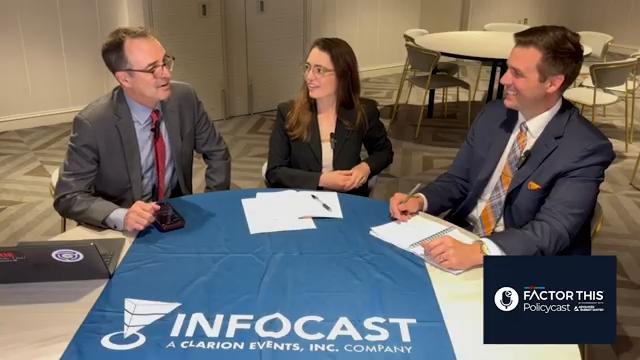
On this episode of the Factor This Policycast, moderated by Factor This content director Paul Gerke and recorded live-to-tape at the 2026 Infocast Transmission & Interconnection Summit, Caitlin Marquis, managing director at Advanced Energy United, and Rob Gramlich, president of Grid Strategies, outline how each major regional transmission organization (RTO) and independent system operator (ISO) is approaching generator interconnection reform, criss-crossing the country and touching on progress in PJM, ERCOT, SPP, MISO, CAISO, ISO-NE, and NYISO. Marquis and Gramlich also share policy suggestions and discuss the recent show-cause orders issued by FERC to each of the six regional grid operators within its jurisdiction, directing them to either justify or reform the rules governing how large energy users, such as data centers, connect to the electric grid.
Listen to the audio-only version of the episode:
New episodes of the Factor This Policycast go live at 6 am ET every other Thursday.
RTOs across the board are placing substantial focus and efforts into improving the management of the interconnection process, including hiring additional staff, improving project management tools, applying automation, increasing transparency, and improving coordination with transmission owners and interconnection customers. Some regions have innovated above and beyond the requirements of FERC Order No. 2023, including Southwest Power Pool (SPP), which garnered significant positive attention at the Infocast event with its Consolidated Planning Process (CPP), a promising model to deliver a more efficient, faster, and more predictable interconnection process.
In many places, however, reforms have been slow, delays have been common, project withdrawal rates remain high, post-interconnection delays are both persistent and opaque, and fast-track workarounds have primarily benefitted costly thermal-generation projects. Project developers (interconnection customers) still generally face uncertainty regarding both the cost and the time to connect to the grid.
What FERC’s show-cause orders really mean
“When I was working for the FERC chairman, a full show cause order was a big deal,” said Grid Strategies’ Gramlich on the podcast. “It was a tough, muscular action… It’s interesting that all five commissioners, on a bipartisan basis, are willing to use their powers in a pretty assertive way, if not a non-aggressive way.”
“It’s slower to do the nationwide rulemaking. You really have to go through the notice-and-comment process, and that takes a long time,” he added. “I don’t think FERC ever penalizes (the RTOs) or discourages profits, because they don’t have profits, but I think RTOs (almost always) follow their lead. At the end of the day, FERC can just lay down the law and say, ‘Nope, your tariff is this, it’s not that,’ and they have to follow.”
Progress in PJM and optimism in SPP
“They went through a four-year process of transitioning to a cluster study process; not great timing for a region that was experiencing explosive load growth to be pausing on accepting new interconnection requests,” said Marquis of PJM Interconnection when discussing the transmission operator. “They’ve just started studying their first new cluster, which was an enormous cluster, and they’ve indicated it would be a one-to two-year process. I think that’s the big question in PJM right now, whether they’re able to achieve that one-to two-year process with this new cluster, given the size of the cluster.”
“The CPP is the Consolidated Planning Process, which actually is a great, concise description of what the process is,” Marquis explained when asked about Southwest Power Pools’ new scheme, which garnered considerable positive attention at the Infocast event. “It’s consolidating, bringing together the transmission planning process and the generator interconnection process, and it’s solving a bunch of issues at the same time. And I think what’s exciting about it is it’s taking some of those root causes that are challenges in the generator interconnection process of lack of transmission capacity, uncertainty in terms of cost and timeline to interconnect, and it’s trying to solve them all through this one process, and the reason that there’s this sort of excitement and trepidation is that’s a lot to do, that’s a big ask for one process, so how it’s implemented will really matter.”
Policy advice for grid operators
The report issued by Advanced Energy United, Brattle Group, and Grid Strategies advances a list of policy solutions for improving generator interconnection, which are also discussed on the podcast. They include:
- Proactively planning capacity and prioritizing “most ready” interconnection requests utilizing an entry fee.
- Creating or updating processes for the replacement of existing plants and making use of immediately available system capability.
- Identifying the most cost-effective solutions for resolving reliability violations.
- Leveraging automation to expedite interconnection studies.
- Improving reporting on the post-generator interconnection agreement transmission construction phase.