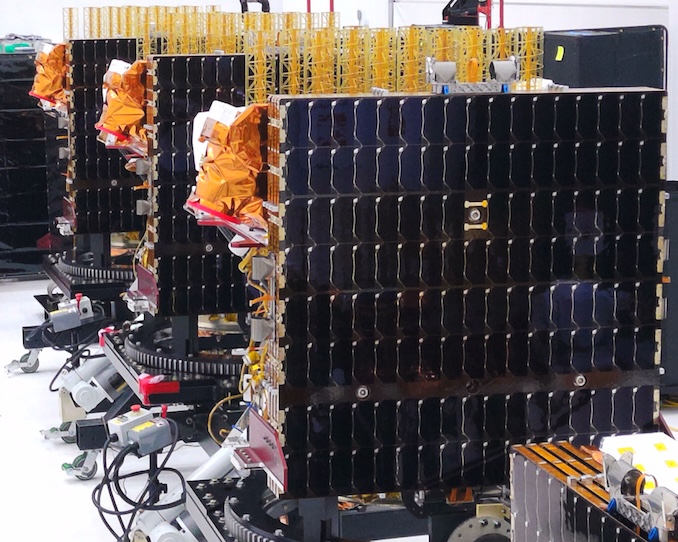
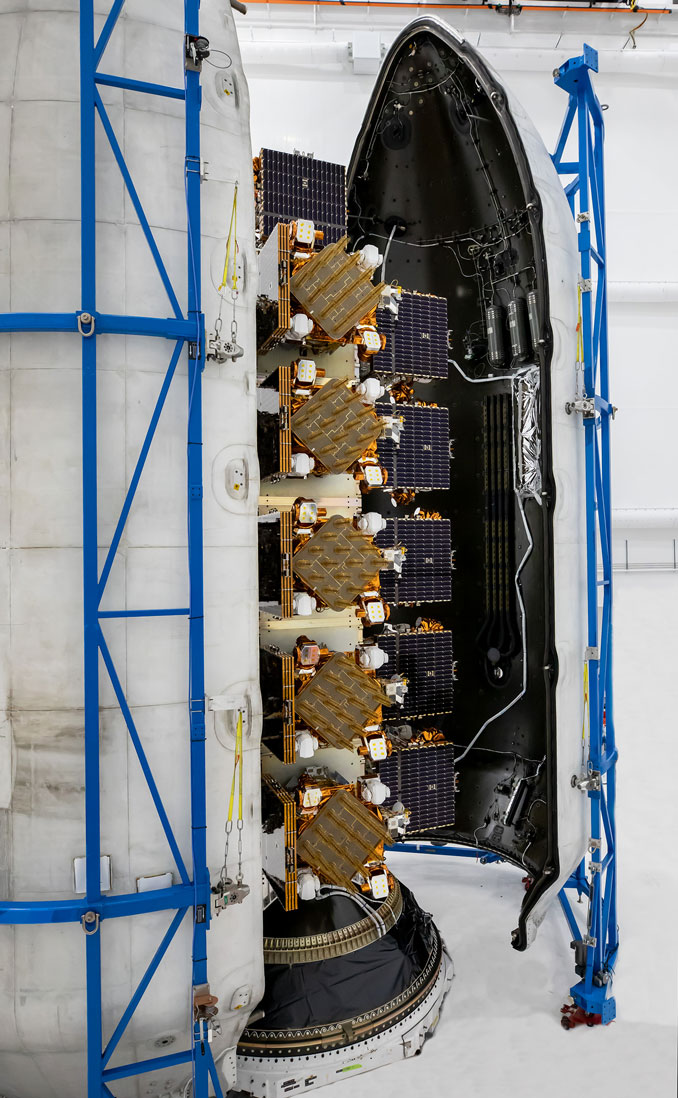
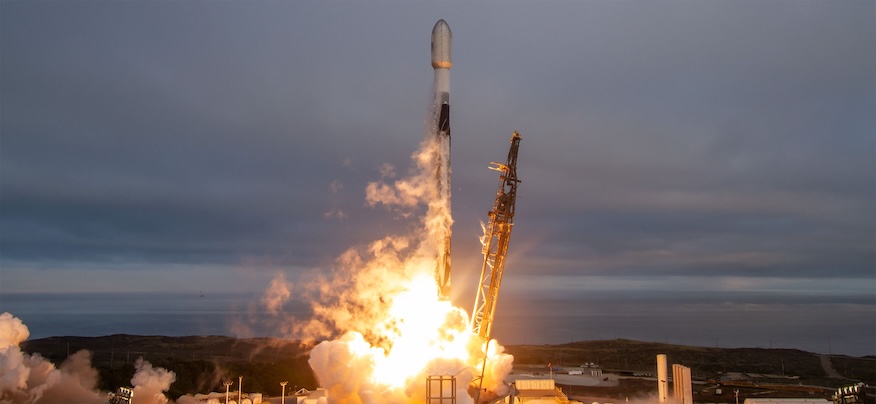
The Space Development Agency is set to launch its third batch of operational satellites designed to improve secure communications between members of the U.S. military and its allies across the globe aboard a Falcon 9 rocket from California.
The SDA’s constellation, the Proliferated Warfighter Space Architecture (PWSA), consists of a series of series of interconnected satellites with varying focuses, from missile tracking to navigation. The satellites launching on Thursday afternoon are part of the communications layer, referred to as the Tranche 1 Transport Layer (T1TL).
Liftoff of SpaceX’s Falcon 9 rocket from Space Launch Complex 4 East (SLC-4E) at Vandenberg Space Force Base is scheduled for 1:32 p.m. PDT (4:32 p.m. EDT / 2032 UTC).
Spaceflight Now will have live coverage beginning about an hour prior to liftoff.
SpaceX will launch the T1TL-E mission using the Falcon 9 first stage booster B1103, making its fourth flight after previously launching Starlink 17-35, Starlink 17-42, and NROL-179.
A little more than 8.5 minutes after liftoff, B1103 will target a landing on the SpaceX droneship, ‘Of Course I Still Love You’, positioned in the Pacific Ocean. If successful, this will be the 211th landing on this vessel and the 639th booster landing to date for SpaceX.
Building out the Transport Layer
There will be 154 operational satellites spread across the various layers of the Tranche 1 portion of SDA’s PWSA constellation. That breaks down to the following, according the SDA:
- 126 Transport Layer satellites
- 28 Tracking Layer satellites
- 4 missile defense demonstration satellites
These satellites will be managed from Space Operations Centers located at the Grand Forks Air Force Base in North Dakota and Redstone Arsenal in Alabama.
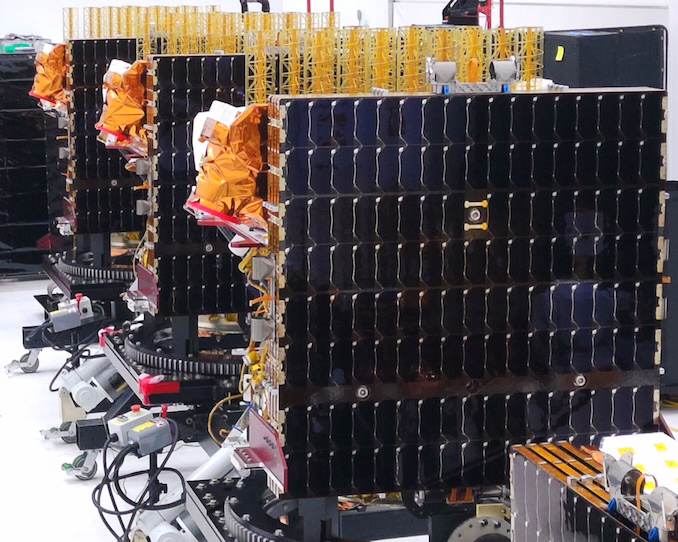
The SDA awarded satellite construction contracts to Lockheed Martin Space, Northrop Grumman Strategic Space Systems and York Space Systems in February 2022 to build the satellites for the T1TL portion of the constellation.
The first 21 T1TL satellites from York Space Systems launched on the T1TL-B mission on Sept. 10, 2025. That was followed by the T1TL-C mission a month later with satellites from Lockheed Martin.
In a September 2025 statement to Spaceflight Now, Col. Ryan Hiserote, the U.S. Space Force’s Space Systems Command’s (SSC) division chief in System Delta 80 Assured Access to Space, said that the order of the first three missions for the SDA’s T1TL were “interchangeable” and didn’t need to fly in alphabetical order.
“York was the first of the Tranche 1 performers to ship and launch its satellites. All spacecraft from York’s first production lot were confirmed healthy within hours of launch separation, and the constellation has since passed numerous milestones as it continues through early operations,” the company said in a June 5 press release.
“With this second production lot, York is again first among Tranche 1 primes to complete T1 spacecraft production, continuing to demonstrate the high-rate production capabilities required to support proliferated space architectures. Upon full delivery, York’s first and second production lots represent more than 40 spacecraft developed in support of the proliferated mission.”
Launch of the T1TL-E mission was awarded to SpaceX as part of fourth order year of missions within the National Security Space Launch (NSSL) Phase 2 contract, which is managed by Space Systems Command. Announced in June 2023, T1TL-E was one of six missions awarded to SpaceX.
When awarded, these missions were scheduled to launch in fiscal year 2025. However, as happens with a number of NSSL missions, the payloads can be years behind schedule.
The February 2022 press release from the SDA announcing the awards for the T1TL missions stated that these satellites should be “ready for launch by September 2024.” However, the first batch didn’t fly until a year later.
Spaceflight Now reached out to SSC to learn more about why none of the satellites manufactured by Northrop Grumman have launched to date but we did not receive a response before publishing this article.