
AI ain’t gonna power your air conditioner. We need more people.
It’s no secret that the U.S. energy workforce must expand to accommodate projected load growth over the coming years. The Center for Energy Workforce Development (CEWD) estimates 32 million energy jobs will be added over the next decade. However, building and stocking a talent pipeline is easier said than done.
Last month, the CEWD launched two new regional coalitions built to address our growing energy needs: the Ohio Energy Workforce Consortium (OEWC) and the Northeast Energy Workforce Consortium (NEWC). Both are anchored by local utilities and large energy companies; the OEWC by AEP, Duke Energy, FirstEnergy, Siemens, and others; the NEWC by National Grid, the New York Power Authority (NYPA), Eversource, Con Edison, and more.
Consortium members will work collaboratively to raise awareness of, and access to, workforce opportunities and the demand for critical roles that support the energy ecosystem across their regions. They will also engage with essential workforce development partners including educators, workforce systems, community-based organizations, and organized labor.
“We focus on national workforce solutions that can support local action and implementation,” CEWD executive director Missy Henriksen explained to Factor This. “From programs that bring more awareness and access to energy careers to Veterans (Troops to Energy Jobs) and women (Hire PowHER); to pre-apprenticeship programs with the National Urban League and UnidosUS that drive connections to industry employment; to creation and promotion of free energy curriculum for high school and post-secondary learners; to connecting energy and workforce policy, CEWD is a big-tent organization that recognizes the importance of an industry wide approach to attracting, training, and retaining the talent we need.”
CEWD’s consortia currently operate in more than 20 states, coordinating utilities, contractors, labor unions, educators, and community organizations around a shared goal to build the talent pipelines their specific states and grid systems need.
“We have seen some drive adoption of energy curriculum in their states. We have seen others create a mobile education lab to familiarize students with energy careers. Others have focused on career awareness programming, connecting with policy offices, and partnership with educators,” Henriksen recounted. “There is no single recipe for success, but committed stakeholders focused on sector-wide solutions are a common ingredient in all consortia.”
According to the U.S. Department of Energy’s 2025 U.S. Energy & Employment Report, Ohio had 332,125 energy workers statewide in 2024, representing 3.9% of all U.S. energy jobs and 6% of state employment. Job distribution is shown in the pie chart below.

Ohio’s energy sector is expanding on multiple fronts. The state’s major utilities are planning tens of billions in transmission and infrastructure investment, driven by surging demand from data centers and industrial growth. Ohio’s natural gas and oil industry supported 375,000 jobs and contributed $58.8 billion to state GDP in 2019. Further, Ohio’s renewables sector is growing rapidly, with installed solar capacity exceeding 3,600 megawatts in 2024, with new utility-scale projects still underway. The Consortium brings Ohio’s energy employers and workforce partners together to meet this moment—aligning programs, sharing intelligence, and moving at a scale and speed that no single organization can match.
“The OHEWC will provide the boots on the ground needed for action and implementation within the states,” said Henriksen. “They will lead statewide coordination with educators, community-based organizations, workforce systems, state policymakers, and others that are essential to ensuring the sector can attract the best and brightest to the field.”

Like in Ohio, the need for bolstering the energy workforce is apparent in Connecticut, Massachusetts, New York, and across the Northeast, where the NEWC has set up shop.
“We have great programs and partnerships to fill our critical roles, but the demand for a skilled energy workforce goes far beyond National Grid’s needs,” offered Celeste Schneider, NY chief people officer at National Grid. “Now, by collaborating across the industry, we can bring an increased scope and scale to successful training and education programs – moving away from simply a highly trained and skilled pipeline to a robust energy workforce ecosystem that is good for the sustainability of the industry, and the communities we serve.”
“Addressing the energy challenges of today depends not just on having the latest technology in place; it depends on people,” added NYPA executive vice president and chief innovation officer Daniella Piper. “By working together, we are ensuring that every region has a pipeline of diverse, skilled workers to draw from to ensure our energy system is safe, reliable and affordable.”
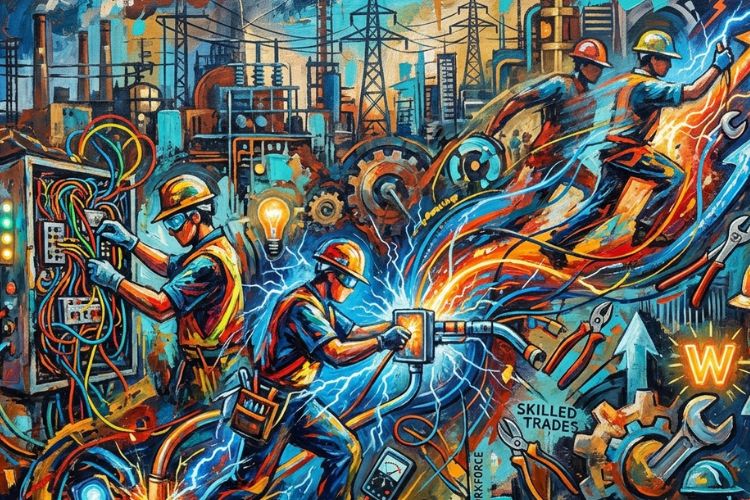
According to Henrisken and the CEWD, skilled trades roles and engineering positions are among the most in demand across the nation, as are roles in manufacturing and construction. Other fast facts about the energy workforce include:
- 32 million people are expected to be hired for energy and infrastructure jobs in a ten-year period.
- 81,000 electricians must be hired and trained every year for a decade.
- The nuclear workforce in the United States is expected to nearly triple by 2050, with a considerable ramp-up by 2035 (U.S. Department of Energy, 2024).
- There is a projected shortfall of 320,000 welders by 2029.
“The energy sector offers a wide array of careers that appeal to almost anyone considering what’s next professionally,” suggested Henrisken when asked for career advice for aspiring energy professionals. “Industry careers are highlighted by strong compensation, excellent opportunities for career advancement, stability, and meaningful and important work that makes a difference. CEWD’s Get Into Energy site connects students and career explorers with information to help guide career considerations and highlights the industry’s search for those with GEDs to PhDs and everything in between.”