
A two-season field study investigating postflowering transpiration in the Pannonian Basin of Hungary has found that stem heat balance sap-flow measurements cannot reliably identify the atmospheric demand threshold associated with the limited-transpiration phenotype in grain sorghum and maize. Agronomists have frequently invoked this physiological trait, which features a plateau in whole-plant transpiration rate once the atmospheric vapour pressure deficit crosses a critical boundary, to explain why grain sorghum often conserves soil moisture more effectively than maize during summer droughts. However, the researchers discovered that after adjusting for incoming solar radiation and temporal changes across the grain-filling window, a statistically significant two-segment demand response could not be identified at the day level in five out of six evaluated group-by-season combinations. The single detected breakpoint occurred at the extreme boundary of the candidate search grid and disappeared entirely when different daily integration intervals were applied. Rather than confirming or refuting the physiological mechanism, the investigative team demonstrated that observational field records from sap-flow gauges carry fundamental identifiability constraints, meaning that the collected field data can neither pinpoint a vapour pressure deficit threshold nor definitively exclude one.
The underlying agronomic rationale for cultivating grain sorghum over maize centres on adaptation to tightening water deficits during reproductive grain filling, particularly across drought-prone continental regions such as the eastern Hungarian Great Plain. Under high evaporative demand, a crop displaying the limited-transpiration phenotype theoretically restricts stomatal conductance, flattening its water loss curve above a threshold vapour pressure deficit and preserving accessible soil moisture for later developmental stages. While numerous controlled-environment trials have documented such plateaus under strictly regulated conditions where vapour pressure deficit is artificially imposed and radiation is held stable, confirming the trait under outdoor field canopies introduces severe confounding factors. In real agricultural stands, ambient solar radiation covaries closely with atmospheric dryness throughout the daily solar cycle, while plants simultaneously undergo continuous phenological senescence and gradual root-zone water depletion. Because these competing atmospheric and biological drivers shift in parallel across the postflowering window, attributing fluctuations in daily stem water movement directly to stomatal regulation requires isolating demand from energy supply, crop age, and gauge performance.
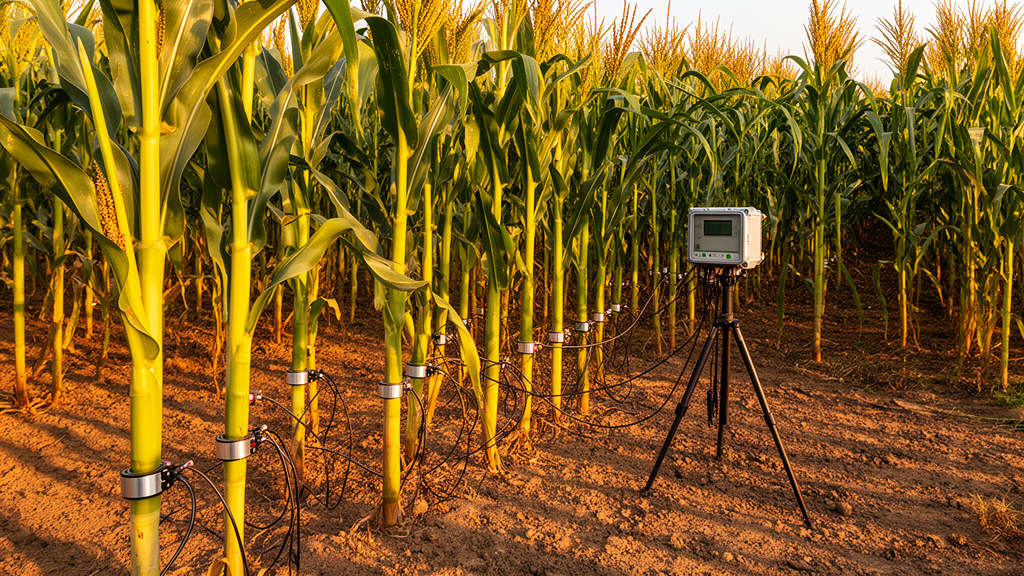
To evaluate whether this demand threshold is truly identifiable from field instrumentation, the researchers established observational field trials during the 2024 and 2025 growing seasons at the Karcag Research Institute in eastern Hungary. The study tracked 37 individual plants across two contrasting postflowering seasons: 18 plants in the exceptionally dry postflowering season of 2024, which received only 7.9 millimetres of rainfall, and 19 plants in the comparatively wet 2025 season, which received 62.9 millimetres over the identical calendar interval. The monitored crops comprised one locally adapted grain sorghum hybrid, designated Zádor, grown under rainfed conditions, and one commercial maize hybrid, designated Sushi, grown under both rainfed and microsprinkler-irrigated regimes. Stem sap flow was logged continuously at 15-minute intervals using commercial Dynagage stem heat balance collars attached below the topmost fully expanded leaf on each plant. Agronomic management differed between the successive seasons, including adjustments to sowing date, planting density, row spacing, and base nutrient applications, which strictly confined primary statistical inferences to comparative contrasts evaluated within each single season rather than across years.
Extracting an unconfounded transpiration signal from stem heat balance gauges required addressing specific physical and methodological constraints inherent to the measurement system. Heat balance collars estimate sap flux by applying a continuous, constant electrical heat input to the stem internode and resolving the energy balance from internal thermocouple signals. Because the external sheath thermal conductance must be estimated rather than measured directly, absolute flux rates carry a multiplicative calibration uncertainty specific to each gauge assembly. To neutralise this gauge-to-gauge multiplicative bias, the authors normalised the midday flux of each instrumented plant by dividing its daily value by the 95th percentile of its own midday flux recorded across that season. Furthermore, the analysis restricted its primary response variable to the midday window between 09:00 and 17:00, relying exclusively on empirically measured 15-minute intervals. This decision avoided distorting the demand response with reconstructed values, as automated linear interpolation had been used to bridge nighttime zero-flow records and periods of missing sensor data, which accounted for more than 40 percent of the raw 15-minute log entries.
When the normalised midday flux values were modelled against daily maximum vapour pressure deficit, the clearness index from an adjacent automated weather station served as an indispensable covariate to account for variations in global solar radiation. Linear mixed-effects modelling revealed that both atmospheric clearness and daily maximum vapour pressure deficit maintained positive, statistically significant associations with midday stem flux across the sampled population. However, when the researchers tested whether a segmented, broken-line model provided a superior fit compared with a continuous linear slope, permutation tests conducted on the daily group mean series failed to confirm a demand plateau in five of the six evaluation cohorts. In those five cohorts, permutation p-values ranged between 0.09 and 0.57. Even in the remaining cohort—rainfed maize in 2025, which yielded a nominal permutation p-value of 0.005 and a Bonferroni-adjusted value of 0.03—the estimated breakpoint settled at 2.05 kilopascals, precisely at the lowest admissible boundary of the candidate search grid where only ten days existed to establish the lower slope segment.
The lack of an identifiable breakpoint prompted the researchers to perform statistical power simulations to establish whether their field design was capable of detecting a genuine plateau if one had existed. Generating synthetic datasets from true two-segment models conditioned on the observed daily meteorological covariates, the authors found that a full plateau beginning at a vapour pressure deficit of 3.0 kilopascals was successfully recovered in only 12 percent to 48 percent of simulation replicates across the different crop groups and seasons, displaying an overall median recovery rate of just 25.5 percent. Because bootstrap confidence intervals around candidate breakpoints spanned up to 57 percent of the entire sampled demand range, the statistical power of the field dataset was fundamentally insufficient to declare the presence or absence of the trait. Consequently, the authors emphasised that failure to detect a broken-line response in field sap-flow data does not prove that stomatal regulation is absent, but rather demonstrates that daily meteorological records and gauge replication cannot resolve the putative breakpoint geometry against natural ambient scatter.
Despite the absence of a distinct threshold, the linear demand models revealed that the adjusted demand slope remained consistently positive across all experimental groups, ranging from 0.051 to 0.119 per kilopascal. In both seasons, rainfed maize exhibited an adjusted demand slope that was roughly half to two-thirds the magnitude of the slope observed in irrigated maize of the identical hybrid, sowing date, and planting geometry. This statistically significant divergence between water management levels confirmed that the gauges were capable of detecting altered demand sensitivity under different soil moisture supplies, serving as a functional positive control. Conversely, rainfed sorghum did not exhibit a suppressed demand slope relative to irrigated maize, instead displaying the highest numerical slope values in both seasons. While the muted slope in rainfed maize aligns with soil water limitation dampening the transpiration response, the authors cautioned that this empirical association cannot be interpreted as active stomatal water conservation because root-zone soil moisture was not continuously logged, and late-season canopy senescence naturally flattens regression slopes over time.
A critical analytical finding emerged when comparing different temporal integration windows: the mathematical selection of the response variable drastically reshaped the apparent demand sensitivity of the crops. While midday flux restricted to measured records produced positive demand slopes for all groups, calculating full 24-hour daily cumulative totals caused the fitted slopes of both rainfed maize and rainfed sorghum to collapse to values near zero, while the slope for irrigated maize remained robustly positive. A cumulative daily total incorporates overnight hours and interpolated low-flow segments, effectively combining daytime stomatal dynamics with nocturnal water refilling and thermal lag effects. Depending on whether an investigator selects an eight-hour midday interval, a fourteen-hour daylight span, or a twenty-four-hour cumulative daily sum, the relative performance ranking between irrigated and rainfed crops shifts substantially. The authors noted that this sensitivity underscores why integration periods and data reconstruction protocols must be defined transparently prior to analysis rather than adjusted post hoc to match expected physiological curves.
The investigation also uncovered severe scaling discrepancies when researchers attempted to extrapolate single-plant sap-flow measurements to whole agricultural stands using standard plant population densities. Multiplying the mean daily water use of instrumented sorghum stems by the stand planting densities yielded stand-level transpiration estimates of 279.3 millimetres in 2024 and 354.3 millimetres in 2025. Over the identical postflowering timeframes, FAO-56 Penman–Monteith reference evapotranspiration summed to only 212.6 millimetres and 188.0 millimetres, resulting in scaling ratios of 1.31 and 1.88. Even when compared against Hargreaves–Samani reference calculations or corrected by subtracting nocturnal flow, the density-scaled sorghum estimates significantly exceeded both reference evapotranspiration and tabulated FAO midseason basal crop coefficients. The authors traced this overestimation primarily to size-biased sampling: because available gauge collars could only fit stems wider than 8 millimetres, the instrumented sorghum plants represented dominant, vigorously growing individuals within the dense stand, meaning their elevated water flux could not accurately represent the average plant across the canopy.
Similar scaling instabilities invalidated attempts to establish a definitive interannual drought-tolerance ranking between the two summer crops. When evaluated per plant across calendar-aligned windows, rainfed sorghum demonstrated remarkable consistency, showing an interannual amplitude of only 0.1 percent between the dry and wet seasons, compared with 27.5 percent in rainfed maize. However, because sorghum planting density had been adjusted from 250,000 to 333,000 plants per hectare between seasons, that same comparison expressed per unit ground area yielded an interannual amplitude of 33.0 percent. Furthermore, aligning the analytical windows by sowing date rather than calendar date altered the duration of the comparison from 43 to 30 days and inverted the apparent crop stability ranking, with rainfed maize displaying less interannual variation than sorghum. Grain yields harvested from the experimental plots also showed rainfed maize outyielding rainfed sorghum in both seasons, reaching 5,444 versus 4,477 kilograms per hectare in the dry year and 5,233 versus 3,268 kilograms per hectare in the wet year.
Based on their findings, the research team outlined essential reporting criteria for future field studies attempting to phenotype the limited-transpiration trait from sap flow. Researchers must explicitly declare their demand variable calculations, confirm that sampled meteorological ranges adequately bracket candidate thresholds on both sides, and include solar radiation covariates to prevent collinearity errors. Moreover, investigators must account for reconstructed records, specify integration windows in advance, report gauge collar size distributions alongside canopy stem dimensions, and avoid density-based stand scaling without independent micrometeorological or lysimetric validation. Because single-plant sap-flow gauges cannot isolate stomatal conductance from whole-canopy energy exchanges, the authors concluded that field-fitted breakpoints should not be deployed as operational irrigation triggers until their statistical identifiability and scaling validity are rigorously demonstrated across varying integration windows and representative stand structures.
Subject of Research: Identifiability and scaling limits of field sap-flow phenotyping for crop transpiration responses to atmospheric vapour pressure deficit
Article Title: Identifiability and scaling limits of field sap-flow phenotyping: a two-season case study of the vapour pressure deficit response in maize and grain sorghum
Article References: Pásztor, D., Kovács, G., Nagy, A., & Tamás, J. (2026). Identifiability and scaling limits of field sap-flow phenotyping: a two-season case study of the vapour pressure deficit response in maize and grain sorghum. Frontiers in Agronomy, 8, 1960561. https://doi.org/10.3389/fagro.2026.1960561
Image Credits: AI Generated
DOI: 10.3389/fagro.2026.1960561
Keywords: sap flow, limited-transpiration phenotype, vapour pressure deficit, grain sorghum, maize, stem heat balance, transpiration, evapotranspiration, Pannonian Basin, stomatal conductance, crop water use, phenotyping, agrometeorology, clearness index, irrigation scheduling, canopy scaling, soil water deficit
Tags: agrometeorologycanopy scalingclearness indexcrop water useevapotranspirationgrain sorghumirrigation schedulinglimited-transpiration phenotypemaizePannonian Basinphenotypingsap flowsoil water deficitstem heat balancestomatal conductancetranspirationvapour pressure deficit