When you look at the Milky Way stretching across the sky, it shows the result of billions of years of evolution. Collisions and mergers play a huge role in that process. However, so does star formation. It turns out to be a major driver in galaxy evolution.
Researchers led by Ohio State University graduate student Debosmita Pathak, wanted to know more about how starbirth regions change galaxies. So, they studied 18,000 star-forming regions in nearby spiral galaxies to understand the many different appearances and effects of star formation.
Their goal was also to get a greater understanding of the starbirth process and its galactic effects. They used data from Hubble Space Telescope, the James Webb Space Telescope, and the Atacama Large Millimeter/Submillimeter Array as part of the Physics at High Angular resolution in Nearby GalaxieS (PHANGS) survey to probe galaxies at different wavelengths of light. The goal is to understand the physics of gas and star formation, and measure the interplay with galactic structure and evolution.
The Starbirth Effect
The process of star formation is a complex one that begins in clouds of hydrogen gas called HII regions. Areas of those clouds coalesce under the influence of gravity, and when conditions are ripe, protostars form and eventually light up as a full-blown star. Hot young stars heat up their surroundings as they grow and evolve. They emit light that energizes (ionizes) atoms of gas in the birth clouds, and they can emit jets of material that plays havoc with surrounding regions of space.
As part of the survey, Pathak’s team found that in normal galaxies, pressure from star-ionized gas plays a role. Essentially, it drives the expansion of young star-forming regions. However, whether these zones continue to grow or remain stagnant is strongly dependent on their surrounding environment, according to Pathak. “When young massive stars are born, she said, “they’re very energetic and pump out a ton of photons into their surroundings. In that process, they disrupt their local environments and start to drive interstellar material out of the area.”
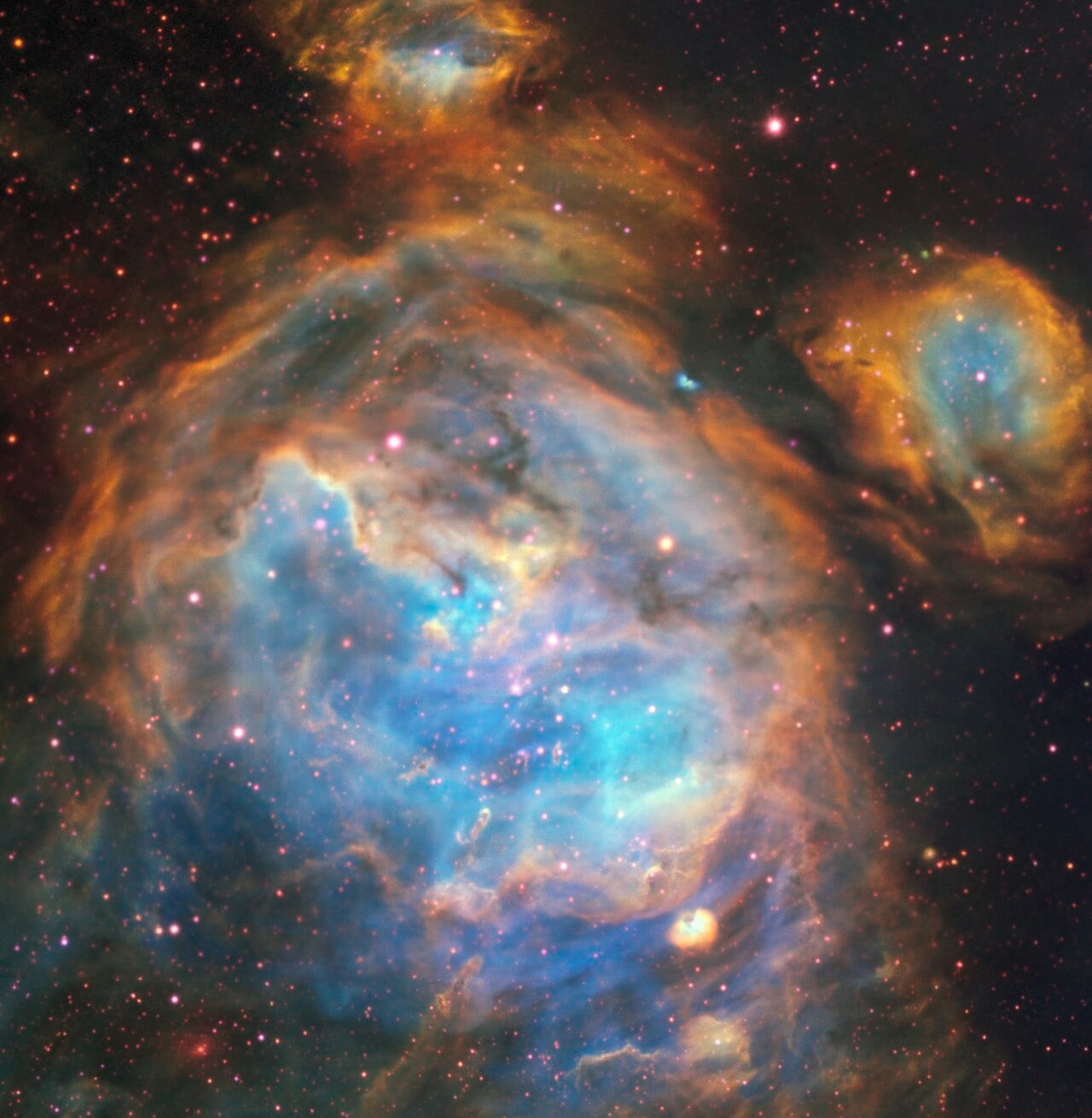 *Newborn stars carved out a cavern in this cloud of gas in the Large Magellanic Cloud. Their UV radiation eats away at the gas, sculpting the cavern where they remain. Courtesy: ESO*
That driving mechanism is called “stellar feedback”. It includes the action of stellar winds on nearby clouds of gas, as well as shock waves from supernova explosions, and jets from newborn stars carving out caverns in the birth clouds. Such feedback can either stimulate new starbirth in nearby regions or it can choke off the star forming process by eating up gas clouds. Additionally, a galaxy’s chemical evolution can get affected by star formation. If, for example, a given set of newborn stars burn off great swaths of gas clouds, that destroys any materials that could have formed planets.
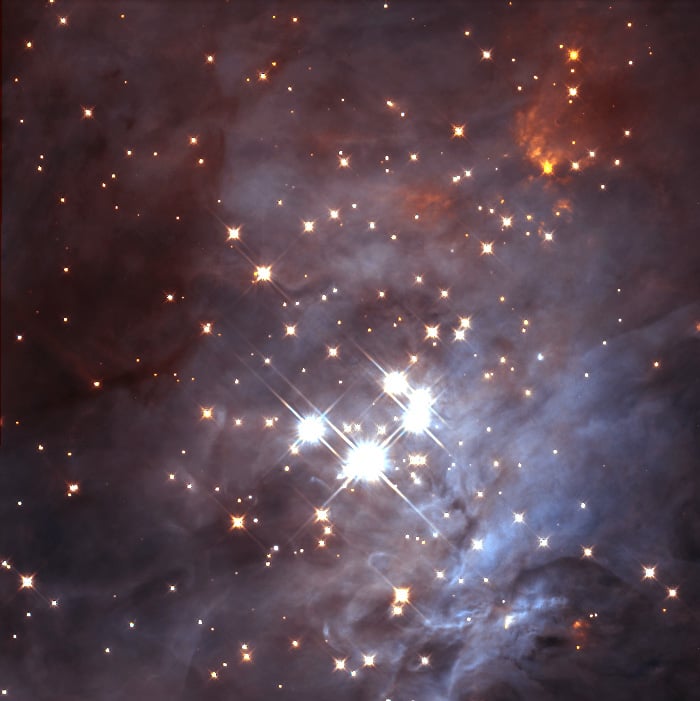 The center of the Orion Nebula, where hot young stars are steadily affecting their local environment. Courtesy STScI.
The Milky Way has many regions of starbirth scattered across its spiral arms. It forms (on average) one star a year, according to Pathak. Other galaxies can produce huge numbers of stars, likely spurred by another process: collisions. “Galaxies that have an abnormally high amount of stars typically underwent a more violent process to form, such as a major merger, where two galaxies collide,” she said. The results of violet galaxy collisions can be seen across the Universe. Our own Milky Way, for example, formed through repeated mergers of smaller galaxies. In fact, it’s still cannibalizing smaller dwarf galaxies, although the results is not spectactular waves of star formation.
![[Top View] – The current night sky is dominated by the white glow of myriad middle-aged stars along the lane of the Milky Way. Interstellar "pollution" from thick dust lanes can be seen threading through the long band of stars. They are interspersed with a few pinkish emission nebulae from ongoing star formation. [Bottom View] – This is an imaginary view of our young Milky Way as it may have appeared 11 billion years ago, as seen from the surface of a hypothetical planet. The night sky looks markedly different than the view today. The Milky Way's disk and central bulge of stars are smaller and dimmer because the galaxy is in an early phase of construction. The heavens are ablaze with a firestorm of new star formation, seen in the pinkish nebulae glowing from stars still wrapped inside their natal cocoons. The handful of stars visible in the night sky are blue and bright because they are young. Credit: NASA, ESA, and Z. Levay (STScI)](https://www.universetoday.com/article_images/mwgformation_960x1200_20260628_230931.jpg) [Top View] – The current night sky is dominated by the white glow of myriad middle-aged stars along the lane of the Milky Way. Interstellar “pollution” from thick dust lanes can be seen threading through the long band of stars. They are interspersed with a few pinkish emission nebulae from ongoing star formation. [Bottom View] – This is an imaginary view of our young Milky Way as it may have appeared 11 billion years ago, as seen from the surface of a hypothetical planet. The night sky looks markedly different than the view today. The Milky Way’s disk and central bulge of stars are smaller and dimmer because the galaxy is in an early phase of construction. The heavens are ablaze with a firestorm of new star formation, seen in the pinkish nebulae glowing from stars still wrapped inside their natal cocoons. The handful of stars visible in the night sky are blue and bright because they are young. Credit: NASA, ESA, and Z. Levay (STScI)
[Top View] – The current night sky is dominated by the white glow of myriad middle-aged stars along the lane of the Milky Way. Interstellar “pollution” from thick dust lanes can be seen threading through the long band of stars. They are interspersed with a few pinkish emission nebulae from ongoing star formation. [Bottom View] – This is an imaginary view of our young Milky Way as it may have appeared 11 billion years ago, as seen from the surface of a hypothetical planet. The night sky looks markedly different than the view today. The Milky Way’s disk and central bulge of stars are smaller and dimmer because the galaxy is in an early phase of construction. The heavens are ablaze with a firestorm of new star formation, seen in the pinkish nebulae glowing from stars still wrapped inside their natal cocoons. The handful of stars visible in the night sky are blue and bright because they are young. Credit: NASA, ESA, and Z. Levay (STScI)
When already-formed spirals collide, for example, the process can be quite dramatic. Each galaxy’s gravitational influence can tear the other apart and send shock waves
racing through clouds of gas and dust. The shock waves compress the gases and the end result is often massive starbirth activity. Those galactic dances can take millions of years to perform, and in many cases, the result is a merged blob of stars called an elliptical galaxy. In a few billion years, the Milky Way could collide with the Andromeda Galaxy. At that time, both galaxies will deform, and shock waves will spur waves of newborn stars that will go on to affect their local environments.
What Happens When Galaxies Collide?
The starburst galaxy NGC 3256 is a good example of a pair of spirals affected by a collision. One result of a galaxy collision is an uptick in star formation as the systems merge. It happens because the collision sends shock waves across space and that compresses clouds of gas, resulting in bursts of star formation.
The survey results showed that stellar feedback pressures in NGC 3256 are about 100 times stronger than in other Milky Way-like spiral galaxies. The stellar feedback constrains young, massive star clusters in the densest regions, although most are likely super-powered enough to continue expanding. The galaxy also contains regions of high turbulence in NGC 3256. That means the gas being constrained hasn’t flattened out into a disk where star formation can take place.
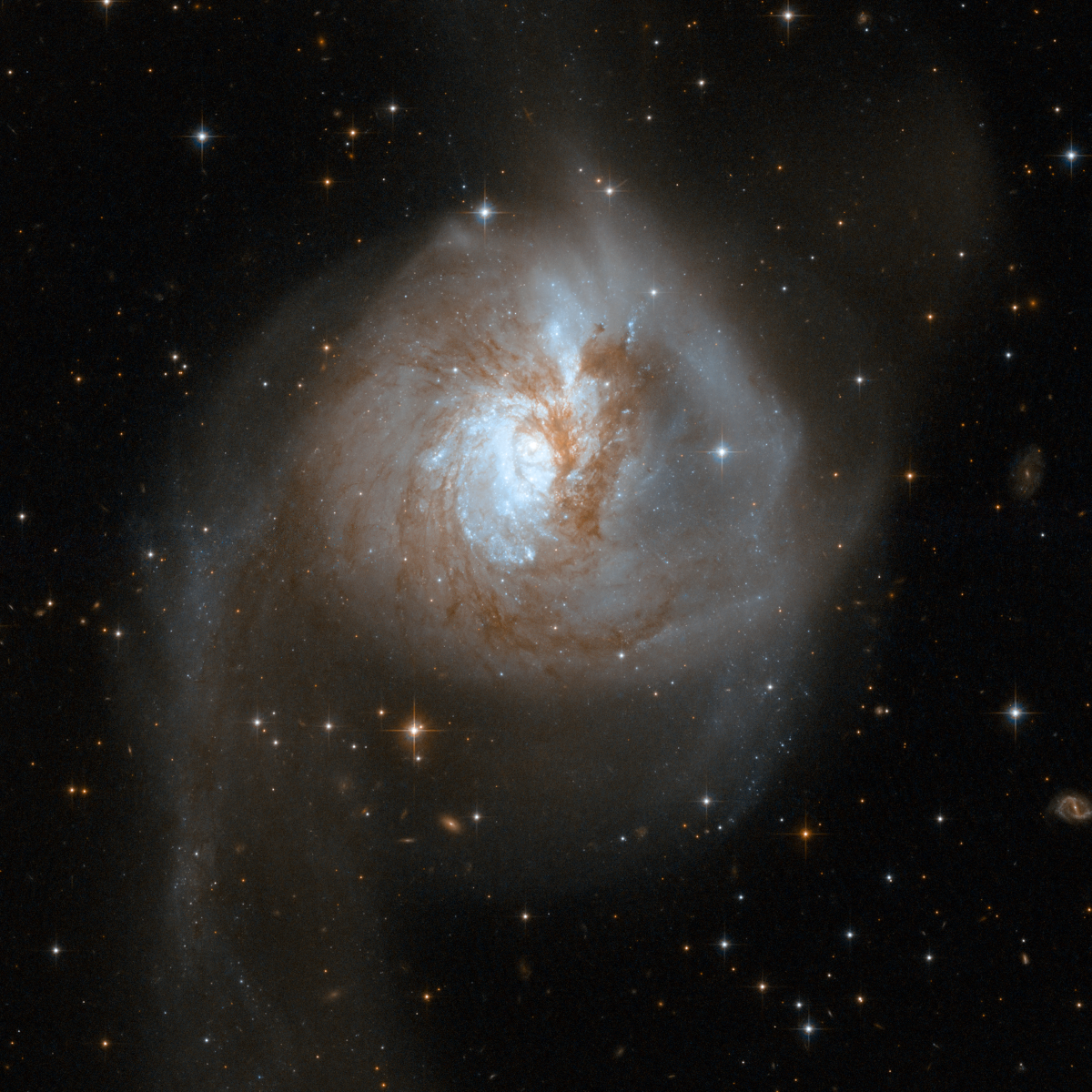 Two galaxies in NGC 3256 are merging. The collisions is igniting regions of starburst activity. Those young stars will go on to affect the evolution of the resulting galaxy. Credit: Image: NASA, ESA, Hubble Heritage–ESA/Hubble Collaboration, Aaron Evans (UVA, NRAO, State University of New York at Stony Brook)
The team’s study results are improving astronomers’ understanding of how star-forming regions work. In addition, it’s giving new insight into how the process works across many different cosmic settings as young stars help regulate and shape galactic evolution in the early stages of a galaxy’s life. This is long before the most massive stars evolve to become supergiants and eventually die in supernova explosions that also affect starbirth activity.
“It’s important to study environments in normal parts of the universe, but also how things deviate in the extremes,” said Pathak. “Without this type of research, we wouldn’t know if the physics that we’re working with and the models that we’re building actually hold true in such extreme places.”
For More Information
Young Stars Shape the Fate of Galaxies
Masses, Star-formation Efficiences, and Dynamical Evolution of 18,000 HII Regions