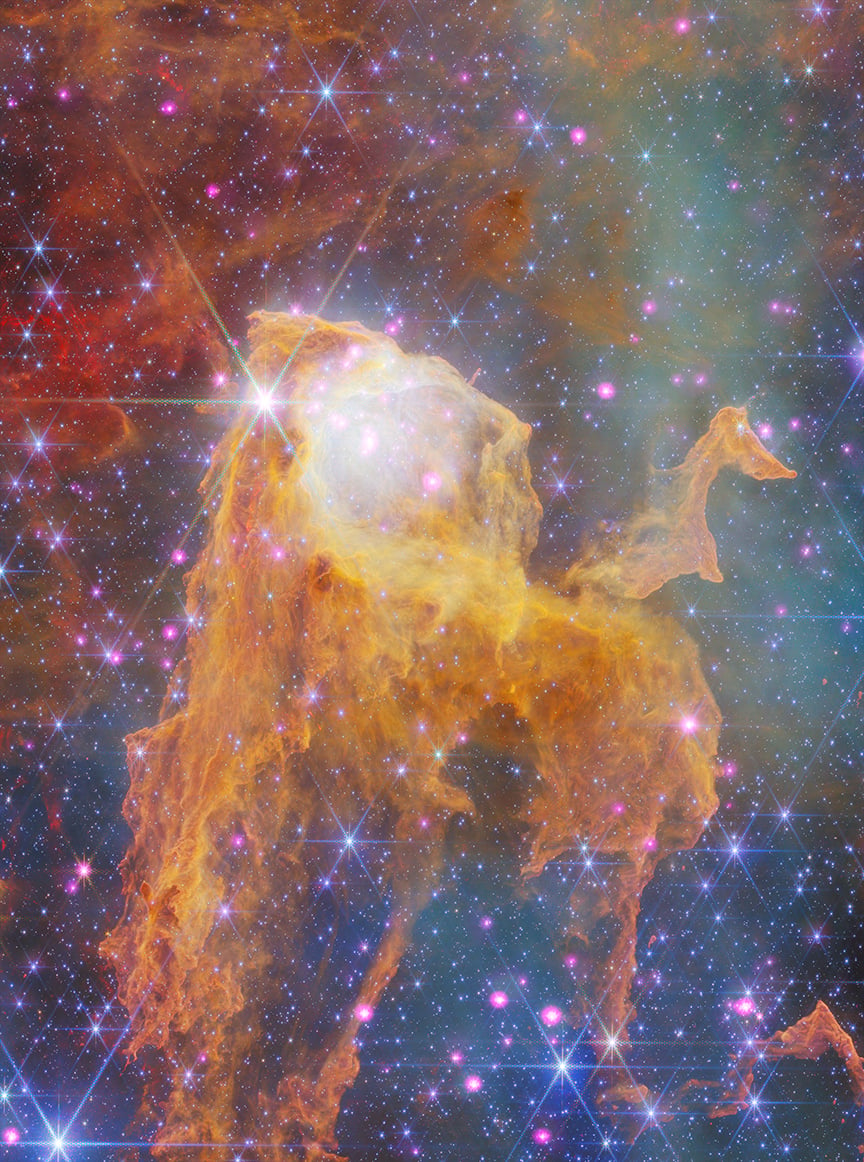
Astronomers using the Chandra X-ray Observatory (CXO) and the James Webb Space Telescope (JWST) zeroed in on a wispy-looking region of the Carina Nebula and found a ghostly looking cloud seemingly floating in isolation among the other clouds of gas and dust. Just in time for Halloween, although, it turns out that little cloud isn’t the soul of a departed star. Instead, it’s a region of the nebula that has been actively engaged in creating batches of hot, young new stars.
By studying this region in X-rays and infrared light, astronomers are getting a good look at the structure of the cloud as well as the stars it has formed. Not only that, but it helps them piece together more information about the larger Carina Nebula, which lies more than 7,500 light-years away from us.
Most of us are familiar with one of the brilliant and weird objects that lights up the nebula: Eta Carinae. It looks like one star, but is actually a binary that has a combined brightness of around 5 million times that of our Sun. Periodically, this object brightens and dims, probably due to clouds of condensed dust that coalesced around the binary stars. It experienced a huge outburst in the 1840s called the “Great Eruption”, which boosted tremendous amounts of gas and dust into space. It has since experienced other, smaller outbursts.
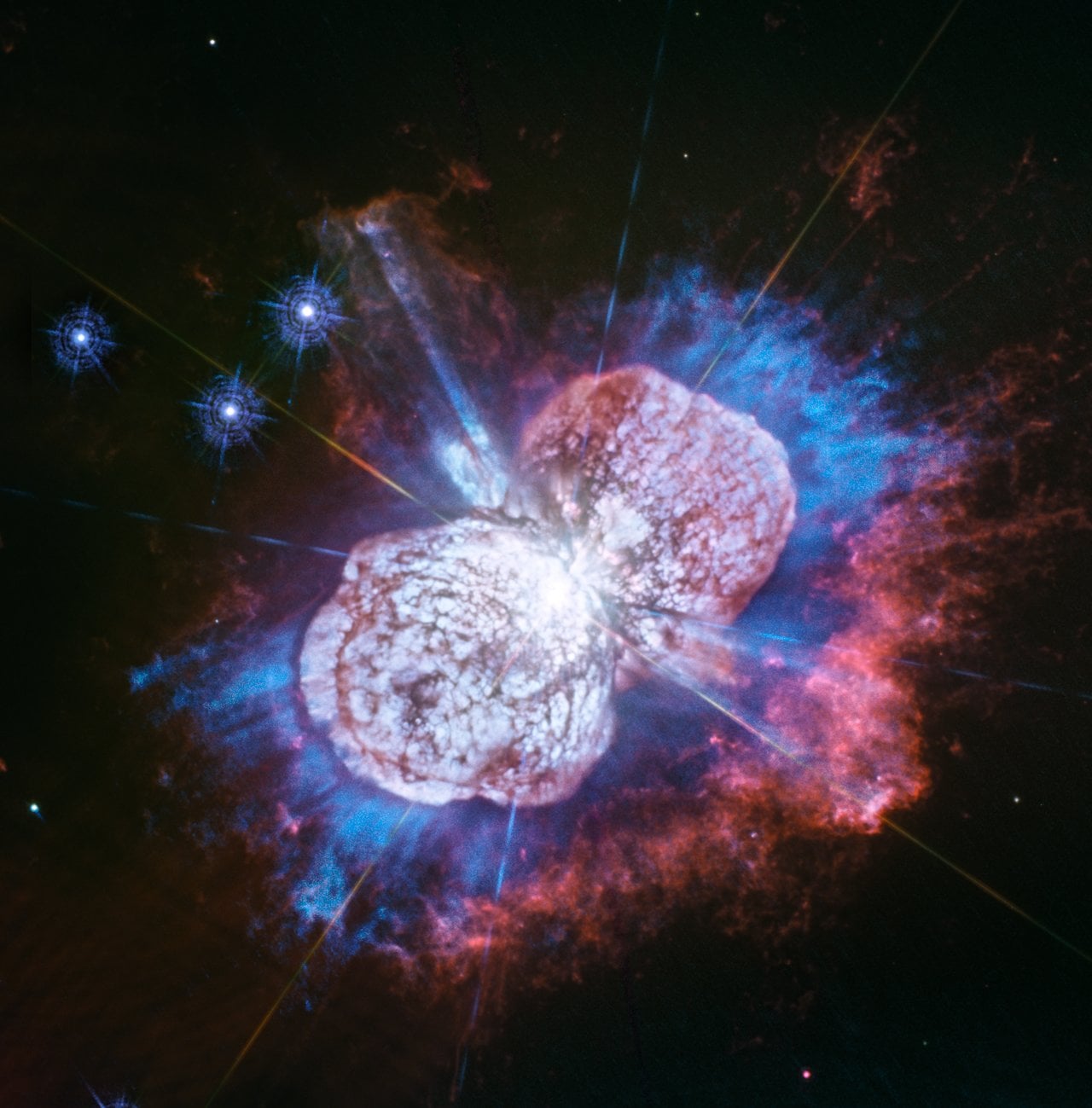
An ultraviolet image of the Homunculus Nebula (Eta Carinae) taken by the Hubble Telescope. Credit: NASA/ESA/StSci
The Carina complex is a huge diffuse nebula containing a collection of newborn stars nestled in a sea of starmaking gas and dust. It continues to produce new stars, many of them extremely bright and massive. Many telescopes have studied it, most notably the Hubble Space Telescope and JWST. Each view brings new insights into the makeup of the cloud as well as the objects it contains. In addition, astronomers are also keeping an eye on Eta Carinae because its primary star — a luminous blue variable star &emdash; is likely to explode as a supernova. When that happens, the shock waves will transform much of the nebula, probably spurring new rounds of star birth.

A broad panorama of the Carina Nebula, a region of massive star formation in the southern skies. This new method of determining the age of stars will help astronomers better understand the process of star formation. Credit: ESO/T. Preibisch
Obviously, the Eta Carina binary is a tantalizing subject, but there are also places such as the Keyhole Nebula. It’s a dark and cold molecular cloud that covers about 7 light-years of space. Ionizing radiation from the nearby Eta Carina binary is shaping and eating away at the Keyhole.
There’s also the open cluster Trumpler 14, which is a six light-year-wide grouping of more than 2,000 OB-type stars. These are massive and short-lived stars and are very bright in ultraviolet light. These are very young stars, ranging in age from about 300,000 to 500,000 years old.
The ghostly nebula that CXO and JWST imaged is still making stars at its heart. At the same time, ionizing radiation from the nearby Eta Carina binary, as well as hot young stars, is eating away the materials in the cloud. Thanks to that “cannibalizing” ultraviolet radiation from those stars, the cloud has developed several comet-like “knots”. Astronomers often refer to them as cometary globules because of their familiar shapes. The Carina Nebula is not the only place where such cometary knots are seen. Astronomers have spotted them in other star-forming regions as well as in planetary nebulae, where stellar winds collide with material previously ejected from a dying star like the Sun. As those collisions happen, they shape similar types of knots in the clouds of gas and dust.
Since the stars will have much shorter lifetimes than that of the Sun, someday this region will look more like a stellar graveyard. The remains of those stars we see as newborn today will, in tens of millions of years, be ghosts of their former selves, spreading their materials to interstellar space.
For More Information
Helpful Cosmic Ghost Brings Stellar Birth, Not Death
https://chandra.si.edu/photo/2026/reaper/