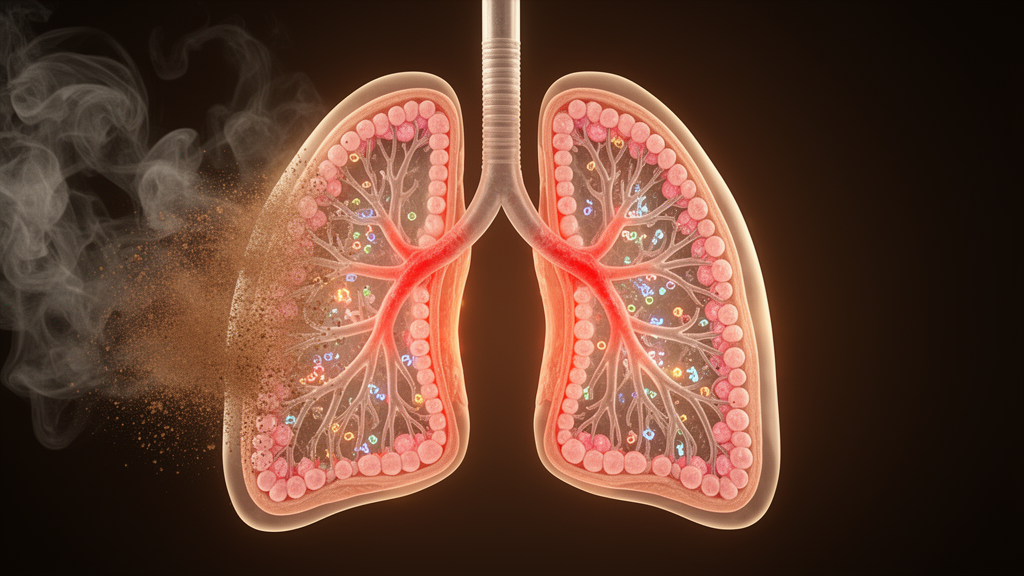
Wood smoke particulate matter, described by the study’s authors as an important public health hazard, induced eosinophilic and modestly neutrophilic airway inflammation and other features of asthma in mice through a mechanism involving the ERK1/2 regulator Sprouty2. In the study, a short-term airway exposure to wood smoke particles induced airway hyperreactivity to methacholine, eosinophilic inflammation with a lower extent of modest neutrophilic inflammation, mucus production and airway remodeling in naïve B6 mice. These pathologies depended on Sprouty2, a regulator of the ERK1/2 signaling pathway: inducible deletion of the Spry2 gene prevented the induction of airway hyperreactivity, airway inflammation, mucus production, airway remodeling and ERK1/2 phosphorylation.
The study, published in Frontiers in Allergy as a Brief Research Report, set out to establish a mouse model of wood smoke particulate-induced airway inflammation and hyperreactivity. The authors note that wood smoke particulate matter has been linked to a genetic risk variant that regulates the expression of Sprouty2, which is why they examined this ERK1/2 regulator in the disease mechanism. When naïve B6 mice were exposed to wood smoke particles in their airways over a short exposure period, their airways became hyperreactive to methacholine, and they developed eosinophilic inflammation, and to a lower extent modest neutrophilic inflammation, mucus production and airway remodeling.
At the cellular level, the smoke exposure set off a coordinated immune response. The number of group 2 innate lymphoid cells, or ILC2s, and CD4 T cells increased, ERK1/2 phosphorylation rose, and the animals produced more of the signaling molecules IL-5, IL-13 and IL-17A. The study reported increased production of IL-5, IL-13 and IL-17A alongside the airway pathologies; IL-5 and IL-13 are associated with the eosinophilic inflammation observed in the model. The finding that IL-17A was also increased points to a mixed inflammatory signature, consistent with the modest neutrophilic component observed alongside the eosinophilic inflammation.
The decisive experiment involved mice in which the Spry2 gene could be deleted on demand. When Spry2 was deleted, the wood smoke particles no longer induced the measured airway pathologies. Inducible deletion of Spry2 prevented the induction of airway hyperreactivity, airway inflammation, mucus production, airway remodeling and the phosphorylation of ERK1/2 itself. In other words, without this signaling regulator, the smoke particles did not induce airway hyperreactivity, inflammation, mucus production, remodeling or ERK1/2 phosphorylation, which the authors interpret as Sprouty2 playing a non-redundant role in the disease pathway.
The cellular effects of Spry2 deletion were selective and revealing. Spry2 deletion inhibited the increase in ILC2 frequency but not CD4 T cell frequency, indicating that Sprouty2 was required for the smoke-driven ILC2 increase but not for the CD4 T cell increase. ERK1/2 phosphorylation, however, was inhibited in both ILC2s and Th2 cells in the absence of Sprouty2, showing that the protein controls this signaling pathway inside both innate and adaptive immune populations in the airways.
Cytokine production told a similarly nuanced story. Spry2 deletion reduced the expression of IL-5, IL-13 and IL-17A in ILC2s, stripping the innate arm of its full inflammatory output. In CD4 T cells, the picture differed: deletion reduced production of IL-17A and IL-13 but left IL-5 untouched. This partial dependence suggests that Sprouty2 contributes to some but not all of the cytokine programs in the different immune cell types responding to wood smoke particles.
Sprouty2 is described in the study as a regulator of ERK1/2. The authors conclude that Sprouty2 plays a non-redundant role in wood smoke-induced airway pathologies, in part, by facilitating ERK1/2 activation, which was inhibited in both ILC2s and Th2 cells in the absence of Spry2. The authors conclude that Sprouty2 plays a non-redundant role in wood smoke-induced airway pathologies, in part, by facilitating ERK1/2 activation, and that wood smoke particulate matter induces eosinophilic and modestly neutrophilic airway inflammation along with other features of asthma.
The authors frame wood smoke particulate matter as an important public health hazard. The study was conducted in mice, and the authors present it as the establishment of a mouse model of wood smoke particulate-induced airway inflammation and hyperreactivity. The authors note that wood smoke has been linked to a genetic risk variant that regulates Sprouty2 expression, though the study itself was conducted in mice and did not test human interventions.
As with all animal research, the findings require careful interpretation. The exposures were short-term and delivered to the airways of naïve B6 mice, and the disease features were measured in that experimental window. The authors present the work as the establishment of a mouse model, a platform for mechanistic dissection rather than a clinical demonstration. Even so, the model delivers a striking result: a short-term exposure to wood smoke particles was associated with airway hyperreactivity, eosinophilic and modestly neutrophilic inflammation, mucus production and airway remodeling, and inducible Spry2 deletion prevented these induced pathologies.
Subject of Research: A mouse model of wood smoke particulate-induced eosinophilic asthma and the role of the ERK1/2 regulator Sprouty2
Article Title: Wood smoke fire particulate matter induces eosinophilic asthma in a Sprouty2-dependent manner in mice
Article References: Sripada, A., Varma, R., Sirohi, K., Gupta, A., Gerber, A. N., & Alam, R. (2026). Wood smoke fire particulate matter induces eosinophilic asthma in a Sprouty2-dependent manner in mice. Frontiers in Allergy, 7, 1951459. https://doi.org/10.3389/falgy.2026.1951459
Image Credits: AI Generated
DOI: 10.3389/falgy.2026.1951459
Keywords: wood smoke, particulate matter, asthma, eosinophils, Sprouty2, ERK1/2, ILC2, airway hyperreactivity, mucus production, airway remodeling, IL-13, mouse model
Tags: airway hyperreactivityairway remodelingasthmaeosinophilsERK1/2IL-13ILC2mouse modelmucus productionparticulate matterSprouty2wood smoke